




The V.I. Public Finance Authority board on Thursday authorized officials to enter contracts totaling up to $767.7 million for the initial phases of major utility and road projects on St. Thomas and St. Croix, following questions from board members about sharply different construction estimates and the decision to favor experience and project approach over the lowest price.

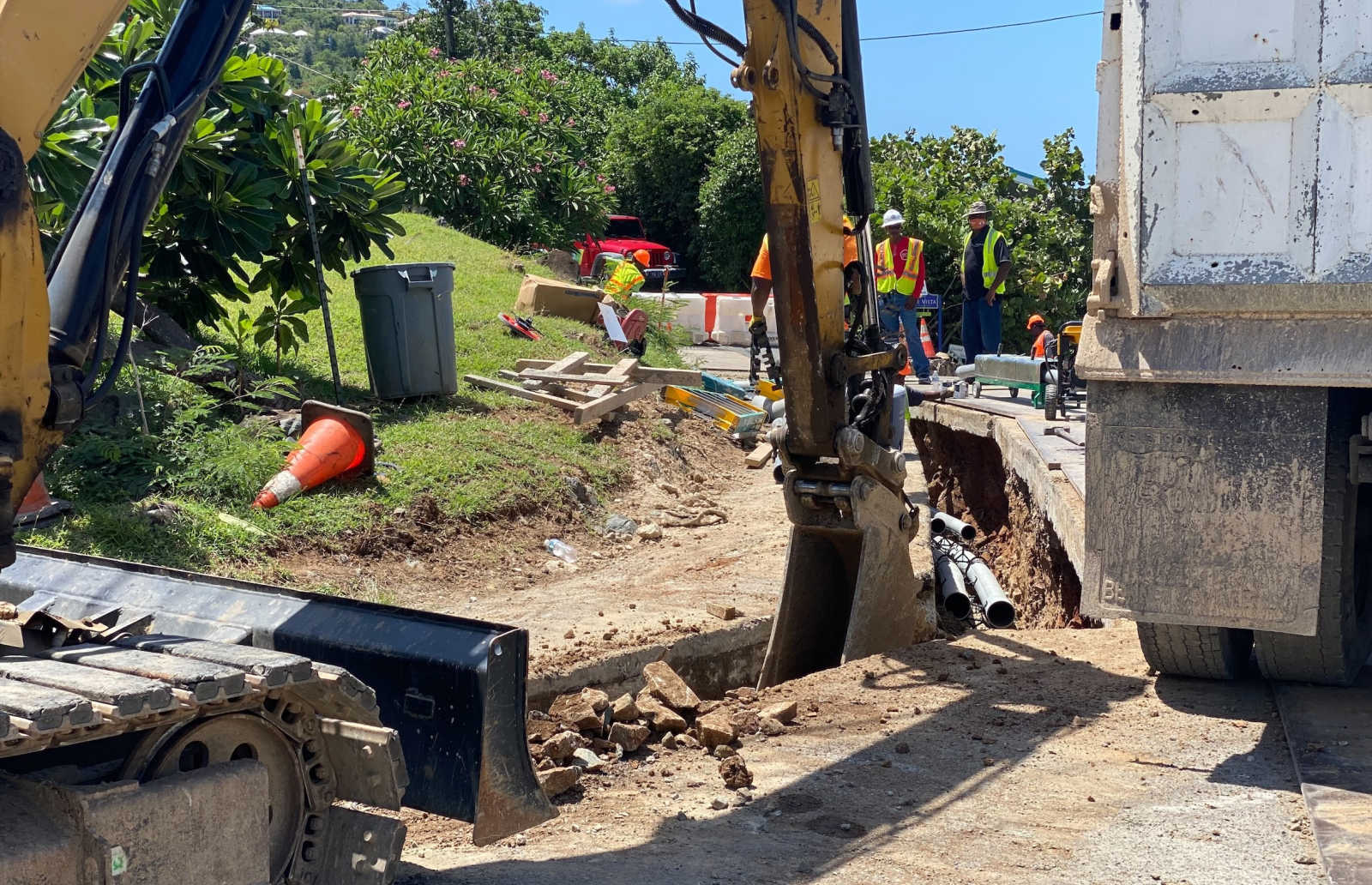
The Oct. 1 approvals cover the St. Thomas West and St. Croix Southwest horizontal infrastructure bundles under Rebuild USVI. Both involve installing electric, water and wastewater utilities, followed by paving. The combined $767,721,702 authorization covers preconstruction services and early work packages. It does not establish the final construction price of either project, which officials said would be developed through design and cost reviews and brought back to the board for approval.
For St. Thomas West, the board authorized a contract with KHVI, a joint venture of Kiewit Infrastructure South and Haugland Virgin Islands. Its initial phases total $414,962,127: up to $114,962,127 for preconstruction services over as many as 12 months, and up to $300 million for early work packages over as many as 18 months.
The St. Croix Southwest authorization went to Kiewit Infrastructure South for initial phases totaling $352,759,575. That includes up to $112,759,575 for preconstruction services over as many as 12 months and up to $240 million for early work packages over as many as 18 months. Those time limits apply to the specified phases and do not establish a completion date for the entire project.

Beyond those initial authorizations, the board examined much larger preliminary estimates for construction across the St. Croix Southwest project. Kiewit estimated approximately $1.6 billion, compared with $990.9 million from the Benton-Middlesex joint venture and approximately $2.2 billion from Aecon. These were estimates of the broader construction work each company believed the project would require, rather than the amounts the board was being asked to authorize Thursday.
Kiewit’s estimate was approximately $608 million higher than Benton-Middlesex’s, prompting questions about whether the companies were pricing comparable work. Atiim Senthill, executive delivery manager for the Super Project Management Office under the Office of Disaster Recovery, said the proposals reflected different assessments of the utility work required and would be refined as detailed designs were developed. The presentation did not clearly establish how the early work authorized Thursday was accounted for in those broader estimates, so the figures do not provide a basis for calculating a combined final project cost.
Board secretary Keith O’Neale Jr. questioned how such a large difference could arise if the firms were pricing the same scope. Mr. Senthill said proposers had different views of the magnitude of individual utility components. “And how can you judge them on the same criteria?” Mr. O’Neale asked.
Mr. Senthill said interviews helped evaluators understand the proposals, but detailed design would follow the contract award. Existing conditions, pipe sizes and soil conditions would help refine the work and its cost. “Well, then aren’t we putting the cart before the horse?” board member Dorothy Isaacs asked.
“They’ve given a budgetary number. That number is not the final number,” Mr. Senthill said, explaining that the final figure would be developed through the guaranteed maximum price process. Mr. O’Neale continued pressing the distinction, saying he understood that the figures were preliminary but wanted to know whether a lower estimate reflected less work or a different understanding of the scope.
Mr. Senthill emphasized that the procurement was structured around best value, with personnel experience, construction approach and preconstruction approach weighted more heavily than cost. The evaluation considered completed projects, active work and experience with FEMA-funded, government and private-sector projects, he said.
Kiewit scored 93.39 out of 100 for St. Croix Southwest, ahead of Benton-Middlesex’s 91.52 and Aecon’s 91.10. For St. Thomas West, KHVI scored 93.56, compared with 91.55 for Benton-Middlesex and 90.71 for Aecon. The recommendation drew on the teams’ existing work on the St. Croix North Central and St. Thomas East bundles, with Mr. Senthill citing established permitting strategies, FEMA amendment processes, design standards and shared logistics, along with lessons from those projects.
For St. Thomas West, he acknowledged that KHVI’s proposed hourly rates were higher on average than rates under existing professional-services contracts reviewed by the committee. Evaluators concluded that project-specific efficiencies could offset the higher preconstruction costs by reducing redesign, delays, rework and construction expenses.
Under the progressive design-build method, the government and contractor develop the scope, schedule and price together. Mr. Senthill said independent cost estimates would be prepared as early work packages develop and considered alongside estimates from the owner’s representative to determine the most cost-effective scope.
Governor Albert Bryan Jr. defended the approach as a way to agree on pricing and work before construction proceeds, reducing the risk of repeated change orders. He also emphasized coordinating utility installation and road restoration so roads would be paved once after the underground work.
The discussion extended to staffing, with Mr. O’Neale asking how contractors would obtain enough workers to meet demanding schedules. Mr. Senthill said contractors would need to bring in labor when local availability was insufficient. Mr. Bryan said the selection of large contractors was intended to secure firms capable of managing their own workforce, housing and logistics.

Both contract authorizations passed without objections. Final guaranteed maximum prices will return to the PFA board as the designs and negotiations advance.