




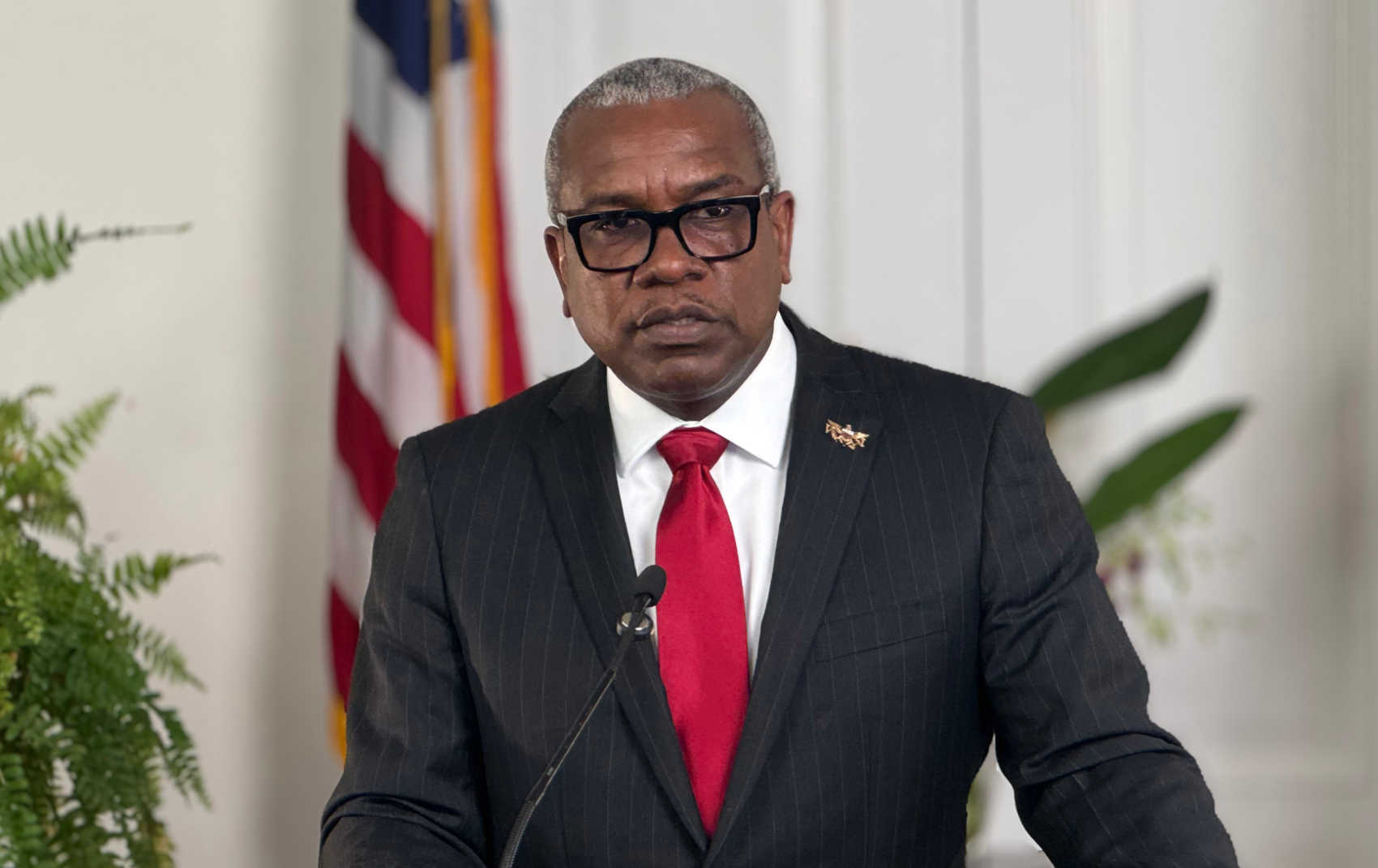
Gov. Albert Bryan Jr. says the Federal Emergency Management Agency is prepared to continue helping the Virgin Islands overcome obstacles to its hurricane recovery as billions of dollars in federally obligated projects move into what he characterized Monday as a new, construction-focused phase.

“It’s about execution,” Mr. Bryan declared during Monday’s Government House press briefing, pointing to that morning’s launch of the Yvonne E. Milliner Bowsky School modernization project on St. Thomas as the latest example. The school’s official calendar lists a revitalization groundbreaking ceremony for September 28, while federal-consistency documents describe a project that will renovate and expand the existing campus, modernize classrooms and other facilities, and construct a new gym.
It was against that backdrop that Mr. Bryan revisited his recent Washington meeting with FEMA and White House Office of Management and Budget officials. “When we get letters from the federal government, people always take it as an antagonizing or a negative thing,” he said. “But I think in this case, it was very positive.”
The meeting followed an August 24 FEMA letter placing the territory’s recovery program under an enhanced compliance review covering the status and pace of projects, documentation, financial oversight, management costs, time extensions and other federal requirements. The Consortium previously reported that FEMA required senior territorial officials to attend the Washington meeting and sought a project-by-project accounting, while reserving the ability to impose additional oversight if concerns were not adequately addressed. Mr. Bryan said after the meeting that no individual project had been flagged and no new funding restrictions were imposed.

On Monday, the governor said federal officials understood the territory’s position after what he described as a lengthy presentation by the Virgin Islands delegation. He said they were also satisfied with measures intended to “ensure the spending and the integrity of the money” and had agreed to help accelerate projects caught in federal regulatory processes.
Government House’s account of the September 21 meeting similarly said OMB and FEMA officials expressed a willingness to work with the territory on barriers including workforce housing and environmental reviews. The administration reported that approximately $12 billion in recovery projects are moving through environmental-compliance processes, making the speed of those reviews an important factor in construction schedules. Through Rebuild USVI, the government says it has executed 12 contracts covering 39 projects backed by about $13.7 billion in obligated federal funding.
Mr. Bryan said FEMA officials are also willing to assist with one of the most difficult logistical problems facing the coming construction surge: housing the large temporary workforce expected to be needed in the territory. “We have two weeks to present a housing plan,” he said, raising possibilities including “floating hotels” or mancamps onshore.
The governor said the administration had deliberately sought contractors large enough to manage the financial and logistical demands of the territory’s recovery portfolio, but even those companies are encountering difficulties. “Even they are having problems on getting it all together,” he said. “FEMA is willing to assist. I think it was a tremendous meeting.”
Government House’s published account of the Washington meeting confirms that federal officials expressed a willingness to explore workforce-housing opportunities, though it does not identify a specific FEMA financing program or dollar commitment for temporary accommodations. The administration listed shortages of skilled labor and workforce housing, contractor availability, construction capacity, debris disposal, inflation, market conditions and environmental permitting among the factors affecting project delivery.
Mr. Bryan pointed to the growing number of recovery projects launched during 2026, particularly within the Department of Education’s school construction program, as evidence that the territory is moving beyond years dominated by project formulation, federal obligations, procurement and design. Government House said in April that the launch of the new St. Croix Central High School marked the third major school infrastructure project started within 30 days, following work at Bertha C. Boschulte and Charlotte Amalie High School. The Lockhart K-8 modernization was formally launched September 10, and the Bowsky project followed Monday.
“This is what the next phase of the recovery looks like,” Mr. Bryan said. “Federal obligations become contracts, contracts become construction, and construction becomes schools, hospitals, roads, utilities, and public facilities our people have waited on for years to be rebuilt.”
But moving into construction is also forcing the government to confront how much the federal dollars obligated for projects can now buy after years of rising construction costs. Government House itself identified inflation and market conditions as recovery obstacles during its Washington presentation.
Mr. Bryan acknowledged Monday that the administration is already reducing the size or scope of some projects to account for those increases. “We’re doing that,” he said when asked whether projects are being downsized as costs rise.
One recent example is the replacement of the Governor Juan F. Luis Hospital on St. Croix. Territorial Hospital Redevelopment Team Executive Director Darryl Smalls told the hospital board last week that the planned structure had been reduced from eight stories to five, though officials said the redesigned hospital would retain all of the services planned for the facility. Read the Consortium’s report on the JFL redesign
“Prices will escalate,” Mr. Bryan acknowledged. “So it puts a contractor now under immense pressure to deliver because they know they’ve already committed to a price for this particular project.”

The governor said the territory is therefore attempting to divide the financial risk between government and contractors while keeping projects moving. “We’re balancing the risk with the contractors who want to make sure they get these projects turned over and get them [delivered] in a reasonable way,” he said.