


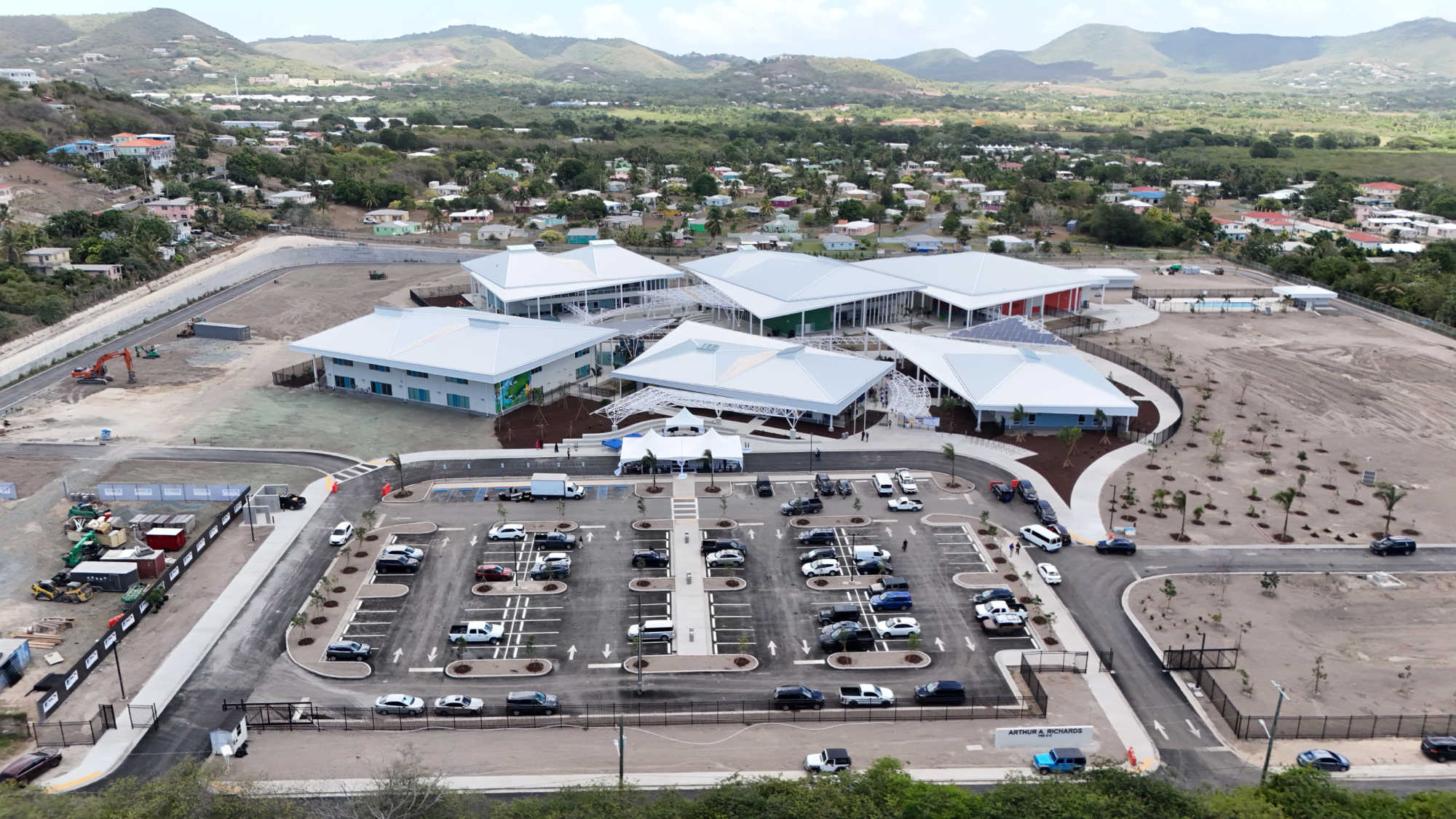
ST. CROIX — The Virgin Islands government on Friday formally opened the new Arthur A. Richards PreK-8 School, completing the territory’s first public school rebuilt from the ground up using disaster-recovery funding and delivering a major education reconstruction project just days before public schools reopen Monday. The campus was constructed on the site of the former Evelyn M. Williams Elementary School.

The new PreK-8 campus includes classrooms built to withstand future storms, playgrounds and a swimming pool that expands opportunities for physical education, athletics and swimming instruction. The Evelyn M. Williams Commons houses the cafeteria, library and media center and can accommodate 750 students. Education officials described the wider campus as designed for safety and innovation while supporting curiosity, collaboration, creativity and learning. Students are expected to begin using the new facility when public schools open Monday.
Governor Albert Bryan Jr., Lt. Gov. Tregenza Roach, Delegate to Congress Stacey Plaskett, Senate Vice President Kenneth Gittens, Education Commissioner Dr. Dionne Wells-Hedrington, Public Works Commissioner Derek Gabriel and Office of Disaster Recovery Director Adrienne Williams-Octalien were among the officials participating in Friday’s ribbon-cutting ceremony. The Richards family was represented by Duane Richards, while MCN Build Senior Vice President Lisa Anders represented the project’s design-build contractor.

For Wells-Hedrington, the opening capped a process she said began for her in 2019, when she started working closely with federal partners, ODR and the Department of Education team responsible for developing the territory’s new schools.
She described Arthur A. Richards as the beginning of a much wider transformation of the public-school system, saying close to 20 projects are now moving through design or construction.
“This site marks the beginning of what's to come in all of our other schools,” Wells-Hedrington said.
A central issue early in the process, according to the commissioner, was ensuring that federal disaster funding did not simply reproduce the facilities that existed before hurricanes Irma and Maria. Federal partners initially focused on rebuilding what had been lost, she said, while Education officials pushed for schools that reflected modern educational needs and standards.
Wells-Hedrington recalled months of negotiations over the costing of Arthur A. Richards, saying an initial figure was in the $80 million range. Because whatever was accepted for the project could establish a foundation for the costing of other schools, she said she refused to accept the initial amount and continued negotiating.
She said those discussions eventually resulted in “270 plus million for this site.”
“There's no way, if we had settled for that 80 million, would we be here today celebrating this ribbon cutting,” Wells-Hedrington said.
The commissioner said the rebuilding process required damage assessments, cost estimates, environmental reviews, engineering studies, compliance with federal regulations, numerous design meetings, procurement requirements and funding approvals, along with sustained coordination between territorial and federal agencies.
She credited staff at the Department of Education, ODR, Public Works, DPNR and other government agencies, along with federal partners, consultants, architects, engineers, contractors and subcontractors.
Wells-Hedrington also recognized the new school advisory board, which was created to bring government, education and community stakeholders into the planning process. She said the group helped complete the facilities master plan now serving as the blueprint for the territory’s school recovery work.
O’Halloran Smith has been selected to lead the new school, with Concepcion serving as assistant principal.
Wells-Hedrington said the new building must now be matched by gains in student achievement, literacy and mathematics, attendance, innovation, family engagement, college and career readiness, and the development of future leaders.
$232 Million Obligated as Wider School Rebuilding Program Advances
Williams-Octalien placed Arthur A. Richards within the territory’s broader post-hurricane recovery effort, saying ODR has more than 1,600 projects, of which 1,160 have been completed.
She said work on the school began before all of the FEMA obligations ultimately supporting the project were in place, with the government using available resources to begin moving the project forward.
Williams-Octalien also credited congressional action following the 2017 hurricanes and the subsequent work to establish recovery standards for the Virgin Islands.
When Congress allowed the territory to rebuild to industry standards, she said, territorial officials still had to develop those standards, defend them and convince FEMA that they were appropriate for the Virgin Islands.
She said the broader recovery effort grew from about $8 billion to $24 billion as the territory worked through federal regulations and funding negotiations.
“I learned very early on all of that passion has to be grounded in the regulations,” Williams-Octalien said. “Very early, so I left the emotion and understood how to use the regulations to get us what we need here in the Virgin Islands.”
“And I say, from $8 billion to $24 billion, I think we did a good job.”
Williams-Octalien said Arthur A. Richards was obligated for $232 million and described it as the largest vertical recovery project completed in the territory to date. She distinguished it from the composite pools project, which she placed at approximately $338 million and described as larger overall.
The new school is also one component of a substantially larger education reconstruction portfolio. Williams-Octalien said more than 17 schools are currently under contract, in construction or finalizing design, representing approximately $5.2 billion in school projects.
Inflation, however, continues to place pressure on those budgets, she said, requiring the government to closely evaluate the remaining projects, their designs and whether the resulting facilities can be properly maintained.
“We must do our due diligence on these remaining projects,” Williams-Octalien said. “We must continue to collaborate. We must continue to ensure that every design can be maintained.”
She also emphasized the need to build local capacity for a recovery effort that she said is expected to continue for another decade. ODR hired University of the Virgin Islands students studying in high-demand occupations during the summer to expose them to recovery work and prepare Virgin Islanders to take on future roles.
Construction Completed Following 2023 Groundbreaking
MCN Build served as the design-build contractor for Arthur A. Richards, working with design partner Perkins Eastman and a network of government agencies, consultants, subcontractors and suppliers.
Anders said construction followed a February 2023 groundbreaking and that the project was delivered on schedule despite tariffs, supply-chain problems and other challenges encountered during the roughly three-year construction period.
She described Arthur A. Richards as the first major FEMA recovery project undertaken at that scale in the Virgin Islands and said its completion demonstrated that large recovery projects could be successfully delivered in the territory.
Anders said partnerships with local subcontractors were central to completing the project and argued that its economic impact extends beyond the school itself.
Experienced stateside trade partners and suppliers brought in for the project are now working alongside local businesses, she said, transferring knowledge and helping build additional construction capacity and competition that could benefit future schools, hospitals and other major projects.
“The Arthur Richards School is proof that recovery isn't measured simply by the projects we finish. It's measured by the opportunities we create for the next generation,” Anders said.
She thanked the Department of Education, ODR, Public Works, DPNR, the Virgin Islands Public Finance Authority, Perkins Eastman, subcontractors, the project workforce and the St. Croix community.
Public Works Commissioner Derek Gabriel similarly described the new school as more than a construction project, saying schools and other public facilities are community assets whose value is ultimately measured by the lives they affect.
Gabriel acknowledged that Arthur A. Richards encountered challenges during development but credited employees at Public Works and other territorial agencies, ODR, FEMA, contractors, engineers and subcontractors with remaining focused on completing the facility.
Plaskett Connects New School to Post-Hurricane Federal Changes
Plaskett tied the completed campus to changes made at the federal level after hurricanes Irma and Maria damaged schools, hospitals, the power system and other critical infrastructure across the Virgin Islands.
She said the territory committed after the storms to changing a system that had left the Virgin Islands underfunded and under-resourced and to rebuilding facilities as they should have been, rather than simply reproducing what existed before.
According to Plaskett, federal funding formulas that had shortchanged the territories were changed, the federal cost share for recovery was increased, and red tape delaying relief was reduced so that the federal response could better match the scale of the territory’s losses.
“That fight brought exponentially more funding to the Virgin Islands, funding that is now built into the walls around us today,” she said.
Plaskett also credited the Bryan administration, territorial agencies, federal partners, MCN Build, local subcontractors, engineers, laborers, educators, parents and community members with converting available federal resources into a completed school.
She said rebuilding does not end with Friday’s ceremony, but continues through classrooms, PTA meetings, budget hearings and the support provided to students.
New Campus Carries Arthur Richards' Legacy Forward
The ceremony also focused heavily on the educators whose names are connected to the property.
Arthur A. Richards was born on St. Croix and educated in the territory’s public schools before continuing his studies at Howard University, Hampton Institute and New York University, where he earned a doctorate in education.
His professional career took him from the classroom into school leadership and later to the College of the Virgin Islands, where he served in several senior roles, including provost, vice president and president. The Virgin Islands Legislature named the Arthur A. Richards School in his honor in 1977.
His son, Duane Richards, recalled his father as a Frederiksted educator whose career began in the classroom and later included service as a principal, commissioner of education and university president.
Richards said his father championed academic excellence, the Bachelor of Arts in Caribbean Studies, nursing programs and a national student exchange during his university tenure. He also credited his leadership with helping bring about UVI’s designation as a historically Black college and university.
Richards said the PreK-8 school was a particularly fitting tribute because the campus will serve students during the years when the foundation of their education is formed.
Speaking directly to school administrators, he said, “Remember that buildings do not change lives; people do.”
To students, Richards noted that his father was once a child growing up on St. Croix just as they are.
“You can do the very same thing,” he told them after recounting his father’s journey from St. Croix student to educator and university leader.
Members of the Richards family and representatives of the first class to attend the former Arthur A. Richards School in 1977 were recognized during Friday’s ceremony.
Evelyn Williams' Legacy Preserved on Campus
Officials also paid tribute to Evelyn M. Williams, whose former elementary school occupied the site where the new campus now stands.
Williams began teaching in 1931 at Diamond Rural Elementary School and spent more than 40 years as a teacher and principal across several schools. She earned a bachelor’s degree in elementary education and a master’s degree in supervision and administration of elementary education and was credited during Friday’s ceremony with educating thousands of Virgin Islands students.
Gittens noted that the new campus represents the consolidation of two schools with long histories — Arthur A. Richards Junior High School and Evelyn M. Williams Elementary School — and said Williams’ contributions should remain permanently visible to future generations.
He said he would also like to see prominent photographs or other visual recognition of both Richards and Williams incorporated into the new campus.
Wells-Hedrington later responded that Williams’ legacy has been incorporated directly into the facility through the Evelyn M. Williams Commons, ensuring that her name remains part of the new school complex.
Gittens said Williams died in 2013 at age 98 after a lifetime in education.
“Our children should know the pioneers upon whose shoulders they now stand,” he said.
Pool Prompts Focus on Student Safety
With the campus introducing a swimming pool into the public-school environment, Gittens said the new educational opportunity must be accompanied by appropriate safety measures.
He urged the Department of Education to ensure that a qualified school health technician is permanently assigned to the campus and encouraged every physical education teacher who will use the pool to become certified as a lifeguard.
“Safety must always accompany innovation,” Gittens said, adding that with proper planning the pool could become one of the school’s strongest educational assets.
Gittens also acknowledged that setbacks earlier in the week had delayed occupancy because the campus was not yet ready to safely accommodate staff. He said he remained hopeful that teachers and students would soon begin the new chapter in an environment built around learning, creativity and success.
By Friday’s ceremony, Education officials were preparing to welcome students to the campus Monday.
Officials Emphasize Maintenance After Construction
Long-term maintenance emerged as one of the most consistent themes of the ceremony.
Wells-Hedrington said completing construction shifts the government and community into another phase of responsibility.
“So the school is built, so we know what the next step is: maintenance,” she said.
The commissioner called for sufficient resources for the Bureau of School Construction and Maintenance and said the goal should be for residents to return a decade from now and find the campus maintained to the same standard as when it opened.
She called on senators, government agencies, families and the wider community to help preserve the investment.
“It is going to be our responsibility, senators, to ensure that we have funding to maintain this facility, to ensure that this vision doesn't die, to ensure that it remains vibrant,” Wells-Hedrington said.
Roach made a similar point, recalling that the Virgin Islands rebuilt schools following Hurricane Hugo in 1989 and Hurricane Marilyn in 1995, only to later encounter problems involving maintenance and upkeep.
He described the new Arthur A. Richards campus as a “dream realized” after years of drawings, conversations, planning, groundbreaking and interagency work, but said preserving the facility cannot fall on one agency or individual.
“We all have the responsibility,” Roach said, urging the children who will attend the school to care for the facility as a gift not only to them, but to generations that will follow.
Gittens likewise said government has a fiduciary responsibility to construct, fund and maintain schools, while parents, students, educators and neighbors share responsibility for protecting the campus.
Bryan Points to School as Part of Wider Infrastructure Push
Bryan used his remarks to place the school within the broader construction and recovery work undertaken during his administration, pointing to projects involving Veterans Drive, downtown St. Thomas, roads, ports, airports, ferry transportation, Paul E. Joseph Stadium, Walter I.M. Hodge Pavilion and infrastructure work in Christiansted.
He described traveling through the territory Friday morning and seeing infrastructure completed or under construction, including roadwork, airport improvements, port projects and other public facilities.
On Arthur A. Richards specifically, Bryan emphasized the standard he believes the territory should demand from major public projects.
“We're not building shabby schools. We're not building boxes to stick people in. We're building monumental things,” he said.
Bryan said the new campus was worthy of carrying Richards’ name and argued that the ultimate measure of the investment would include both the condition in which the facility is maintained and the students who emerge from it.
“This is a school worth putting Arthur Richards' name on,” he said. “This is what we're doing: building monuments to people who deserve it, serving our people in the best way we know how, and it matters.”
He thanked the officials and employees who worked through the recovery and construction process, MCN Build and residents surrounding the project who endured construction noise and dust.

Friday’s program included the posting of colors by the St. Croix Central High School JROTC, performances of the national anthem and Virgin Islands March, and a musical tribute to Evelyn Williams by the Rising Stars Youth Steel Orchestra.
Following the benediction and blessing of the new campus, officials, members of the Richards family and other participants gathered at the entrance for the ribbon cutting, formally opening the school ahead of students arriving Monday.