




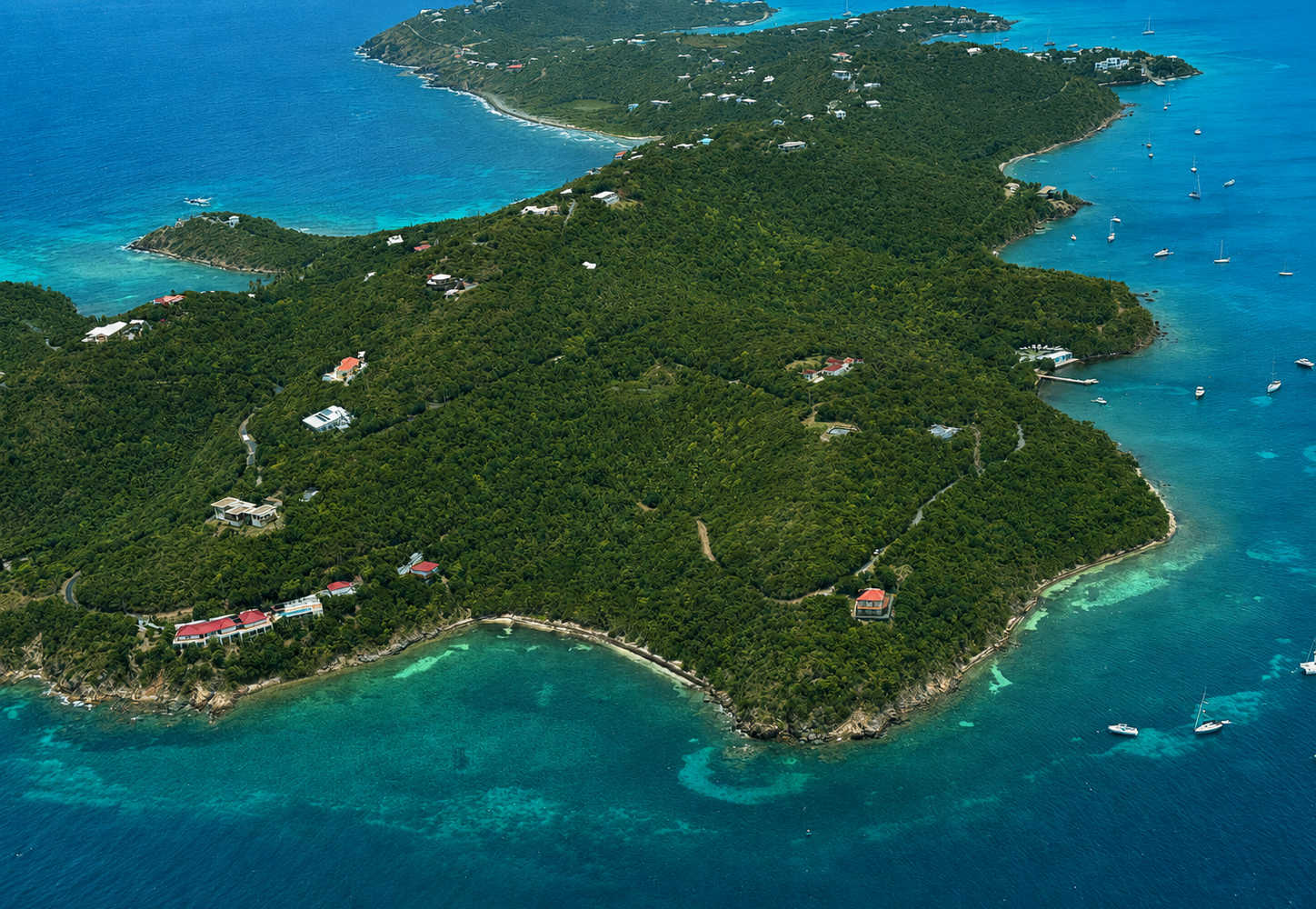
Portion of Water Island, USVI. Photo Credit: ERNICE GILBERT, V.I. CONSORTIUM.
A proposed hotel and marina development on Water Island drew calls for stronger public engagement, greater transparency and closer scrutiny of lease provisions during a lengthy Committee of the Whole hearing that functioned as a public forum on the project.

The discussion centered on a request to amend a lease tied to government-owned land on Water Island. Residents, the developer and the Department of Property and Procurement all presented positions, while lawmakers repeatedly said the proposal needs additional review before the Legislature acts.
At issue is an amended lease connected to a planned tourism development that would include a five-star resort, marina, spa, restaurants, branded residential units, workforce housing, a retail village and service facilities. Developers say the project could bring hundreds of millions of dollars in investment, jobs and tax revenue. Residents, however, raised concerns about the project’s scale, the sale of residential units, transparency, infrastructure obligations and whether the lease provides enough protection for Water Island.
The original lease dates back to 2014, when the Government of the Virgin Islands entered into an agreement with Water Island Development Company LLC to develop a hotel property on government-owned land. A series of delays and “reduced performance,” according to Vincent Roberts, assistant commissioner in the Department of Property and Procurement, led to termination of the lease in April 2025.
Negotiations later followed to reinstate the lease with “updated terms.” The parties involved are Water Island Development Company, Blue Water Global Advisors and Innovative Architecture.
The amended lease is a 99-year arrangement with the option to renew for one two-year period. It is dated May 1, 2026, but requires legislative approval.
Annual rent is set at $120,000, payable in monthly installments of $10,000. In the 20th year, annual rent would increase to $240,000. Beginning in the 25th year, and every year after that, annual rent would increase by 5%.
The amendment also provides a 60-month, or five-year, construction period after all permits are secured. During that period, monthly rent would be reduced to $1,000.
According to the Department of Property and Procurement, the lessee is expected to invest in significant infrastructure improvements for the wider Water Island community. Those improvements include roads, drains, potable water infrastructure, solid waste management and utility upgrades.
The government would retain ownership of the property and receive value through lease payments, “a minimum $300 million private investment commitment,” and other contractual obligations, according to testimony.
A $3 million performance bond is intended to provide financial protection to the government. Assistant Commissioner Roberts said the bond applies to “pre-development and early stage obligations” and would be reduced only after benchmarks are achieved.
The proposed development includes an 88-room five-star resort, a marina, spa and restaurants. The project also includes “approximately 90 branded residential units,” which would be sold by the developer.
Other planned components include workforce and employee housing, a “retail village, and facilities to support the police, fire, medical, and security services.”
Assistant Commissioner Roberts said those plans are part of a “conceptual development framework” and do not constitute final project approval under the lease. The developers would still be required to go through the full local and federal permitting process.
According to the department, the project has been “significantly reshaped in response to public input and stakeholder concerns.” Areas including Honeymoon Beach and Spratt Point are reportedly excluded from the lease.
The “overall development concept was shifted towards a greater residential component…,” Assistant Commissioner Roberts said. He maintained that the amended lease “represents a substantially stronger agreement for the territory than the original lease.”
Developers also emphasized the project’s potential economic benefits. Alex Moskowitz, who was involved in negotiating the amended lease, testified that the final project budget could reach $400 million and provide “substantial” financial benefit to the government.
Mr. Moskowitz referenced $5 million in annual hotel occupancy taxes, $16 million in residential sales commissions, millions in stamp taxes and property taxes, the creation of “200 new jobs with an average salary of $75,000,” and “millions in consumer spending.”
He said that while the current redevelopment “represents more land in the gross,” the density of structures is “significantly lower” than originally contemplated. Architect Steve Miller said the project footprint is less than 30 acres.
The developers plan to construct a retail center and rebuild the marina at Flamingo Bay to “create dockage provisioning and fuel services, as well as pump out stations.”
According to Mr. Moskowitz, the lease requires Blue Water to build and maintain municipal service stations. Developers intend to upgrade infrastructure “to the tune of $42 million.”
He said that once the lease is amended and approved, Blue Water would “work with the Water Island residents…to create a design that is economically feasible, environmentally sound, and works for Water Island residents…”
Water Island residents, however, urged lawmakers not to move quickly.
Chuck Nestrud, president of the Water Island Civic Association, said he was speaking on behalf of approximately 200 Water Island residents.
“The size and scope is simply too much for this tiny island,” he said.
Mr. Nestrud described a “complete lack of transparency that needs to be corrected” and said residents need greater engagement with the developers. In lengthy testimony, he identified concerns with the amended lease and said residents have reason to be cautious.
“we’ve been burned before by slick presentations and empty promises,” he said.
He also stated that the lease “does not track what we’re being told.”
Mr. Nestrud called the $3 million performance bond “inadequate and terminates prematurely.” He also said the reported $42 million for public infrastructure may be insufficient once developers construct critical services, including a solid waste treatment plant, reverse osmosis treatment and wastewater treatment.
He asked that the developer’s “aspiration” to improve public infrastructure be “fleshed out and put in the lease as a binding obligation.”
Another resident, Rachael Ackley, raised concern that the plan “requests to purchase public lands and develop residential units and sell them forever, removing them from the Virgin Islands people.”
Dr. Stephan Bitterwolf asked that all stakeholders “work with the developers to close the loopholes, codify environmental restoration, and formalize investments in workforce development directly into the lease.”
Lawmakers first focused on public notice and community involvement. Senator Alma Francis Heyliger insisted that Water Island residents were not adequately informed of a virtual town hall meeting on the proposal.
Senator Franklin Johnson asked about the date of the next town hall meeting and emphasized the importance of “genuine partnership.”
Senator Marvin Blyden said the Legislature would take the lead on public engagement on Water Island. He said that engagement is necessary to “bridge the gap.”
The $3 million performance bond also drew significant attention. Senator Ray Fonseca questioned whether it is “sufficient.”
Daniel Mita, an external attorney for the Department of Property and Procurement, said the amended lease includes a “combination” of protections for the government. Among them are “negative covenants” stating what Blue Water is not allowed to do.
Senator Kenneth Gittens, however, said $3 million appeared nominal when compared with an anticipated project value of $400 million to $440 million. He also questioned why the government reentered negotiations with the developers after the earlier agreement failed to perform.
Assistant Commissioner Roberts cited the “new terms” of the lease as a determining factor.
“The government fired a warning shot in terms of the termination letter…We talked about how we would move forward to make sure that the errors that were made in the past…will not happen again,” Mr. Roberts said.
Unlike Senator Gittens, he described the $3 million performance bond as “significant.”
The broad consensus from the meeting was that development on Water Island is likely, but that the lease and project details must be carefully examined before any approval. Some lawmakers also expressed concern that the amended lease does not codify an actual final project.
Senator Novelle Francis Jr. recommended “continued dialogue, collaboration, and communication.” He said he was “hoping that we could really be able to resolve those issues before we make a good decision in this matter.”
Senator Kurt Vialet said Water Island residents must be protected while the territory prepares for development.
“At some point, development is going to come to Water Island. We want to make sure that the development is controlled and is in the best interest of the island,” Senator Vialet stated.
“Let’s protect the residents. Let’s protect the development. Let’s protect the island…and let’s try to move forward,” he added.
Senator Blyden framed the issue from an economic development standpoint, saying the USVI is “losing market share” while neighboring islands advance tourism development projects.
He said “this is an opportunity that I don’t think we are going to see now for a while.” Like his colleagues, he encouraged more discussion to ensure that “we all on the same page.”
Because the discussion occurred in the Committee of the Whole, no votes were cast. Still, the developers repeatedly urged the Legislature to approve the amended lease.
According to Mr. Moskowitz, “the challenge is timing and the ability to keep financing in place.” While the developers have secured financial commitments, he said having the lease in hand is necessary to move the project forward.



Advertisements