



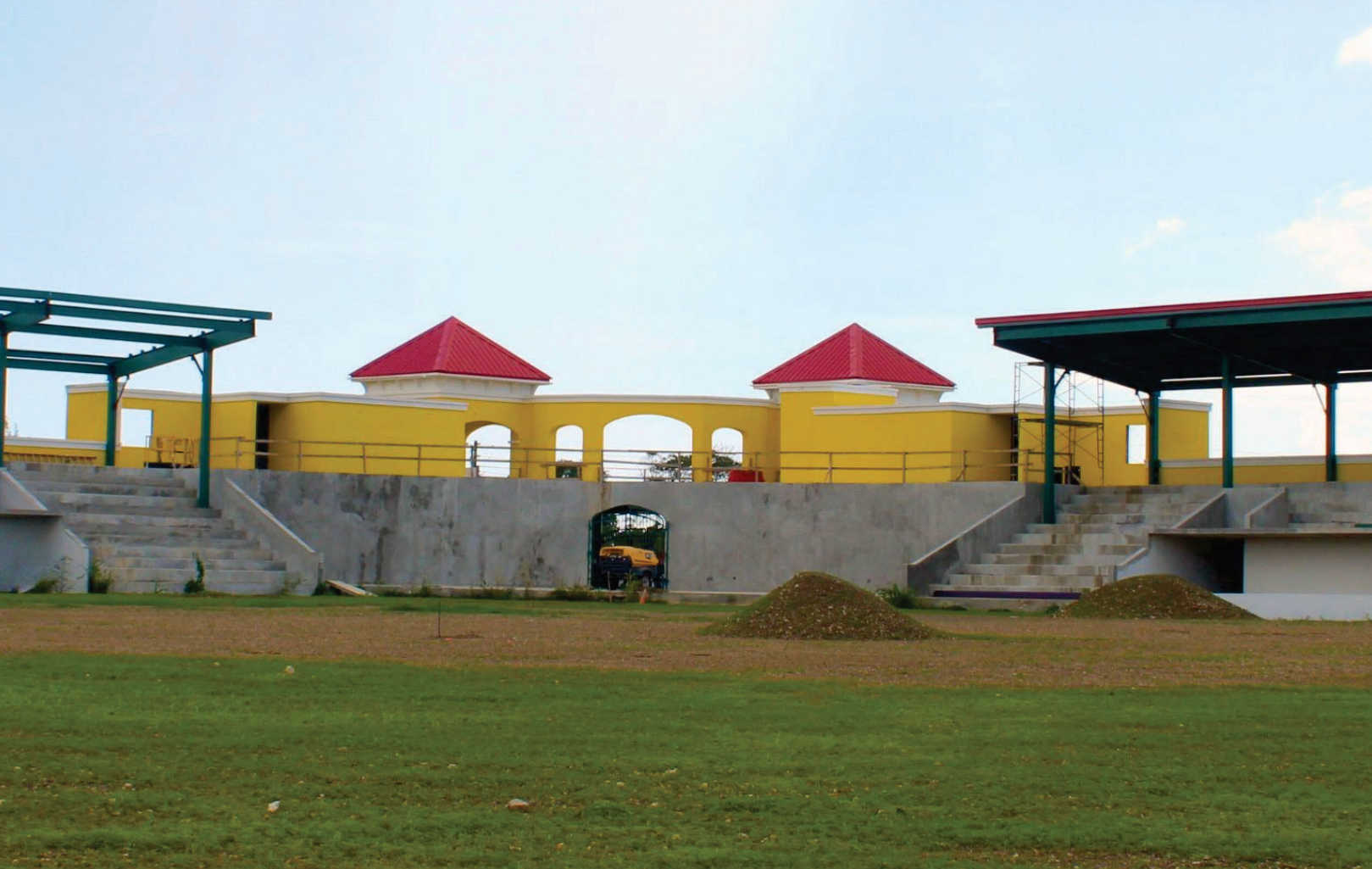
A view of the interior of the Paul E. Joseph Stadium, which remains under construction 12 years after the project first broke ground. Photo Credit: DPW.
Virgin Islanders who were once told to expect the completion of the Paul E. Joseph Stadium as a 2025 Christmas gift are now being told to wait until September 30, 2026, according to the contractor’s latest project schedule. That new date, however, comes as lawmakers question both the contractor’s ability to finish the job and whether enough money remains to complete it, with work effectively stalled and no workers currently on site. Ground first broke on the project in December 2014, and twelve years later, it remains incomplete.

During Monday’s hearing before the Committee on Culture, Youth, Sports and Parks, officials from the Department of Public Works and the contractor, GEC, faced sharp scrutiny over delays, rising costs, cash-flow problems, and the limited options now confronting the government.
A series of project stakeholders appeared before the committee after being subpoenaed to provide updates on the delayed stadium project. Public Works Commissioner Derek Gabriel’s testimony was among the most significant, as he disclosed that the new completion date of September 30, 2026, comes from a March 10, 2026, schedule submitted by GEC, LLC.
The contract itself, however, has only been extended to July 2, 2026, and Mr. Gabriel acknowledged that it will likely need to be extended again. Questions during the hearing focused heavily on whether the Department of Public Works still has confidence in GEC and whether enough funding remains to finish the stadium.
Originally expected to cost $20 million, the Paul E. Joseph Stadium now carries a price tag of $32,124,000, with $26,250,097.02 already spent. That leaves approximately $5.8 million for GEC to complete the job, this time by September 30.
A series of change orders has prolonged the contract between the Government of the Virgin Islands and GEC to account for multiple setbacks. DPW attributed the delays to “material procurement lead time, cash flow challenges, administrative hurdles, and design finalization.” Among the design changes cited were the decision to use reinforced concrete bleachers instead of aluminum and to shift from drywall to concrete interior walls. Gabriel also said a Bureau of Internal Revenue lien filed on February 2, 2026, “temporarily stalled financial processing,” though the lien has since been released.
Despite those explanations, lawmakers appeared unconvinced that the new date could be met, particularly since work at the stadium has effectively stalled. Material delays and cash-flow constraints have contributed to the slowdown, and no workers are currently on site as GEC waits for government payments.
In response, Gabriel said the government has taken a “more assertive role in project management.” He explained that the government is now paying material vendors directly, bypassing “contractor-level cash flow bottlenecks.” That, he said, allows the government to ensure “taxpayer dollars go straight to the steel, tile, and fixtures needed to finish this project.”
Even with lawmakers openly questioning the contractor’s performance, Commissioner Gabriel maintained that “pursuing completion of the project with the current contractor remains the most fiscally responsible decision.” He said DPW had considered terminating the contract and hiring a new firm, but estimated that such a move could add another $10 million and delay completion by as much as two years. Therefore, unless the Legislature indicates a willingness to invest “significant dollars for contract termination and re-issuance of a solicitation,” GEC will continue the work, he said.
That left lawmakers pressing for a direct answer about GEC’s ability to finish. Committee Chair Senator Angel Bolques Jr. asked Gabriel whether he was confident the company could complete the project by the July 2 contract end date. Mr. Gabriel replied that “that's not a yes or no answer.” Instead, he said, “it's difficult to say because…we have to accept that the project is rife with challenges, particularly cash flow.” He added that John Wessel of GEC maintains, “given the resources remaining available on the project, that he can finish it in a schedule that he's given us.” Because DPW has elected to continue with the contractor, Gabriel told lawmakers, “I'm not going to say in a public forum, I'm not satisfied, or I'm not confident in him.”
Lawmakers then turned to the question of whether the money left on the project is actually enough. Senator Avery Lewis asked whether the remaining roughly $6 million could realistically complete the work by July 2. Senator Alma Francis Heyliger suggested that the remaining funds could not be “turned into any world-class stadium.” Gabriel responded, “You ask the contractor, he may feel different,” but then acknowledged, “Just given what we've seen in the last few months, I don't think that we have the cash flow sufficient to finish the project in a timeline identified.” Senator Lewis then asked, “If you don't have the money, come July, we still ain't gonna have a stadium, correct?” Commissioner Gabriel called that a “fair” assumption.
John Wessel’s testimony repeatedly referenced delayed project funding, including a promised $1.5 million in contract delay costs tied to external revisions. Though the Legislature approved that money in 2025, it will not be available until the contract ends. Gabriel said that arrangement “really doesn't do much by putting it in a cage, if you will, because then we can't access it.” He also said Mr. Wessel appeared unaware until Monday’s hearing that such conditions had been attached to the reimbursement. Some of the limited money that remains has already been earmarked for key components, including the press box and generator.
Earlier in his testimony, Gabriel said, “It's not like we're hiding cash. We don't have it to be able to finish, and we have done our best to hold this current contractor accountable.” He also reminded lawmakers that construction costs have risen significantly since the stadium project began in 2014.
Monday’s hearing unfolded much like previous sessions on the stadium. Lawmakers again voiced frustration with the delays and dissatisfaction with GEC’s performance. Senator Franklin Johnson called the contractor a “loser” and told Mr. Wessel that he has been “a disaster.” He referred to GEC’s failure to complete other local projects and dismissed Wessel’s attempts to defend his track record. Senator Johnson also said Mr. Wessel reportedly owes several vendors and read text messages from angry individuals. Senator Novelle Francis explored possible legal action and the collection of liquidated damages. Senator Bolques said the issue ultimately comes down to performance.
From the project team’s perspective, however, the choices remain limited: continue with GEC or spend the money required to terminate the contract and find a replacement. Gabriel acknowledged that, “It may come across that I'm trying to protect or insulate the contractor,” but argued that “when you look at the perfect storm of circumstances, there aren't very many contractors that would have been able to extend something like this.” He also said, “The political circumstances that were involved in this and that came to play really cast a very significant shadow over the project,” a point Senator Alma Francis Heyliger echoed when she said, “maybe it could have been done in a timely manner if three different administrations did not induce politics into this.”
At times, the five-hour meeting descended into pointed exchanges and shifting blame. Several lawmakers said they were unwilling to put more taxpayer dollars into the stadium, while also insisting that the project be finished in a way that honors the legacy of Paul E. Joseph. Mr. Gabriel encouraged private discussions with legislators, an idea lawmakers appeared open to. For now, the public remains waiting on a project that no lawmaker appears confident will be completed by the newly proposed September 30, 2026 date.



Advertisements