




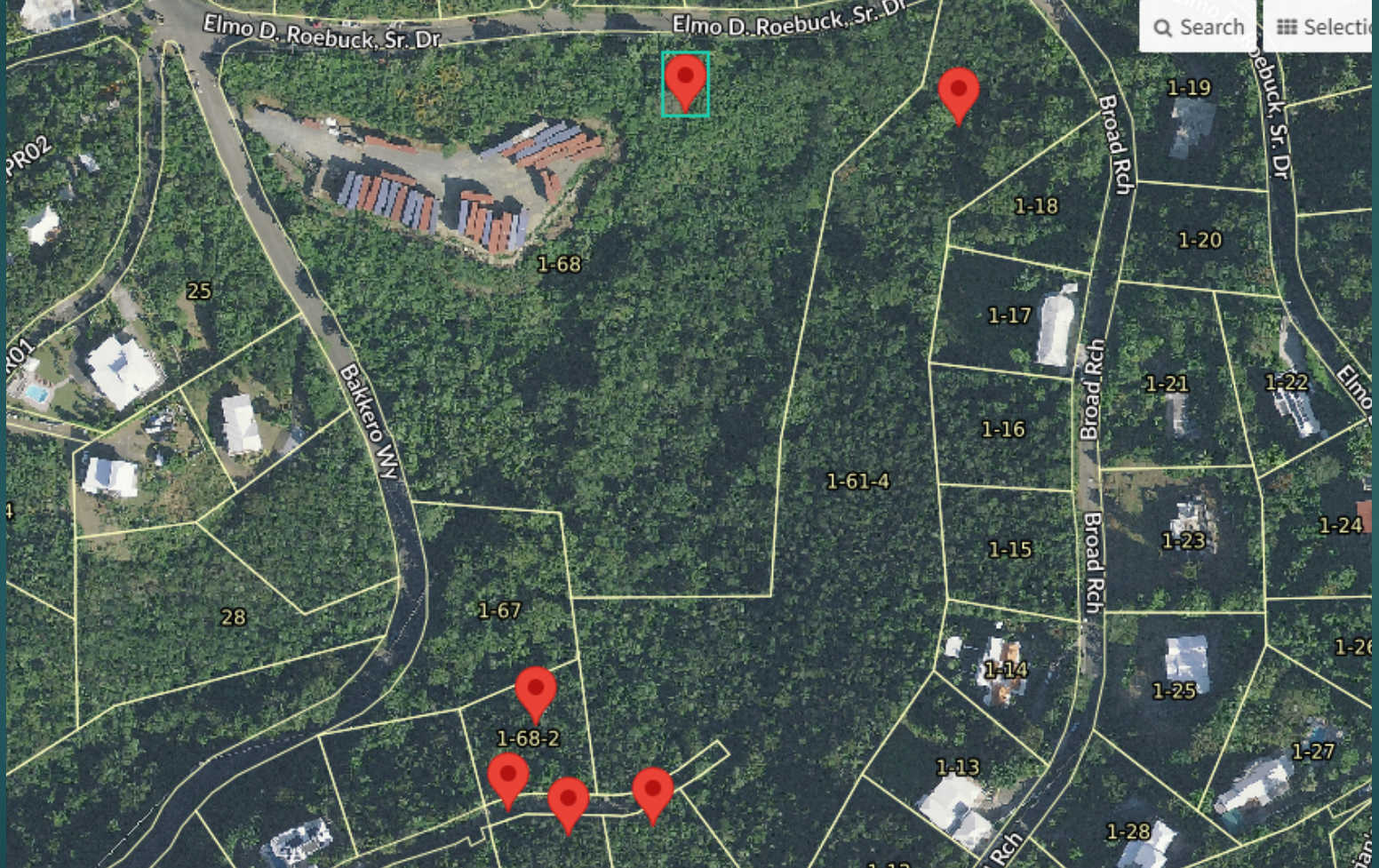
A proposal to build temporary workforce housing for up to 450 people in Estate Bakkero has placed residents, a developer, and planning officials at odds, leaving lawmakers to weigh the territory’s acknowledged need for worker accommodations against concerns over neighborhood compatibility, traffic, parking, restrictive covenants, and the long-term future of a quiet St. Thomas community.

On Monday, the Committee of the Whole heard testimony on Bill No. 36-0287, which seeks to rezone several parcels in Remainder Estate Bakkero. The property is currently zoned R-1, but owner Joseph Todd Donohoo is seeking a change to R-3. The Department of Planning and Natural Resources has instead recommended a Planned Area Development, or PAD, within the existing zoning designation.
Lawmakers later learned that Mr. Donohoo does not support the PAD option.
According to Planning Technician Gail Pagan, the proposal includes 18 one-story buildings, including 15 housing buildings and 30 single-occupancy modular units. The site would also include common areas such as a kitchen and dining space, along with a fitness center. The plan provides for “approximately 257 parking spaces.”

Construction is expected to take about six months and includes the “relocation, from St. Croix, of renovated modular units from Lime Tree’s modular housing.” The workforce housing site is expected to be temporary and remain in operation for 10 to 15 years.
The proposal has drawn strong opposition from Estate Bakkero property owners. Fourteen residents submitted letters to DPNR after a public hearing, citing recurring concerns that included neighborhood incompatibility, traffic, pollution, security issues, and the view that the project “resembles a temporary industrial style, man camp.”
Two residents appeared at Monday’s hearing, including Aaliyah Felix-Blyden, who argued that property owners were “deprived of a meaningful opportunity to conduct due diligence” because of “serious procedural deficiency surrounding the notice and disclosure process.” Ms. Felix-Blyden repeatedly suggested that the process had lacked transparency.
While she said she understood the need for workforce housing, Ms. Felix-Blyden argued that “supporting workforce housing does not mean supporting the placement of a large-scale transient workforce encampment or trailer-style housing facility within an established, family-oriented, low-density residential community.”
She also contended that instead of using “established hotels, guest houses, apartment rentals” and other existing lodging options, the developer preferred to establish the mancamp to “reduce operational costs and maximize convenience.”
Ms. Felix-Blyden also addressed DPNR’s PAD recommendation. “Residents find this deeply concerning,” she said. “A PAD should not become a mechanism to accomplish indirectly what cannot be justified directly through rezoning.”
Another property owner, Kurell Sheridan, also objected to the project. She said residents “received no notification” of the change to a PAD and raised concerns similar to those of Ms. Felix-Blyden. Ms. Sheridan said Estate Bakkero has “already faced the consequences of poorly coordinated development approvals,” and warned that existing street parking problems could worsen if the project moves forward.
“If workforce housing was truly a priority for the executive branch, then legislation in that vein should have been sent down by the governor, not this zoning request,” Ms. Sheridan argued. “We are asking the legislature to stand up for its constituents and demand responsible, coordinated planning,” she said.
Ms. Sheridan also told lawmakers that property in Estate Bakkero is governed by covenants stating, in part, that “alterations or excavations of terrain shall not be made which will substantially affect adjoining or other property.” She said the covenants also provide that temporary structures are not allowed for more than 30 days and that “no shanty garage, trailer, tent or other structures of a temporary nature, shall be used for residential purposes.”
Territorial Planner Leia LaPlace-Matthew said the covenant issue could complicate the project.
“The applicant may not have been aware that there’s covenants and restrictions…That covenant existence may put a hindrance on their project. The zoning code states that the zoning law cannot be used to abrogate or annul covenants. This may end up being a court matter.”
Mr. Donohoo presented the project as an effort to help address the territory’s recovery-related workforce housing needs. He told lawmakers that “in light of the delays in major capital projects,” he believed it was prudent to “assist the territory and government by assisting in providing workforce housing.”
He acknowledged that workforce housing “may not be the ideal use of this land,” but said it is a “necessity for our community.”
Mr. Donohoo also assured lawmakers that the workforce housing development would be temporary. His long-term plan, he said, is to use the 14-acre property for “a vibrant mixed-use housing community.” That goal is the main reason he opposes the PAD recommendation. He explained to Senator Milton Potter that an R-3 designation would allow him to begin building the permanent housing community once the need for temporary workforce housing ends.
Lawmakers struggled with whether to support DPNR’s recommendation, the developer’s request, or neither option. Several senators raised questions about the absence of a legally binding guarantee that the trailers would be removed when construction projects are completed.
Senator Alma Francis Heyliger was among those who raised that concern. She also pointed to parking problems in the area, which she said are already compounded by the Westin Hotel.
Senator Franklin Johnson questioned whether the project would “depreciate” the value of homes in Estate Bakkero. “I can’t see me supporting this measure,” he said. “This is not a good look for that neighborhood.”
Senator Dwayne DeGraff expressed a similar view, while Senator Angel Bolques suggested that all parties return to the drawing board.
Senator Kurt Vialet questioned the proposed location and repeated a previously shared view that government-owned land should be leased to developers interested in building workforce housing.
“At the end of the day, not this one, it can't happen, not in that area,” said Senator Marvin Blyden. He suggested that there is an individual who can house over 2,000 workers. “He have the land. He had the resources, nothing so far,” Senator Blyden lamented.
Another issue that emerged during Monday’s hearing was who encouraged Mr. Donohoo to pursue such a large workforce housing complex. In response to Senator Vialet, Mr. Donohoo said he had received interest from some contractors through “word of mouth,” but that the Office of Disaster Recovery was the entity that “came to me.”
Senator Clifford Joseph said that conflicted with what he recalled hearing from ODR Director Adrienne Williams-Octalien, noting that “housing gonna go through the contractors, so I’m just surprised to hear that.”
Senator Blyden later said he had spoken with Ms. Williams-Octalien, who “never told anyone about building workforce housing.” He said the same response was given to an individual he had referred to ODR. According to Senator Blyden, Ms. Williams-Octalien gave the Legislature the same information: “they need to go to the contractors.”
“I must say, this is a challenging one,” said Senator Milton Potter near the end of the discussion.
Lawmakers now face the task of weighing the testimony presented Monday, as the need for workforce housing connected to major capital projects collides with residents’ concerns over the character and future of Estate Bakkero.
Ms. Sheridan closed with a warning to lawmakers.

“Don't be fooled, and don't be scared into action by this false sense of urgency that we have from one property owner,” she stated.