
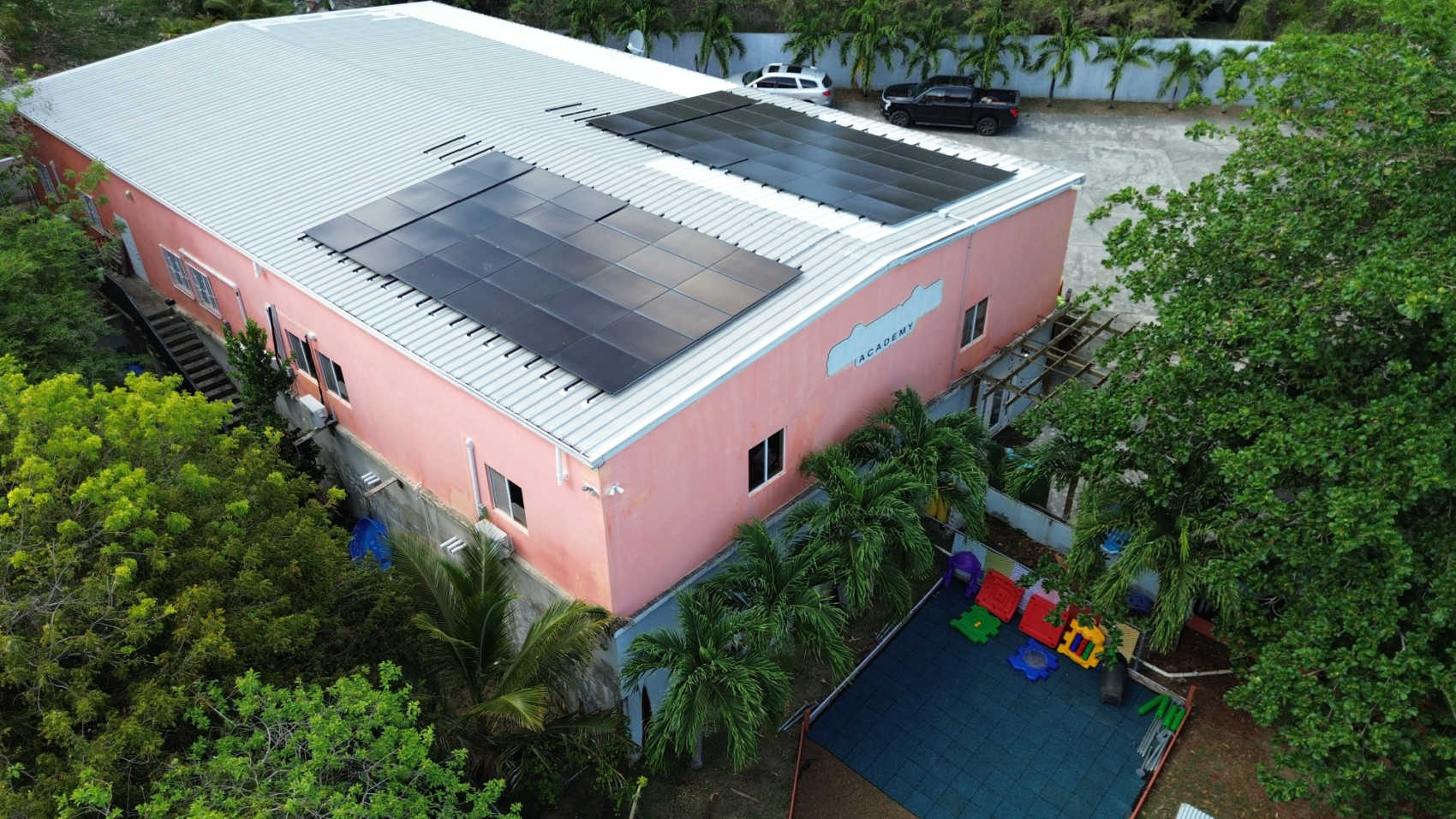
The V.I. Energy Office has completed the first solar and battery microgrid installation under the Community Electrical Innovation Program at a St. Croix day care, while also issuing a request for proposals for five additional day care and Head Start sites across the territory.

The program, funded through the Virgin Islands Housing Finance Authority, is intended to strengthen essential community services through solar and battery microgrids that can keep critical facilities operating during power outages while reducing monthly energy costs.
According to the Energy Office, the Community Electrical Innovation Program aligns with the Bryan/Roach administration’s renewable energy and grid resilience strategy by reducing the territory’s exposure to imported fuel costs and grid disruptions.
The first completed CEI-funded installation is at Happy Faces II, a St. Croix day care that provides childcare services to working families in the U.S. Virgin Islands.

The system was installed and commissioned by ProSolar Caribbean in May 2026. It includes 9.9 kilowatts of solar photovoltaic capacity paired with 40.5 kilowatt-hours of battery energy storage.
The Energy Office said the system is designed to improve the day care’s resilience during outages while also reducing its electricity bill. The battery system includes three Tesla Powerwall 3 units, which have already been registered in the VIEO’s recently launched Virtual Power Plant program.
According to the Energy Office, the Virtual Power Plant expands the value of CEI-funded sites beyond individual facility resilience by enabling future grid-support services through coordinated distributed energy storage.
The system at Happy Faces II was designed to reduce service disruptions caused by outages, helping ensure that childcare services remain dependable for families and allowing parents and guardians to continue working with greater confidence that the facility can remain online.
The Energy Office also announced the release of Request for Proposals BD-26-26-270-2710-642, CEI Solar and Battery Systems Phase 1, for five additional CEI-funded day care and Head Start microgrid sites across St. Thomas, St. John and St. Croix.
Collectively, the RFP represents 149 kilowatts of solar photovoltaic capacity and 600 kilowatt-hours of battery energy storage. The Energy Office described the projects as a near-term expansion of community-scale resilience infrastructure supporting facilities that serve children, families and working households.
The five project sites and specifications are:
- St. Thomas: DHS Sugar Estate Head Start — 72 kW solar / 224 kWh BESS
- St. John: DHS Cruz Bay Head Start — 32 kW solar / 211 kWh BESS
- St. Croix: DHS Anna’s Hope Head Start — 21 kW solar / 65 kWh BESS
- St. Croix: DoReMi Daycare — 12 kW solar / 50 kWh BESS
- St. Croix: Tenacious Toddlers Learning Center — 12 kW solar / 50 kWh BESS
VIEO is administering the CEI program as a subgrantee under VIHFA’s award of U.S. Department of Housing and Urban Development Community Development Block Grant–Disaster Recovery E-Grid funds.
The program is designed to support community-based organizations and nonprofits in underserved areas through the development of small- to large-scale solar and battery energy storage microgrid systems.
Last summer, VIEO conducted a comprehensive application process and identified 29 critical facilities across the U.S. Virgin Islands. The agency said it is now moving into the execution phase for solar and battery microgrids at selected sites.
The scope of work for each CEI project site includes engineering, equipment procurement, system construction, final commissioning and initial training.
Vendors are being invited to respond to the RFP. Each project site will be considered for award individually, and vendors may bid on all sites or any subset of sites based on their capabilities and interests.
More information on the RFP is available at https://gvibuy.buyspeed.com/bso/.