




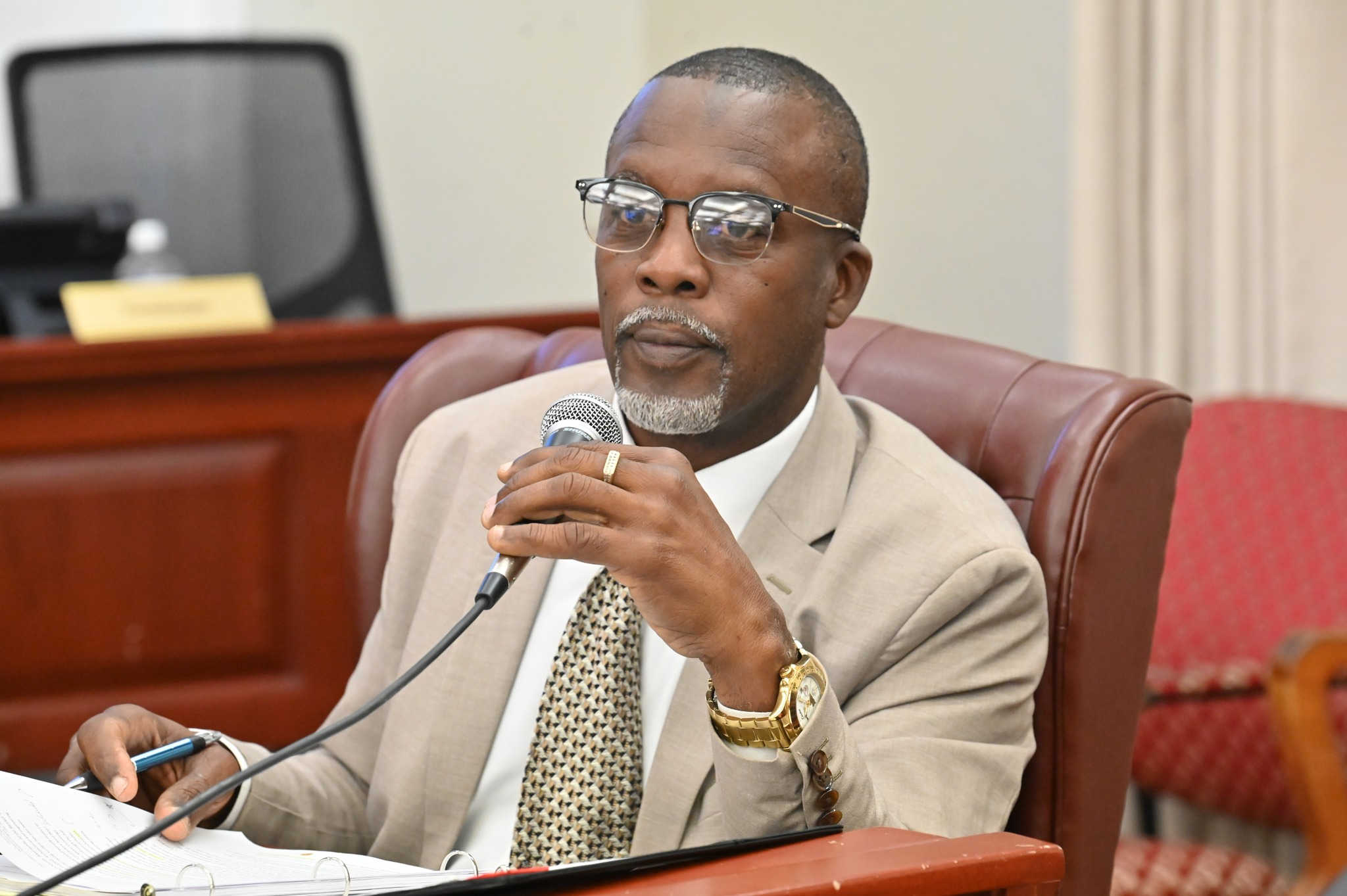
Senator Marvin Blyden, sponsor of Bill 36-0102, defended requiring local construction materials for government projects as an economic boost despite federal compliance concerns. Photo Credit: V.I. LEGISLATURE.
An effort by Senator Marvin Blyden to require government-funded projects to prioritize the use of locally manufactured construction materials failed to secure enough votes to move on to the next legislative stage.

Heard in the Committee on Government Operations, Veterans Affairs, and Consumer Protection on Monday, Bill 36-0102 sought to reinstate a section of the Virgin Islands Code. Title 31 Section 236b was repealed in the 1980s simply because the manufacturing base was not large enough to warrant such a stipulation.
Senator Blyden's bill would have applied to all government contracts whether locally or federally funded, and would have required builders to use “locally produced or finished construction materials if they are in sufficient supply, if they meet quality standards and if the price does not exceed the cost of outside materials by more than 15%.” This would have created a “multiplier effect” in the local economy, Blyden belives.
The lawmaker also addressed claims that the bill violates federal laws, citing the Buy America Act of 1933 and the fact that Puerto Rico enacted similar legislation approximately 70 years ago. “This is not a trial approach on uncharted grounds,” he stated.
Still, testifiers and legislators remained concerned over possible conflict with federal laws and the stipulations outlined in federal funding agreements for the territory’s recovery projects.
Commissioner Lisa Alejandro of the Department of Property and Procurement emphasized the need for compliance with federal grant awards and asked that the bill be amended to include an exception that the requirements “would not apply if they are not consistent with the terms and conditions of the applicable grant funding.” Compliance is crucial to ensure the territory can “remain eligible for reimbursement and drawdowns,” she declared.
Ma. Alejandro offered other recommendations, including a need to ensure project costs are balanced. Ultimately, she asked that the bill be “held for further development.”
Department of Public Works Commissioner Derek Gabriel also had some reservations, including a concern about the bill overstepping federal laws. “Local preferences are strictly prohibited by certain grand conditions and procurement regulations,” Mr. Gabriel advised. “Even though the bill aims to give local manufacturers an advantage, this puts both the project and its funds at risk, delaying the necessary construction projects’ completion,” he added.
He considered the comparison to Puerto Rico as “irrelevant," noting that “their manufacturing base and legal system are very different than our own.” When the bill is taken in its full context, Mr. Gabriel says it “does not align with the realities of our unique market.” He requested a similar exemption amendment as Ms. Alejandro and asked for time to consult federal partners and other stakeholders. It would help “ensure compliance with federal requirements and to prevent unforeseen consequences,” he argued.
Kate Davis, director of Procurement at the V.I. Housing Finance Authority, also urged lawmakers to consider the “realities of affordability, quality and federal compliance.”
Senator Angel Bolques was among the first to respond to testifiers’ hesitations. He used Guam’s local procurement preferences as an example. “If Guam can successfully implement those types of protections in their economy under the same federal framework that we actually operate in, then we are not doing anything different,” he argued.
Sen. Blyden repeatedly reminded testifiers that his bill did not seek to establish contractor preferences or include any illegal provisions.
“I don't understand how we have so much pushback,” Senator Novelle Francis remarked. “It should be everyone's best interest here to make sure that we're moving legislation to protect and build diversity in our economic portfolio.” He also reminded those expressing dissent that the bill “speaks to the greatest extent practicable” and does not mandate a particular action. “It's simply suggesting that if the opportunities for local manufacturers are here, let's look at them first, before we go abroad,” he stated.
Indeed, Haldane Davies, who leads the Bureau of Economic Research, testified that the bill has the potential to “lessen revenue leakage and encourage the further development of locally available construction materials into ready-use products.”
“I think provisions just need to be included to make sure that open competition is allowable and we're not offering any preferences to any class of manufacturers,” Gabriel, the DPW commissioner, replied to Sen. Francis.
Senator Alma Francis Heyliger was among those who advised caution. “I like the concept of the bill, but I'm very concerned about what could potentially happen,” she said. Meanwhile, Senator Kurt Vialet said that the measure “might be an incentive for additional companies to come to the Virgin Islands and manufacture.”
Senator Kenneth Gittens noted that there were administrative “complexities” that would have to be considered. How would the phrase “to the greatest extent practicable” be defined? How would compliance be enforced? Gittens also voiced concerns over possible federal conflicts, wondering whether the bill could “jeopardize eligibility for federal funding due to procurement restrictions.”
Having heard Ms. Alejandro's response that DPP had not yet “reached out to any of the sovereign agencies with regards to this bill in particular,” Senator Vialet urged both DPP and DPW commissioners to have those conversations. “I think with all of our heads in here, we can sit down and we can come up with a bill that we can pass that would benefit local manufacturers,” he said.
Though Sen. Blyden had prepared an amendment to address the Department of Property and Procurement and the Department of Public Works’ concerns, both Commissioners Alejandro and Gabriel indicated that they would have to review the changes before endorsing them.

When the meeting ended, only Senators Novelle Francis, Franklin Johnson, and Avery Lewis voted in favor of advancing the bill out of committee. Senators Alma Francis Heyliger, Carla Joseph, and Kenneth Gittens said no, while Senator Ray Fonseca was absent from the chamber during the vote. With the measure now voted down, the sponsor can reintroduce it at a later date, presumably with changes that address Monday’s concerns.


Advertisements