



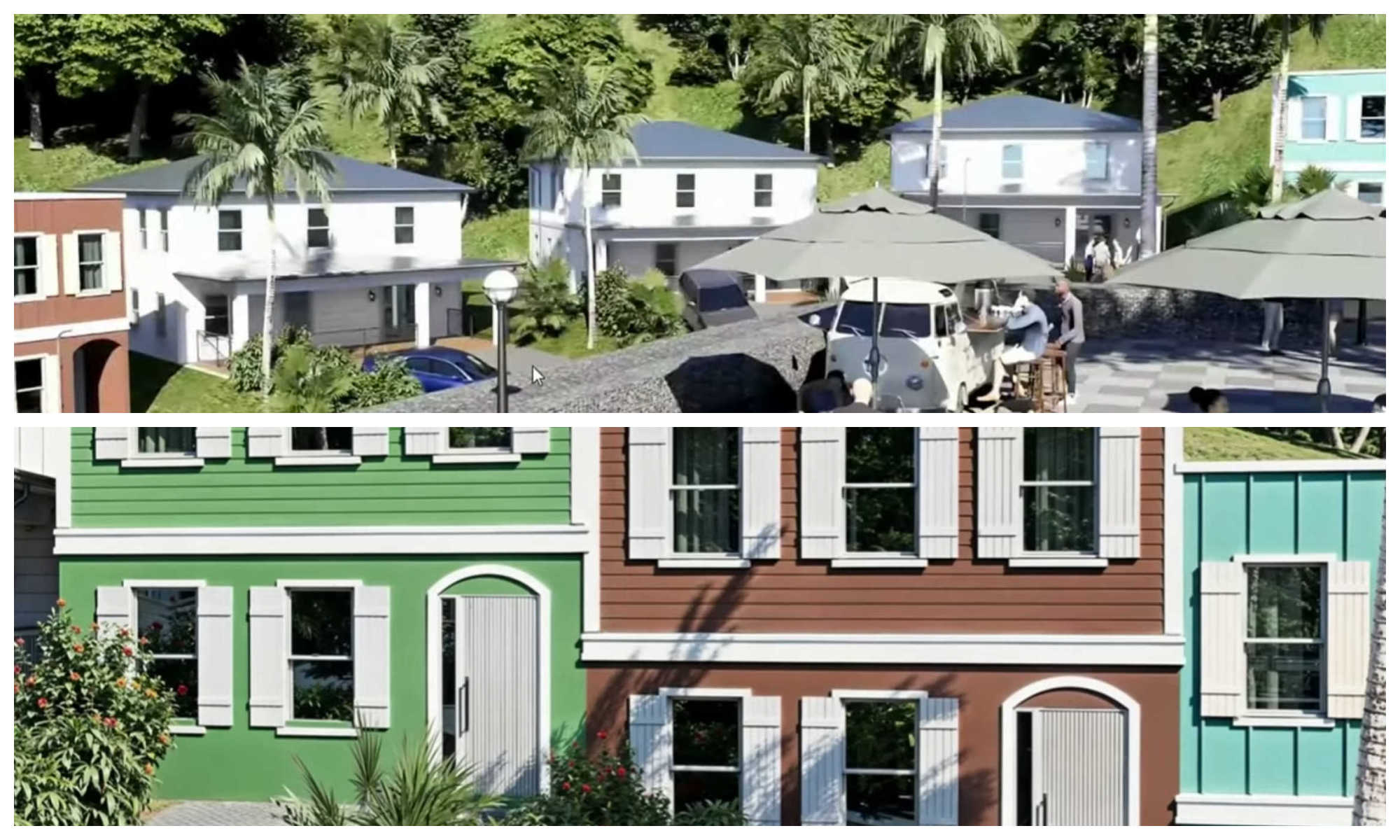
A group of young Virgin Islanders is working to expand the housing stock on St. Thomas—but in order to do so, they’ll need the support of the Legislature. “The proposal is to build an 80-unit, for sale residential development over three phases over 3 to 3.5 years,” explained Leia La Place-Matthew, the Department of Planning and Natural Resources Territorial Planner, during Monday's meeting of the Committee of the Whole.

The developers intend to construct twenty-eight 20-foot townhouses, thirty-six 24-foot townhouses, and sixteen single-family homes, with a total of 195 parking spaces across the property. “There will be individual cisterns, a centralized wastewater system, centralized stormwater management retention and additional rainwater harvesting,” added Ms. La Place-Matthew.
The leadership of AC Development, LLC also appeared before the Committee of the Whole to justify their desire to establish "The Residences at 340 North", a planned area development on the R-2 zoned Parcel Nos. 4i Remainder and 4J Remainder Estate St. Joseph and Rosendahl, No. 4 Great Northside Quarter. The request is covered in Bill 36-0095.
For Ajani Corneiro, born and raised on St. Thomas, “we believe that the Virgin Islands should be developing its own housing, not relying on stateside firms with limited understanding of our terrain, our systems or our communities.” He promised lawmakers that “this project is structured to support that shift.” The development, said Mr. Corneiro, is the “missing link between available resources, ready buyers, and a critical shortage of quality housing inventory.”

Among several funding sources, Mr. Corneiro wants to leverage the Community Development Block Grant Mitigation funds currently available within the territory. “Across the country, communities that can't coordinate or move quickly see those dollars retracted. We can't afford that here. The stakes are too high and the needs are too great,” he stated.
Despite these lofty ambitions, the development has brought forward a host of concerns, many of which were shared at a March 24 public hearing and again ventilated on Monday. Maria Raimer, a resident in the neighborhood, was present in the legislative chambers to oppose the project. She and several members of her family are heirs to multiple adjacent pieces of property. The development includes a proposed easement, which Ms. Raimer said would “disrupt the continuity of the family's connection to both our tamarind tree, which has stood for over 100 years, across the gut, to our family cemetery.” Regarding the easement, “our family is 100% against,” she stated.
Ms. Raimer expressed particular fondness for her family's heirloom tree. “The tree has stood for so long that even my grandfather, David, who was born in 1905 did not know who planted it… Disrupting the underground ecosystem around it by displacing so much Earth in a concentrated area and redirecting the natural water flows, could lead to its demise.” She shared concerns that construction would exacerbate occasional flooding in the area. “We have the sense that they don't quite understand the topography of the area,” said Ms. Raimer, of the Department of Planning and Natural Resources. She asserted that the land “cannot sustain a project of this size and the addition of hundreds of gallons of wastewater.”
“We question not only the planning but the motives,” Ms. Raimer continued, referencing several stalled public housing projects. “For us, this has a sense of a gateway to covertly build exclusive communities under the guise of affordability that will eventually shut out the people, the very people who are in need of housing,” she accused. “This is not the best path to establishing affordable housing in our community and it will be a detriment to the already existing community and environment.”
Outside of Ms. Raimer’s staunch opposition, the team behind the Residences at 340 North is facing challenges in accessing the CDBG-MIT funds. “What we're requesting is access to these funds in the tune of $6.25 million to allocate so we can build phase one of our development,” explained Mr. Corneiro. That infusion of funds would allow the developers to sell the homes well below market value. However, therein lies a hurdle that he has not yet been able to figure out how to overcome.
An affordable housing application submitted to the Virgin Islands Housing Finance Authority will “not be reviewed because our funding structure is not complete based on not having the CDBG-MIT funds allocated,” shared Mr. Coneiro. However, VIFHA has oversight of those funds, which makes the impasse difficult to understand for Mr. Coneiro. “The policy [for the CDBG-MIT funds] has not been created for us to apply for it. It makes no sense to us, but it is where it is.”
Nevertheless, Mr. Coneiro is determined to press forward. Much of Monday’s meeting was spent coming to a compromise. “We could just not do the easement access, really, on the bottom parcel, Mr. Corneiro suggested and offered another access route. “There’s no technical issues at all beyond your emotional concerns,” he told Ms. Raimer. AC Development LLC, is also considering seating a member of the Raimer family on the housing community’s homeowner association board. “That way, they could kind of have [a] say,” said Dr. Jerril Fredericks, another representative.
With most lawmakers suitably satisfied that the two parties could find a middle ground, attention turned to the sticking point of their difficulties thus far in accessing federal funding for the project. “It’s a crying shame,” declared Senator Novelle Francis. He promised that the Legislature would take a closer look at the challenges they are facing.
“It's a little bit unfortunate that maybe we're 20 years too young or too melanated,” said Mr. Corneiro. He told lawmakers that the issues stem from a lack of engagement. “We have $60 million in CDBG funds. The development needs between $5 to $6 million to be sufficient.” Senator Marvin Blyden, who chairs the Housing Committee, has promised to follow up and be “more stern.”
“I know for sure, when other developers come is not an issue. It's not an issue. We roll out the red carpet. But when our own try to do something positive and give back to the community, it’s an issue, and it’s sad,” said a frustrated Senator Blyden.
“We already lose over $70 million in education funds that went back because it wasn't spent,” lamented Senator Kurt Vialet. He urged against “dragging our feet and blocking these individuals from bringing a development to St. Thomas.” He signaled his intention to grill VIHFA on spending the CDBG funds. He bemoaned the loss of qualified professionals due to a shortage of affordable housing. “While we protecting the tree boa and the tamarind tree and everything else, they're gonna fly away.”

Bill 36-0095 is expected to be voted upon favorably during Wednesday’s legislative session.