




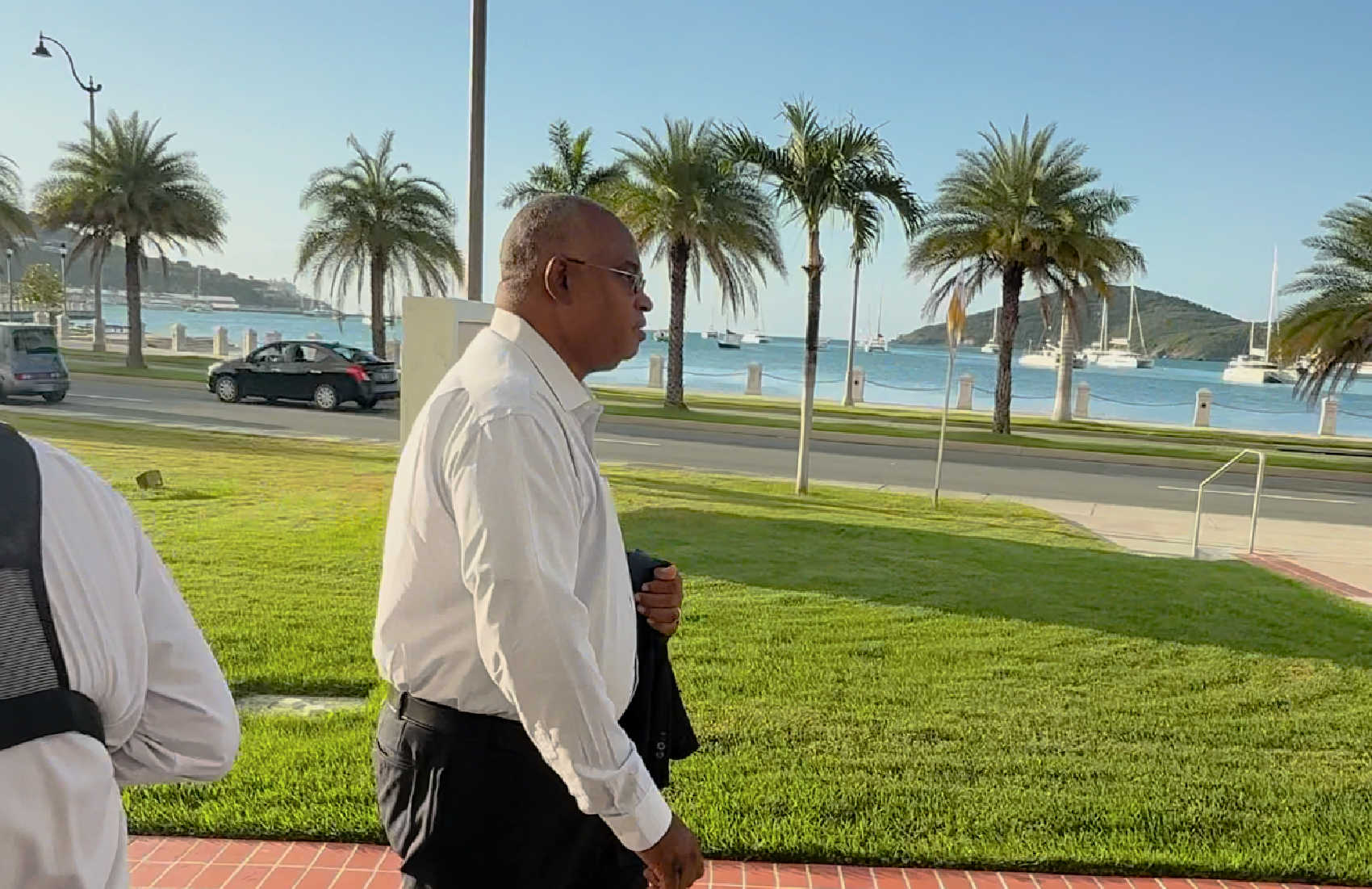
Former V.I. Police Commissioner Ray Martinez, once one of the territory’s most powerful law-enforcement officials, entered federal court Tuesday in brown prison fatigues before being sentenced to 10 years in federal prison after U.S. District Judge Mark Kearney said his crimes represented a grave betrayal of the people of the Virgin Islands and the oath Martinez swore to uphold.

The 120-month sentence followed an emotional hearing in which Martinez cried, apologized to his family, his former colleagues at the V.I. Police Department and the people of the territory, and said the case had left his family shattered. But Judge Kearney made clear that Martinez’s public service and community support could not erase the seriousness of the corruption scheme, saying the victims were not only the government, but the citizens of the Virgin Islands — people whose confidence in public institutions was damaged and whose ARPA-funded resources, intended to benefit the territory at a time of need, were instead used for illegal gain.
The sentence was far below the 24 years sought by federal prosecutors, but substantially above the 60 to 72 months requested by Martinez’s defense team. Judge Kearney said the punishment had to account for both Martinez’s long record of service and the gravity of a senior public official using his position in a scheme that damaged public trust.
Martinez was convicted in December alongside former Office of Management and Budget Director Jenifer O’Neal in the Mon Ethos corruption case, which centered on government contractor David Whitaker, Mon Ethos Pro Support, payments tied to government work, and allegations that senior officials used public power to steer benefits and money. Prosecutors portrayed the scheme as calculated corruption involving bribery, money laundering conspiracy and obstruction, while Martinez’s attorneys argued that his decades of service, health, age and family circumstances warranted leniency.

Judge Kearney emphasized that public corruption carries real victims, even when those victims do not appear in court as individuals who suffered direct physical injury. In this case, the judge said, the victims included the people of the Virgin Islands, whose trust in government was undermined by the conduct of a senior public official. The court also pointed to the nature of the funding involved, with public resources meant to serve the territory instead becoming part of a corrupt arrangement.
The judge also spoke to the significance of Martinez’s oath and former position. Martinez had risen through the ranks, earned public respect and held one of the territory’s highest law-enforcement posts. That made the breach of trust especially consequential, Judge Kearney indicated, because Martinez was not a peripheral public employee but a leader whose authority carried weight across the Virgin Islands.
Martinez’s statement to the court was emotional and at times tearful. He thanked relatives, friends and supporters who stood by him, then apologized to his “VIPD family” and acknowledged the shame the case had brought on the department he once led. He spoke about missed family milestones, including birthdays, games and his son’s graduation, and described the toll the prosecution and incarceration had taken on his wife, children and grandchildren.
Martinez said he was not angry with those who were upset with him and asked the court for mercy, saying his plea was not only for himself but for his family. He rejected the idea that the case reflected the entirety of who he is, saying he had been portrayed as a monster and that those who knew him understood him differently.
His family and supporters echoed that argument, asking the court to view the conviction as one chapter in a broader life of service. Several people spoke on Martinez’s behalf, describing him as generous, hands-on, devoted to his family and deeply rooted in the community.
Greg Davila, who said he had known Martinez for more than 40 years, described him as sincere, a consensus builder and a leader who had the respect of officers who worked with him. Others spoke of Martinez’s years in public service, his work in law enforcement, his family obligations and his willingness to help others.
Martinez’s son, Ray Martinez Jr., told the court that his father was a good man who had supported him and his family, attended important events and helped those around him. A pastor also addressed the court, describing Martinez as someone with a good heart who had contributed to the community and could still be helpful in the future. Desiree Ritter Lambertis, identified in court as a victim advocate with VIPD, said she had known Martinez for a long time and urged the court not to see the conviction as the end of his life.
The defense presented Martinez as a man whose public life could not be reduced to the corruption case. His attorneys pointed to his 35 years of service to the Virgin Islands, his first arrest and conviction, his age, health issues, family responsibilities and the letters of support submitted on his behalf.
Attorney Miguel Oppenheimer argued that a 60- to 72-month sentence would be sufficient but not greater than necessary. He said Martinez’s years of service could not be erased by the offense and argued that the case involved a nonviolent crime. The defense also raised concerns about Martinez’s health and his ability to receive proper medical care while incarcerated.
Attorney Matos de Juan challenged the government’s contract and loss calculations and urged the court not to sentence Martinez based on broader Mon Ethos-related figures. He argued that money tied to work actually performed under the contract should be deducted from the government’s calculation and said Martinez should not be punished as though the entire contract amount represented corrupt proceeds.
Oppenheimer also argued that Martinez had a long personal relationship with Whitaker and that not every interaction or contract discussion was corrupt. The defense maintained that the government overstated the scope of the wrongdoing and asked the court to impose a sentence that reflected Martinez’s history, character and the punishment he had already experienced through incarceration, reputational damage and family hardship.
Federal prosecutors, led by U.S. Department of Justice Trial Attorney Alexandre Dempsey and Cherrisse Amaro, argued that Martinez’s public standing made his conduct more serious. They described the corruption as "called and calculated", and said Martinez had managerial control over the scheme.
Dempsey argued that Martinez’s actions were not excused by his prior reputation or years in office. Prosecutors said the case involved more than a private lapse in judgment; it involved a senior public official using the authority of his office in a scheme that eroded public trust. The government argued that ARPA funds and other public resources were intended for the people of the Virgin Islands, not for officials who used public contracts for private benefit.
Prosecutors also argued that Martinez attempted to minimize or obscure his role even after the jury’s verdict, and that obstruction-related conduct made the case more serious. They asked the court to send a clear message that public corruption would carry meaningful consequences, particularly when committed by officials entrusted with significant authority.
Judge Kearney ultimately imposed a sentence that landed well below the government’s recommended range but far above the defense request. He said the court had considered Martinez’s service, family support, health and personal history, but said those factors could not override the seriousness of the public betrayal.
The judge also rejected the idea that a nonviolent offense should be treated lightly, emphasizing that the harm from public corruption is real even when it does not resemble the harm from violent crime. He said the case was significant because Martinez had taken an oath, held power and betrayed the people who trusted him.
Judge Kearney noted that the Bureau of Prisons would determine credit for time Martinez has already served and would be responsible for addressing medical issues while he is in federal custody.
The sentencing marks a major development in one of the most closely watched public corruption prosecutions in recent Virgin Islands history. Martinez, who once led the V.I. Police Department, will now serve a decade in federal prison for crimes tied to a corruption scheme that prosecutors said exploited public contracts and public trust.

O’Neal, who was convicted alongside Martinez, is scheduled to be sentenced Thursday, while David Whitaker, who is seeking home detention, will be sentenced today.