



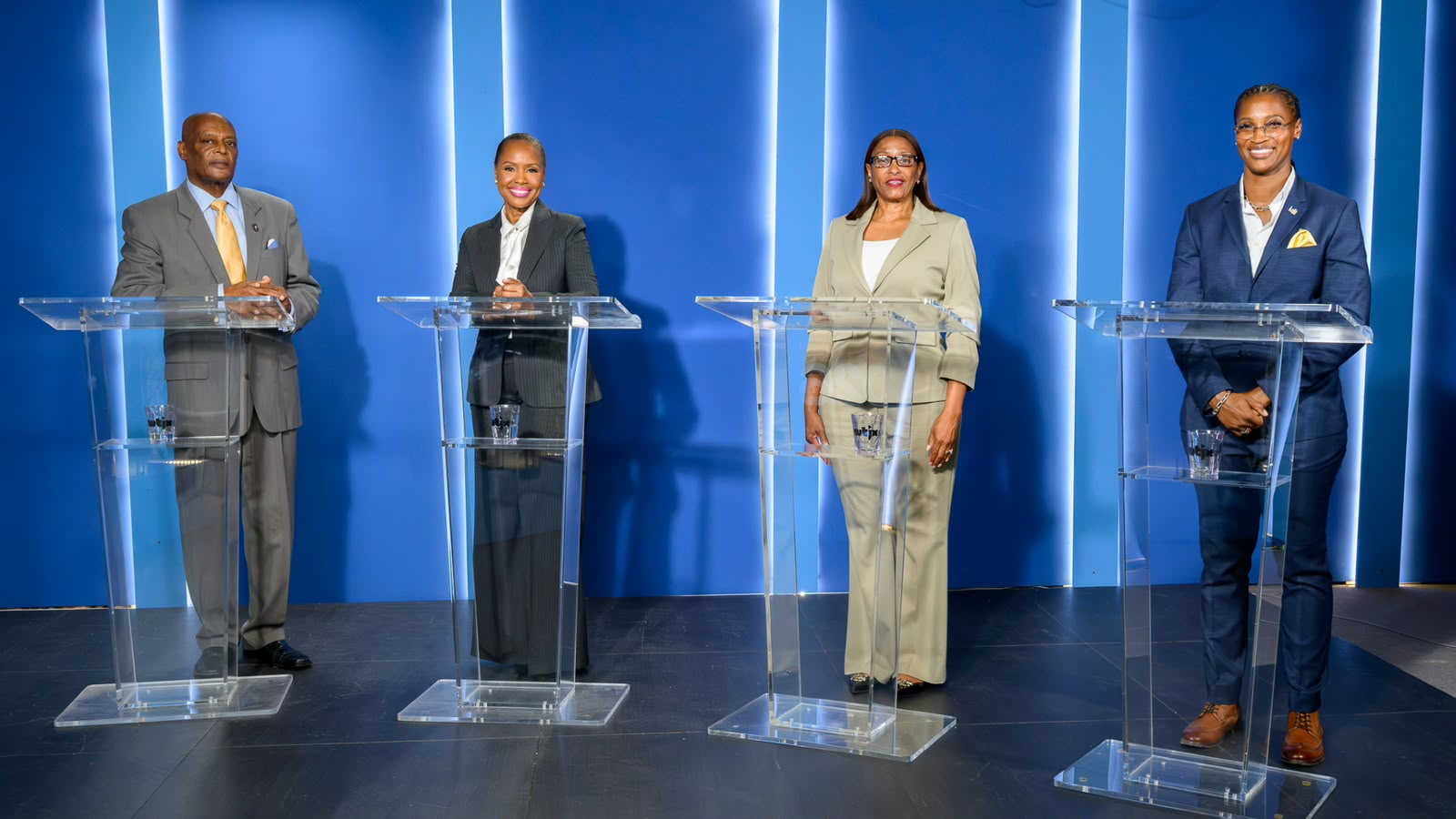
The four candidates seeking the Democratic nomination for delegate to Congress faced 90 minutes of questioning on disaster-recovery funding, territorial rights, healthcare, mail service, crime and their individual records during the final event of the Consortium-WTJX primary debate series.

Delia Smith, Terri Helenese, Janelle Sarauw and Emmet Hansen outlined their approaches to representing the Virgin Islands on Capitol Hill while defending their preparedness for office and addressing controversies involving their public and personal records.
The winner of the Aug. 1 Democratic primary will advance to the November general election in the contest to become the territory’s representative in Washington, D.C.
Candidates Address Rising Recovery Costs

The debate began with the growing gap between federal disaster-recovery awards and the rapidly escalating cost of completing major construction projects in the Virgin Islands.
Despite the millions of federal dollars allocated for hurricane recovery, the territory faces the prospect of having to reduce the scope of planned facilities as construction costs outpace available funding.
Ms. Smith said she would immediately begin discussions “with the secretaries of HUD, the secretaries of USDA, the agency of FEMA…the ones that are responsible for giving us these awards.”
She said federal decision-makers must better understand the expenses associated with completing capital projects in the territory.
“We must include the cost of shipping, the cost of supplies, the cost of construction, and the cost of real estate,” Ms. Smith said, arguing that “these are not factors that are currently being considered when these awards are being decided.”
Ms. Helenese said she would work with members of Congress, particularly those serving on the House Appropriations Committee, “to have a conversation with them about funding.”
She also cited “skyrocketing” supply-chain expenses and said she would encourage the representatives of the other four U.S. territories to join the Virgin Islands in lobbying for additional federal support.
Ms. Sarauw called for disaster-equity legislation and proposed using Government Accountability Office reporting to evaluate the effectiveness of the territory’s Federal Emergency Management Agency process “and the backlogs we have with FEMA approvals.”
She said the findings could then be presented to members of the House Committee on Natural Resources, whom she would encourage to visit the Virgin Islands and examine the recovery challenges firsthand.
“If you are a primary source and you’re there and you witness it, it will be easier to actually make a case within the halls of Congress,” she declared.
Mr. Hansen similarly emphasized gathering sufficient information to present Congress with a persuasive case for increased federal funding.
Bipartisan Relationships in Washington
The candidates were also asked how they would establish productive relationships with lawmakers who do not share their political views.
Ms. Helenese pointed to her existing record of building bipartisan relationships in Washington, including within Congress and the White House. She pledged to continue the work of the previous eight years by reaching across party lines to deliver results for the territory.
Ms. Sarauw repeated the principle that “there’s always people before party,” noting that she served as an independent senator in a Legislature controlled by Democrats.
“For me, it’s a no-brainer because we actually have more in common than our differences,” she said, describing herself as someone who seeks consensus.
Mr. Hansen said the delegate should avoid national political controversies and focus exclusively on advocating for Virgin Islanders.
“We do not have the force to get in a fight with the President of the United Sates…we have to be cordial with everyone,” he declared.
Ms. Smith cited her work under Republican and Democratic administrations and her bipartisan confirmation as U.S. attorney as evidence that she could work across party lines.
Birthright Citizenship
The candidates were questioned about pending House legislation that could, beginning in 2027, deny birthright citizenship to certain people born in the U.S. territories.
Ms. Sarauw said she would work with nonprofit organizations, including Right to Democracy, while mobilizing the Virgin Islands diaspora to advocate for territorial equality.
She noted that large numbers of Virgin Islanders live in states including New York, Georgia, North Carolina, Florida and Texas and could lobby their representatives to support the same rights for territorial residents that Americans receive on the mainland.
Mr. Hansen said he would gather information demonstrating that territorial residents do not “get back an equal benefit” from federal programs into which they pay, including Social Security and Medicare.
He also pointed to the territory’s record of military service.
“When they had the draft…they took in disproportionate numbers of men and women from the territories, and they still do.”
Mr. Hansen said the significant participation of territorial residents in national service organizations strengthens the case for equal treatment.
“It eliminates the thinking that we’re somehow begging,” he declared. “That’s how I feel that we have to approach it.”
Ms. Smith said the lobbying work of previous delegates must continue.
“It’s a continued beat of the drum to make sure that you’re heard, that you’re leveraging your powers to convince those with the power to act on your behalf.”
Ms. Helenese advocated for pursuing territorial equity in stages, beginning with Social Security and Medicaid.
“I would work across the board for equity in healthcare, equity in our tax policies,” she said.
Sarauw and Helenese Address Legal Disputes
Moderators later turned to questions involving each candidate’s record and preparedness.
Ms. Sarauw and Ms. Helenese were both questioned about public legal disputes involving domestic-violence allegations and why voters should trust them with leadership.
Ms. Sarauw said the allegations against her followed abuse that she had experienced.
“When I reacted, that became the problem.”
She said she had learned from the experience and argued that, although neither her candidacy nor her personal life was perfect, she remained authentic, committed and prepared to serve.
“None of us on this podium are beyond reproach. All of us have something that we are not particularly proud of,” she remarked.
Ms. Helenese said the allegations involving her were shown in court to be unsubstantiated.
“This was not even ever litigated,” she said.
Ms. Helenese said she had been lied to by a person she was dating and was later subjected to retaliation after discovering the truth.
“This was thrown out,” she responded.
Smith Explains Court Reprimand
Ms. Smith was questioned about being reprimanded by the District Court judge overseeing a major drug and firearms prosecution that she was handling.
She said the conduct criticized by the judge resulted from a nationwide breakdown of the federal court’s electronic filing system, which caused her to miss important deadlines.
According to Ms. Smith, she was ultimately vindicated after presenting electronic evidence of the systemwide malfunction, which the court accepted.
“It is not within my purview nor my authority to question a judge’s ruling,” Ms. Smith said.
Hansen Defends Lack of Campaign Website
Mr. Hansen was questioned about why voters should entrust him with public office when a campaign website he promised had not been launched.
He attributed the problem to outdated computer equipment and slow internet service.
Mr. Hansen said the absence of a website had not prevented him from engaging with voters through his social-media accounts and regular radio program.
“I see absolutely no relevance,” he declared, arguing that his lack of basic campaign infrastructure had no connection to his ability or preparedness to serve as delegate.
“You have no idea how many meetings I’ve gone to, so I think that you’re mixing apples and oranges,” he told the moderator.
Candidates Propose Changes to Mail Service
The candidates also addressed the continuing problem of slow and costly mail delivery to the Virgin Islands.
Mr. Hansen said the solution would involve lobbying “the board who manages the Postmaster General.”
Ms. Smith proposed separating the mail services and federal funding provided to Puerto Rico and the Virgin Islands.
“There’s no reason that we should have to go through Puerto Rico,” she said, noting that private delivery companies can ship directly to the territory.
Ms. Helenese said discussions had already begun with executive-branch officials about restoring the “de minimis” customs exemption.
She argued that President Donald Trump did not consider the consequences for the territories when he eliminated the duty threshold.
Ms. Sarauw proposed developing the St. Croix free-trade zone into a mail hub serving the wider Caribbean, South and Central America and Africa.
She said such a facility could improve the speed and efficiency of local mail while processing packages destined for other regions.
Healthcare Plans Differ
The candidates were asked to identify their foremost priority for improving healthcare in the territory.
Mr. Hansen called for establishing a veterans hospital in the Virgin Islands. He argued that the facility would attract more federal funding while preventing healthcare reimbursement money from being spent overseas.
Ms. Sarauw identified the elimination of Medicaid and Tax Equity and Fiscal Responsibility Act caps as a priority.
She again emphasized obtaining accurate information from the Government Accountability Office to measure uncompensated care and assess how population loss and outdated federal reimbursement formulas affect territorial health funding.
“If we could provide that data, we’re able to actually have a stronger case to revisit the outdated formulas facing the territory today,” she argued.
Ms. Helenese repeated her proposal to remove Section 1108 from the Social Security Act, which establishes limits on federal healthcare payments to the territories.
Asked why the effort had not advanced during her years working in Washington, Ms. Helenese said it had been underway for “at least four years,” and pledged to continue pursuing it.
Ms. Smith argued that the immediate obstacle was not the federal cap but the territory’s inability to produce its required local contribution.
“We can’t even get to the capped amount because we can’t meet the 17% that is required for matching for Medicaid funds,” she declared.
She called for modernizing the territory’s healthcare billing systems and developing accurate information about its current poverty rate.
“That would then open up room for discussion for additional medical funding that can help the government in meeting that 17% match,” she said.
Candidates Oppose Consolidated Ballot Decision
All four candidates agreed that the V.I. Board of Elections acted improperly when it voted to consolidate the electoral ballot by combining local contests with the delegate to Congress race, contrary to written law.
They were also asked how they would respond when the governor, Legislature and delegate disagreed on a federal matter.
Each candidate supported discussion and the pursuit of consensus.
Ms. Sarauw went further, noting that the delegate may sometimes have access to confidential information unavailable to territorial officials.
“if there’s information and data…I may have to take a position that’s independent,” she asserted.
“There will be times that I will have to make a decision because conscience says it’s right.”
Candidates Divide on Federal Crime-Fighting Role
The discussion later turned to crime and the federal government’s role in assisting the Virgin Islands.
Ms. Helenese said the territory would benefit from a stronger federal law-enforcement presence.
Ms. Smith disagreed that additional federal personnel were necessarily required. She said local agencies should continue strengthening coordination with federal partners “to attack the crime and to act as an intervening force.”
She also argued that federal resources should no longer be distributed by grouping Puerto Rico and the Virgin Islands together.
“We need to be separated from that umbrella, so we have our own resources, so we can patrol our streets, we can patrol our borders, we can use resources in our airports.”
Mr. Hansen agreed that federal assets assigned to Puerto Rico should be relocated to the Virgin Islands.
“Take our damn Coast guard cutter out of Puerto Rico and bring it here,” he said.
Mr. Hansen said the vessel could strengthen marine patrols and help reduce the flow of firearms into the territory.
Ms. Sarauw focused on obtaining additional federal funding for local nonprofit organizations “filling the gap on the prevention and intervention side.”
She also called for an examination of how funding from the Caribbean Basin Security Initiative is being used.
“I would like to allocate more money, if possible, or redirect some of those funds for greater protection of our borders.”
Ms. Sarauw said she would also visit local correctional facilities as delegate to better understand the causes of crime and repeated offending.
“If we’re able to understand the why, we can craft better policies.”
Candidates Define a Successful First Term
The debate concluded with the candidates describing what would constitute a successful first term in Congress.
“It’s leveraging, it’s building, it’s advocating, getting my feet in the door, getting my chair at the table,” said Ms. Smith.
Ms. Sarauw said she would continue work begun by the current delegate while introducing her own priorities.
“finding out some of her initiative, building upon her initiatives, while adding my own flavor and twist to it.”
Mr. Hansen said a successful first term would be defined by improved access to housing and placing the V.I. Water and Power Authority on a more sustainable path.
Ms. Helenese again identified repealing the provisions limiting federal healthcare reimbursements to the territory as a central objective. She also called for establishing a feed mill in the Virgin Islands to improve food security.

With the Consortium-WTJX primary debate series complete, voters now have the candidates’ positions and responses ahead of the Aug. 1 Democratic primary.