


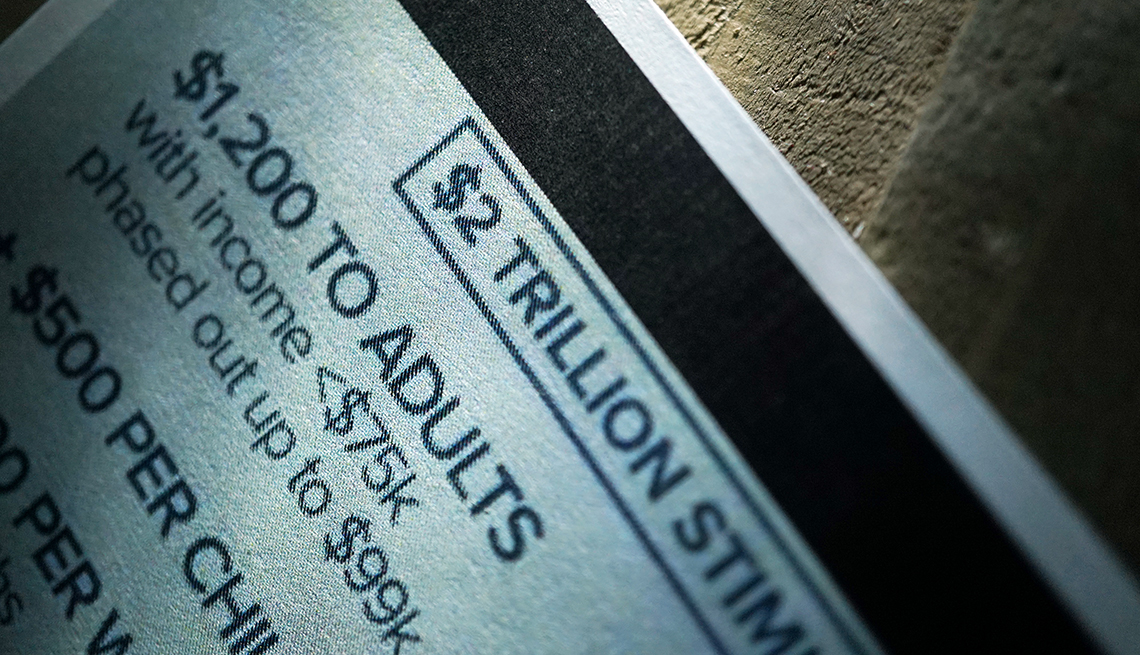
Governor Albert Bryan said Wednesday that Virgin Islanders would start seeing stimulus checks made available by the federal government through the $2.2 trillion CARES Act in the next two weeks, which means by early May many Virgin Islanders should be receiving in the mail the $1,200 checks.

The local government has begun the process of identifying eligible taxpayers and their most recent mailing addresses, the governor said. "We're in the process of arranging the specifics of the transfer from the U.S. treasury to our treasury locally. All of this is to make sure that you get that tax stimulus check as quickly as possible," Mr. Bryan said.
The governor said that as soon as his administration receives the final rules from the U.S. Treasury Department, the process of sending out the checks will begin. "We hope to have that done in the next two weeks," he said.
Per the Wall Street Journal:
How much money is it?
The plan provides $1,200 for each adult and $500 for each child under 17. A married couple with two children would get $3,400. Most people will receive the money in a payment from the Internal Revenue Service soon.
Who qualifies for the stimulus payments?
The payments go to almost any adult with a Social Security number, as long as they aren’t dependents of someone else. Those adults get the payments for the children in their household. Payments start phasing out for those with income above $75,000 in adjusted gross income for individuals, $112,500 for heads of household (often single parents) and $150,000 for married couples. The payments start shrinking above those levels.
For those with no children, the benefit disappears at $99,000 for individuals and $198,000 for married couples.
How can I get the stimulus payment if I don’t usually file tax returns?
The IRS and tax-preparation companies have created a new simple form for people who have no income or too little income to file a tax return in most years. That form is now available through www.irs.gov/coronavirus and individuals can register by answering a few basic questions so the IRS knows where to find them and can send them money.
How does the IRS determine whether you are getting a payment and how much you get?
The government will use 2019 tax returns to set the payment amounts and 2018 tax returns if 2019 isn’t available.
People who haven’t filed tax returns can still file for 2019 to make sure the government has their updated income and bank-account information, as well as 2019 information about recent births, deaths, marriages, divorces and moves. Such changes that happened after 2019 won’t be reflected in the payments, however.
The IRS also will be able to get information from the Social Security Administration about people who get benefits but don’t typically file tax returns, including those who receive Social Security disability benefits. The payments will be made in the same way that those people currently get their Social Security benefits.
For people with incomes over the limits, how does the payment work?
Those households should calculate the total amount of the credit, then subtract $5 from that total for every $100 that their adjusted gross income is over the limit. For a married couple with two children earning $180,000, the credit is reduced by 5% of the amount over the $150,000. That is a $1,500 reduction from $3,400, so their payment should be $1,900.
Governor Bryan on SNAP Benefits and Responsibly Reopening the Economy
Mr. Bryan said while Disaster Supplemental Nutrition Assistance (DSNAP) has not been made available, residents who have been laid off may be eligible for regular SNAP benefits, along with unemployment payments. He encouraged residents to contact the Dept. of Human Services for information on SNAP eligibility.
Relative to restarting the economy, Mr. Bryan said he was encouraged to see that the number of confirmed coronavirus cases in the territory has remained steady at 51 for the past few days, and said that the administration was in early discussions on how to reopen the economy.
"We're starting the initial discussions on how we responsibly reopen our economy because we're going to have to do that one day. But how soon we get there depends on the continued cooperation of this community," the governor said.
The number of confirmed Covid-19 cases holding steady at 51, however, may be a result of the lack of testing in the U.S. Virgin Islands.
Dr. Brett Ellis, director of the Department of Health’s public health laboratory, said last week that the territory’s testing facilities and epidemiology staff were well-prepared and capable of handing a large surge in testing. But obtaining sufficient testing supplies is a challenge in the Virgin Islands and across the U.S., Dr. Ellis said. “We expect that to continue to be a challenge into the coming weeks as manufacturers work on their production capacity and the federal government determines how to allocate those tests as they become available,” he said.
The main issue with testing supplies in the territory and around the country is with the chemicals — called reagents in science and medical circles. During a global pandemic the supply chain is inadequate to meet the worldwide demand for the reagents.
The VI Department of Health last week received lab instruments to perform “extremely rapid testing.” Positive test results can be obtained within three minutes,” Dr. Ellis said. “Negative take within 15 minutes.” The rapid testing equipment is being handed off to the the Juan F. Luis Hospital and Schneider Regional Medical Center for use. The instruments were delivered with 120 tests. “As such we will have to prioritize or limit the testing that is performed. Hospitalized patients and medical personnel who are symptomatic of COVID-19 infection are high on the priority list.”
“We are hoping that the supply chain improves, and that we will be able to do more and more testing here,” Dr. Ellis said.

As of Wednesday, the Dept. of Health had performed 417 tests, 331 of which have returned negative, 51 positive (14 on St. Croix, 35 in St. Thomas and 2 in St. John), 35 pending and 44 have recovered, according to D.O.H. One person has died from Covid-19 in the territory.