
A conservative think tank founded by former Vice President Mike Pence is urging Congress to restrict birthright citizenship in the U.S. Virgin Islands and other unincorporated territories, arguing that the Insular Cases leave territorial citizenship under congressional control and that federal statutes should be amended so citizenship at birth is limited to children with at least one U.S. citizen or lawful permanent-resident parent.

The recommendation appears in an August 25 legal report from Advancing American Freedom’s Edwin Meese III Institute for the Rule of Law titled Federal Policy Responses to the U.S. Supreme Court’s Birthright Citizenship Decision. Authors Hans von Spakovsky and Amy Swearer argue that Congress has authority to limit citizenship in the territories even after the Supreme Court rejected President Donald Trump’s broader challenge to birthright citizenship in Trump v. Barbara.
The report represents the latest development in a series of efforts this summer questioning the future of citizenship at birth in the territories.
On the day the Supreme Court decided Barbara, Vice President JD Vance publicly called the idea of limiting birthright citizenship in U.S. territories “a great idea” and said the administration was examining it. Weeks later, Rep. Morgan Griffith introduced the End Birthright Citizenship for Territories Act, H.R. 9724, proposing changes to the citizenship statutes governing the USVI, Puerto Rico, Guam and the Northern Mariana Islands for births beginning in 2027.

Then, on August 6, President Trump signed Executive Order 14418, which includes provisions addressing births in U.S. territories. The order currently targets people born in territories where citizenship is not conferred by federal statute, along with several other categories involving foreign government employees and commercial arrangements intended to obtain birthright citizenship.
That particular territorial provision does not presently eliminate citizenship at birth in the Virgin Islands because federal law expressly grants it. Under 8 U.S.C. §1406, people born in the Virgin Islands on or after February 25, 1927, and subject to U.S. jurisdiction are citizens of the United States at birth.
The new AAF report goes further by arguing that Congress should change those underlying statutes.
Report Relies on Insular Cases
In its section titled “Limiting Statutory Birthright Citizenship in the Unincorporated U.S. Territories,” the report identifies Puerto Rico, Guam, the Northern Mariana Islands, the U.S. Virgin Islands and American Samoa as the five permanently inhabited unincorporated territories.
It argues that although the United States exercises sovereignty over the territories, “the Constitution does not fully apply within them,” relying on the Insular Cases for the proposition that unincorporated territories are not part of “the United States” for all constitutional purposes.
From that premise, the report says citizenship in the USVI, Puerto Rico, Guam and the Northern Mariana Islands exists through congressional statutes rather than directly through the Fourteenth Amendment.
The authors then propose changing those laws.
“Because citizenship in these territories is effectuated by statute rather than by the Fourteenth Amendment,” the report states, the statutes “can and should be amended” so that citizenship is limited to people born in the territories who have at least one parent who is a U.S. citizen or lawful permanent resident.
That would represent a major departure from current Virgin Islands law, which does not condition citizenship at birth on the immigration status of a child’s parents.
The report argues that current territorial statutes effectively provide citizenship to children regardless of their parents’ immigration status. It cites unauthorized immigration in Puerto Rico and alleged birth tourism in the Northern Mariana Islands as examples of what its authors consider problems created by existing policy.
What Trump v. Barbara Actually Decided
The constitutional question is more complicated than either side’s position alone might suggest.
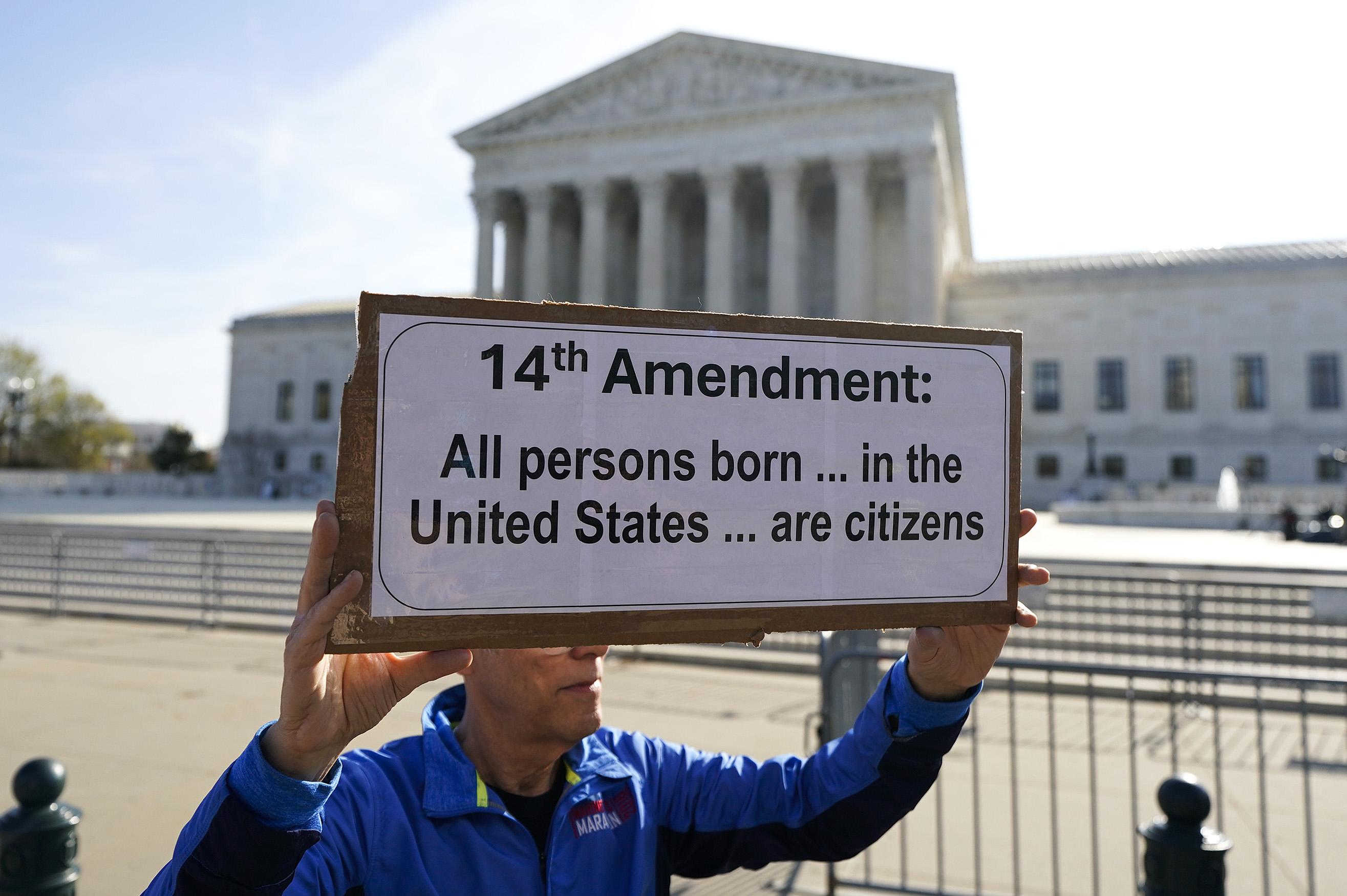
In Trump v. Barbara, decided June 30, the Supreme Court held that children born in the United States to parents who are unlawfully or temporarily present are “subject to the jurisdiction” of the United States and therefore citizens at birth under the Fourteenth Amendment.
The ruling defeated Trump’s January 2025 executive order seeking broadly to deny citizenship to children whose parents were undocumented or temporarily present.
However, the Supreme Court did not directly decide whether the Fourteenth Amendment’s phrase “in the United States” encompasses the unincorporated territories for purposes of the Citizenship Clause.
That unresolved territorial question is the opening the AAF report seeks to use.
V.I. Consortium has previously reported on the competing legal theories. In 2021, a divided Tenth Circuit panel held that the Constitution did not itself guarantee citizenship to people born in U.S. territories, while a dissent argued that the text, purpose and history of the Fourteenth Amendment supported the opposite conclusion.
Right to Democracy maintains that Barbara substantially strengthens the constitutional case for territorial citizenship even though the Court did not squarely decide the territorial issue.
“The idea that Congress has the power to turn citizenship on and off in U.S. territories as it sees fit is a dangerous one that contradicts the clear command of the U.S. Constitution and the Supreme Court’s recent decision in Barbara,” said Neil Weare, co-director of Right to Democracy.
“These ongoing threats to citizenship are just the latest example of how the colonial legal framework established by the Insular Cases can be used to justify the exercise of federal power over communities that have long been denied political rights and self-determination,” he said.
A Pence-Founded Group With Growing Washington Reach
The source of the report is also notable.
Advancing American Freedom was founded by former Vice President Mike Pence in 2021 and has positioned itself as an advocate for traditional Reagan-era conservatism at a time when much of the Republican movement has shifted toward Trump-aligned populism.
According to The Dispatch, AAF recently secured $15 million in donor pledges after initially setting out to raise $9 million and recruited 13 former Heritage Foundation staffers. Former Attorney General Edwin Meese also endorsed moving the legal center bearing his name from Heritage to AAF.
AAF has sought greater influence on Capitol Hill even while Pence’s relationship with the Trump administration remains strained. The organization describes its philosophy around free markets, traditional social values and a strong national defense.
Its territorial-citizenship recommendation nevertheless reaches a similar policy destination to an idea previously endorsed by Vance and advanced in Griffith’s legislation.
Right to Democracy Warns of Broader Consequences
Right to Democracy argues that focusing narrowly on the immigration status of parents obscures the larger constitutional question: whether Congress should be recognized as having unilateral authority over the citizenship of people born under U.S. sovereignty.
“People who think these attempts are just about limiting the rights of particular groups of immigrants should really look closer at what is going on. These proposals uphold the legitimacy of a colonial power grounded in racism that can be used any time to deny rights to all of us,” said Co-Director Adi Martínez Román.
“Until the Insular Cases doctrine is reckoned with and overturned, the territories will remain laboratories of ‘un-democracy’ to test how both the President and Congress can expand their unilateral powers over people’s bodies and lives.”
The organization also challenges the report’s treatment of the Northern Mariana Islands.
Zeno Deleon Guerrero Jr., Right to Democracy’s solidarity director, said the report overlooks the negotiated Covenant establishing the CNMI’s political union with the United States.
“It is very telling how the report ignores that in the NMI’s Covenant with the United States, citizenship cannot be changed unilaterally by Congress, but requires mutual consent. This raises questions about whether Congress will respect the democratic commitments made in that negotiated agreement.”
The Covenant supports that concern: Article III contains its citizenship provisions, while the agreement provides that Articles I, II and III are among the fundamental provisions that may be modified only with the consent of both the United States and the CNMI governments.
Right to Democracy also objected to the report’s description of U.S. territories as American “possessions.”
“It is also insulting that the report calls Puerto Rico, Guam, the Northern Mariana Islands, the U.S. Virgin Islands, and American Samoa ‘possessions’ of the United States. People are not possessions,” Mr. Weare said.
Latest in a Rapid Sequence of Citizenship Challenges
The new report follows VIC’s July coverage of H.R. 9724, which proposed ending the existing statutory guarantee for most territorial births beginning January 1, 2027. The bill contains a separate provision saying citizenship for children of U.S. citizens and lawful permanent residents would be protected, although Right to Democracy previously warned that the operative amendments were drafted more broadly.
VIC also reported earlier this month on Trump’s new citizenship orders. Unlike his original 2025 order, the August directive does not currently seek to erase the statutory citizenship guarantee applying to Virgin Islanders. Instead, one provision applies to territories where Congress has not enacted citizenship protection, while other provisions target alleged birth tourism and certain foreign-government connections.
The AAF report now supplies an explicit policy argument for Congress to take the additional step of rewriting the territorial statutes themselves.
Right to Democracy has responded by expanding its public campaign, including a frequently asked questions page, an online survey seeking territorial residents’ views on congressional power over citizenship and a petition urging Congress, the president and courts to reject the idea that citizenship can be denied merely because a person was born in a U.S. territory.
The organization also represents Michael Pese and Tupe Smith in Alaska cases involving their status as people born in American Samoa, where residents are generally classified under federal law as U.S. nationals rather than U.S. citizens at birth.

For the Virgin Islands, the immediate citizenship guarantee remains intact under federal law. But the latest report adds another prominent conservative institution to a growing debate over whether Congress possesses the power to alter that guarantee — a question the Supreme Court’s decision in Barbara did not directly resolve.