




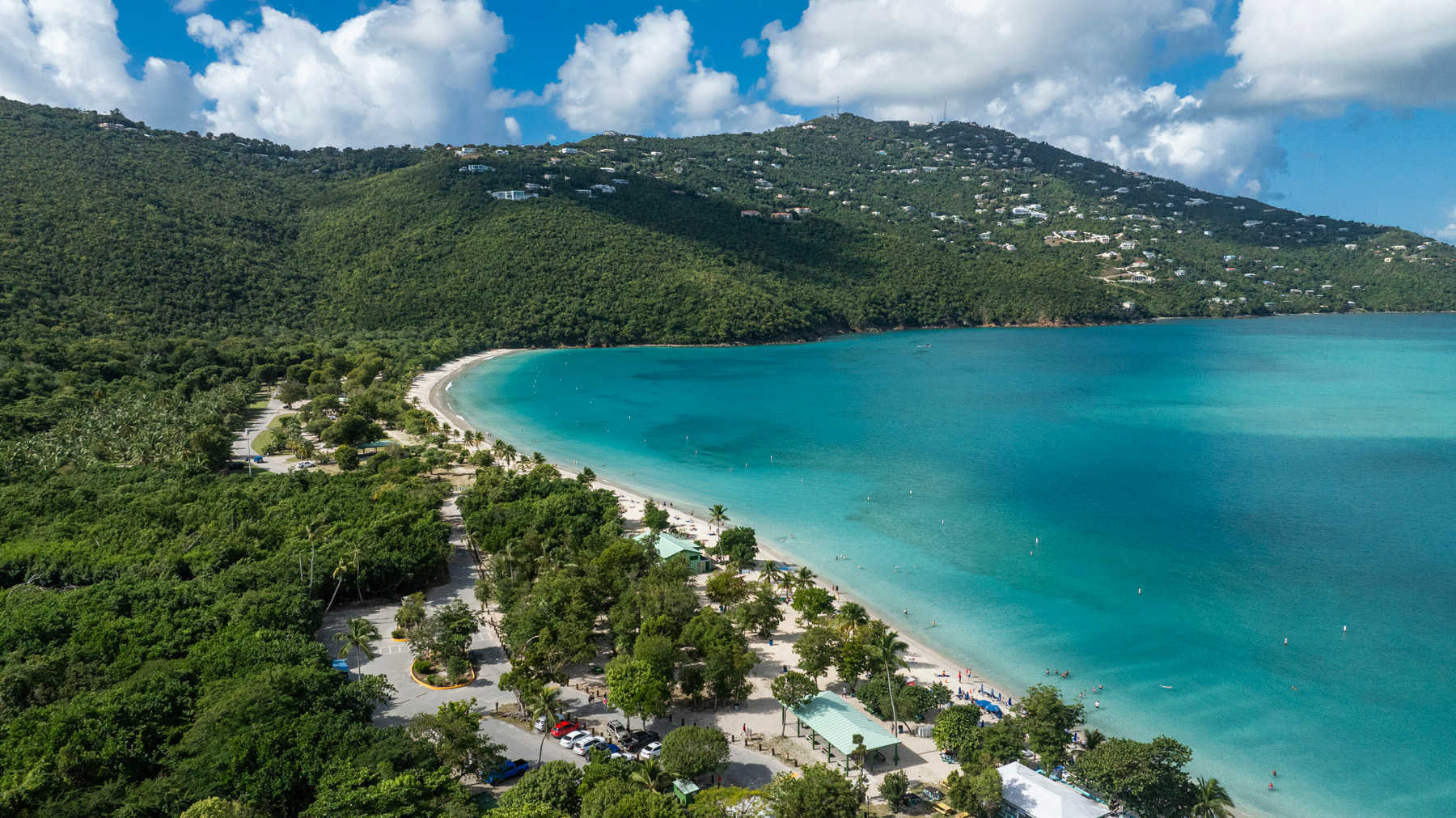
Lawmakers are urging the Magens Bay Authority to consider restricting vehicle access after hours, more closely monitoring anchored boats and potentially limiting long-term anchoring as persistent dumping raises concerns about protecting one of St. Thomas’ most heavily visited beaches.

The recommendations came during the Authority’s budget hearing Monday, when General Manager Monique Simon told the Committee on Budget, Appropriations and Finance that people continue entering Magens Bay around dawn and dusk to dispose of garbage despite sufficient trash receptacles being available.
According to Simon, some individuals “use Magens Bay as their waste station to throw away their trash.”
She confirmed that the dumping occurs inside the beach’s gate, which currently remains unlocked at night.

Lawmakers Suggest Restricting After-Hours Vehicle Access
Sen. Marvin Blyden questioned whether the Authority had considered locking the gate after hours “to prevent not only trash, but other damages to the most precious Magens Bay facilities.”
Simon was unable to provide an estimated cost associated specifically with cleaning up garbage left outside the available trash bins.
For now, she said the Authority is trying to be “a little bit more aggressive as far as having those trash removed.”
Those efforts include working with concessionaires to ensure refuse is not left around the beach.
Blyden encouraged stronger action if the problem continues.
“if it continues, we need to do something in terms of actually shutting it down after hours to prevent it from being not only trash, but being vandalized.”
Sen. Franklin Johnson agreed that the Authority should make greater use of its gate.
If after-hours dumping persists, Johnson said access could be restricted to pedestrians “so that cars don't go in and throw that trash out there and just mess the beach up.”
Anchored Boats Draw Scrutiny
Johnson also questioned whether vessels anchored in Magens Bay are properly securing their waste and avoiding disposal near the beach.
He noted that boats did not always routinely anchor in the bay and described the issue as his “biggest concern.”
Johnson encouraged the Authority to “work closer with DPNR because those boats that are coming here, if it's not being monitored, your beautiful beach is going to get destroyed.”
He suggested that some of the current waste problems could potentially involve boaters. No evidence was presented to substantiate that possibility.
Boaters currently pay the Magens Bay Authority for trash disposal, but Johnson said operators may not always be “honest.”
He recommended collecting disposal fees when vessels dock rather than waiting until boaters come ashore with refuse.
Johnson also suggested that the Authority acquire a small vessel to “monitor them and make sure you collect your fair share.”
Vialet Raises Possibility of Limiting Long-Term Anchoring
Sen. Kurt Vialet went further, questioning whether round-the-clock anchoring should be permitted at Magens Bay.
“Do we want to enter into that practice that is becoming a long-term anchoring spot, or should we just prohibit that in Magen's Bay because of the status and pristine nature?” he wondered.
Simon said she would “bring that up with my board.”
No decision on restricting anchoring or closing the gate after hours was announced during the hearing.
Smith Bay Park Operates at a Loss
Lawmakers also focused on Smith Bay Park, another property managed by the Magens Bay Authority.
Simon said Smith Bay Park “operates at a loss” and has a “different dynamic than Magens Bay,” with fewer visitors.
She believes adding concessionaires could help draw more people to the park.
Blyden supported bringing food vendors to the property, saying it is “critical that we get some local food out there.”
He noted that visitors currently have limited purchasing options.
“you can't even buy a water.”
Blyden also reminded Simon that adding vendors would create another source of revenue for the Authority.
Sen. Avery Lewis recommended installing WiFi at Smith Bay Park.
Sen. Carla Joseph suggested adding electricity to the park’s sheds, but Simon said there are currently no plans to electrify them because Smith Bay is marketed as a “tranquil, laid-back beach.”
Authority Reports $6.2 Million in Revenue
Year to date, the Magens Bay Authority has collected $6,206,665.98 in revenue.
Its estimated operating expenditures for FY 2027 total $4,321,592.41, with payroll and employee-related expenses accounting for 56 percent of that amount.
The Authority generates revenue through admissions, parking, facility rentals, concessions, recreational activities and special events.
An increase in cruise ship arrivals has also contributed to higher revenue.
Vialet raised the possibility of increasing the current $7 nonresident admission fee.
With the Authority recording approximately 100,000 visitors annually, Vialet said “you could easily get a million dollars by just increasing to $3.”

The discussion left the Authority with several potential policy questions for its board, including whether to restrict nighttime vehicle access at Magens Bay, increase oversight of anchored vessels, reconsider long-term anchoring and expand revenue-generating amenities at Smith Bay Park.