




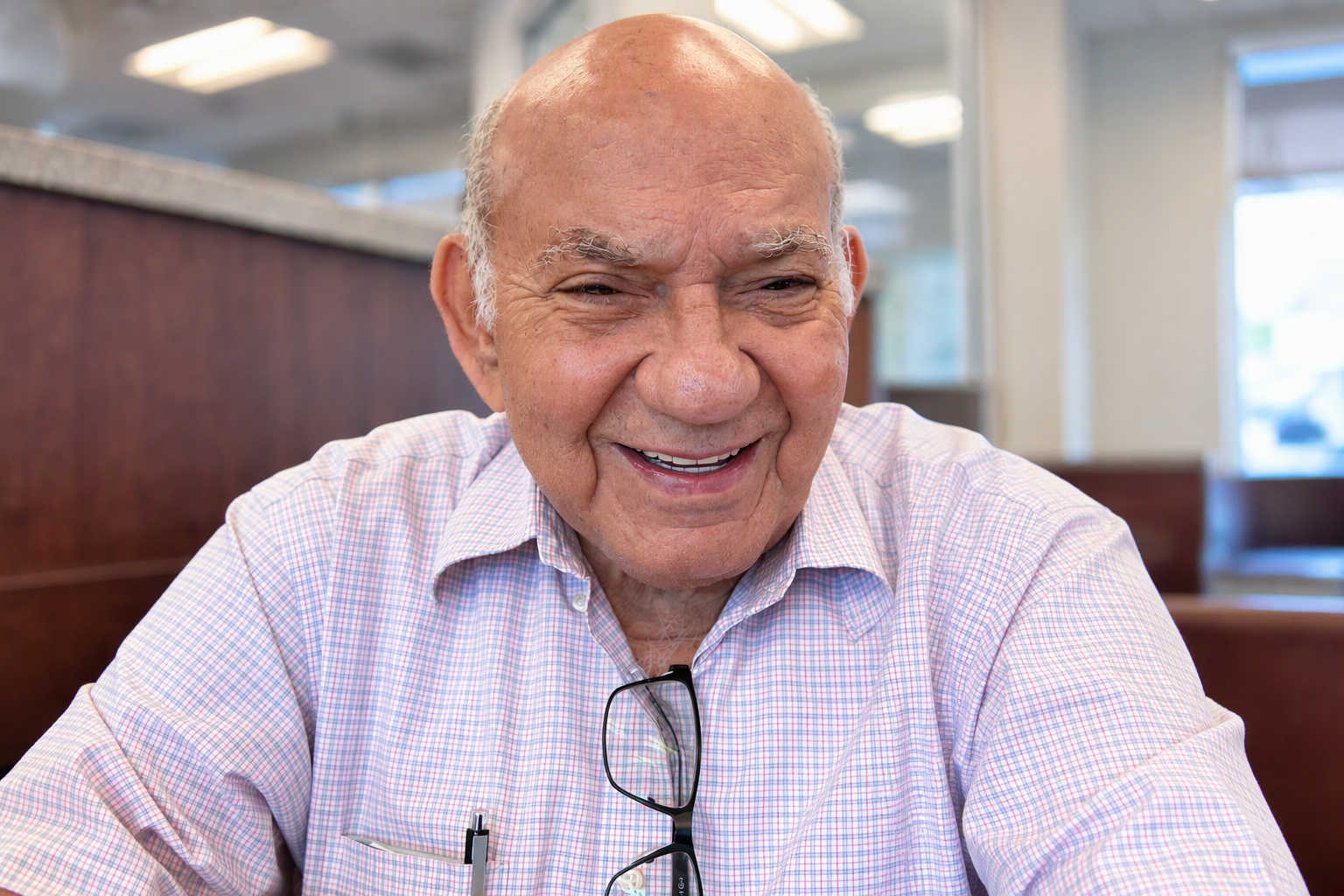
ST. CROIX — Long before Plaza Extra East became one of St. Croix’s most recognizable businesses, Fathi Yusuf walked from village to village carrying merchandise in a suitcase. When a customer could not afford what he was selling, his sons recalled, he would write down what was owed and return later for whatever the family could pay.

The young Palestinian immigrant went on to build businesses, develop properties and create employment for generations of Virgin Islanders. But his children say the circumstances of those early years remained with him, shaping how he treated people long after he had the means to live very differently.
Mr. Yusuf died on Thanksgiving Day, November 26, at 85.
In separate interviews with The Consortium on Friday, three of his sons — Mike Yusuf, the eldest, Nejeh Yusuf and Yusuf Yusuf — described a father whose relentless work ethic was matched by a conviction that success carried responsibilities: to family, to people struggling to get started, and to the island he made his home.

Mike said his father arrived on St. Croix at 19. He began his rounds on foot, eventually earning enough to buy a car. Nejeh remembered his father telling him about walking through sugar cane to reach customers in different communities.
Yusuf said his father had left school in the seventh grade. He arrived with little, and the hardship he knew helped explain his willingness to extend credit to people who could offer only a few cents at a time.
“He never forgot where he came from to the day that he died in his bed,” Yusuf said.
As the business grew, so did the ways Mr. Yusuf reached his customers. The suitcase gave way to a car, then a van, then stores. Mike recalled a clothing shop in Christiansted, followed by a location at Sunny Isle, where his father was a tenant when the shopping center first opened. Furniture businesses followed, expanding to three locations.
Eventually, Mike said, his father sold those businesses and set about building a shopping center of his own. He initially sought an anchor tenant to operate a supermarket, then decided to take on that business himself.
Historical records place the incorporation of his family’s United Corporation in 1979 and the opening of the Sion Farm supermarket, known as Plaza Extra East, in 1986.
For Mike, the construction years were also the beginning of his own working life. As a teenager, he was drawn to the equipment around the shopping-center project. He learned beside his father, became his right hand and developed the interest in heavy equipment and construction that he still carries.
The lesson, he said, was that earning something mattered, even when a family had reached a point where it could afford to give it.
“Don’t worry about falling on your face,” Mike recalled his father telling him. Knowing how to work, he explained, meant knowing how to recover and begin again.
Mr. Yusuf could be demanding about how time was spent. Mike remembered wanting to go to the movies with friends and being questioned about what he would gain from it. His father would ultimately let him go and give him money, but the question stayed with him.
He also remembered his father explaining why he continued working when he could have retired to the beach: he was building for his children, and they would have a responsibility to do the same for theirs.
Asked what that example could teach others trying to succeed, Mike answered, “It takes dedication and hard work.”
He cautioned against measuring progress by someone else’s possessions or pace. His family had admired businesses ahead of theirs, he said, while continuing to work toward goals of their own.
That drive extended beyond retail. Both Mike and Yusuf described their father’s interest in producing things on St. Croix, including ice and bottled water, and in finding ways to meet needs that became especially clear when hurricanes interrupted supplies.
Yusuf said his father understood the island’s limited resources and the cost of bringing in goods. Manufacturing locally offered a way to build a business while making essential products more accessible to residents.
The Consortium’s 2018 reporting documented that effort when representatives of Yusuf Drinking Water appeared before the Economic Development Commission. Mike explained then that the hurricanes had exposed a particular vulnerability: local producers could have water available but lack the bottles needed to distribute it because shipping had stopped.
The company proposed manufacturing bottles on St. Croix, and its finance director reported that $2.5 million had already been invested in water-treatment equipment. The project reflected the kind of local production his sons said their father consistently encouraged.
His help to individuals was often less visible.
Nejeh said his father assisted families moving to the Virgin Islands and helped others develop businesses. He believed giving was a matter between himself and Allah, rather than something that required a public announcement.
“He would never stand there with a check,” Nejeh said, describing his father’s reluctance to put himself on display for a donation.
Yusuf recalled people turning to his father for help buying a car, stocking a store or getting an idea off the ground. His father would lend money without seeking interest, he said, and could be patient when someone needed time to repay it.
People also sought his advice on marriage, children and difficult personal decisions. Yusuf described a man who would listen and help, but who could be direct when he believed someone was making a mistake. His faith informed both his generosity and his expectations of others.
According to Yusuf, his father prayed five times a day, helped build a mosque on St. Croix and supported wells in African communities that needed water. He also said his father purchased and donated land for a mosque project on St. Thomas.
Those efforts, his son said, were undertaken without a demand that his name be placed on what he helped create.
The family’s support for St. Croix has also appeared in public acts. In June 2022, Plaza Extra East donated two solar panels to the V.I. Police Department to replace panels vandalized near the Frederiksted Pier. Yusuf, speaking for himself and his brothers at the time, said they wanted to support the department’s efforts. Watch.
At the center of the life his sons described was a large family. Mr. Yusuf had five sons and five daughters; nine of his ten children were born in the Virgin Islands, Nejeh said. Mike spoke of the importance his father placed on keeping the family close and making sure its members were cared for.
Even as his children took on responsibilities of their own, their father remained available to them. Yusuf remembered him coming to work and making clear that he was there to answer questions and offer advice.
Nejeh said his father continued working until a medical visit to examine his leg led to the discovery of stage four cancer.
“He worked all the way up until that time,” he said.
Yusuf recalled that even near the end of his life, his father asked the people caring for him what they needed and what he could do to help them. He thanked them for being there.
His death on Thanksgiving carried particular meaning for his son, who associated his father so closely with giving.
Governor Albert Bryan Jr., in a statement Friday, remembered Mr. Yusuf as an entrepreneur, a devoted family man and a Virgin Islander committed to the territory’s development.
“I had the privilege of knowing Fathi personally, and I will always remember his constant passion for building these islands, especially St. Croix. He cared deeply about the future of our community, and I respected the determination he brought to helping it grow. His passing is a personal loss, and I join his family and all who knew him in mourning,” Mr. Bryan said.
The Virgin Islands Palestinian Friendship Association also mourned him, describing him in a tribute as “a respected businessman and dedicated supporter of the St. Croix community.”
“May God have mercy on him and grant his family and loved ones patience and comfort during this difficult time,” the association said.
Nejeh said his father was buried at 4:30 p.m. Thursday. More than 200 people attended a gathering that evening to pay their respects and support the family.
On Friday, as Yusuf spoke to The Consortium about his father, he had returned to the gravesite. He wanted his father to hear what he had to share about him.
“I’m at his grave right now,” he said.
Throughout the interview, he had described the person so many people turned to for help and the father he had always looked to for guidance.

“I love him so much."