




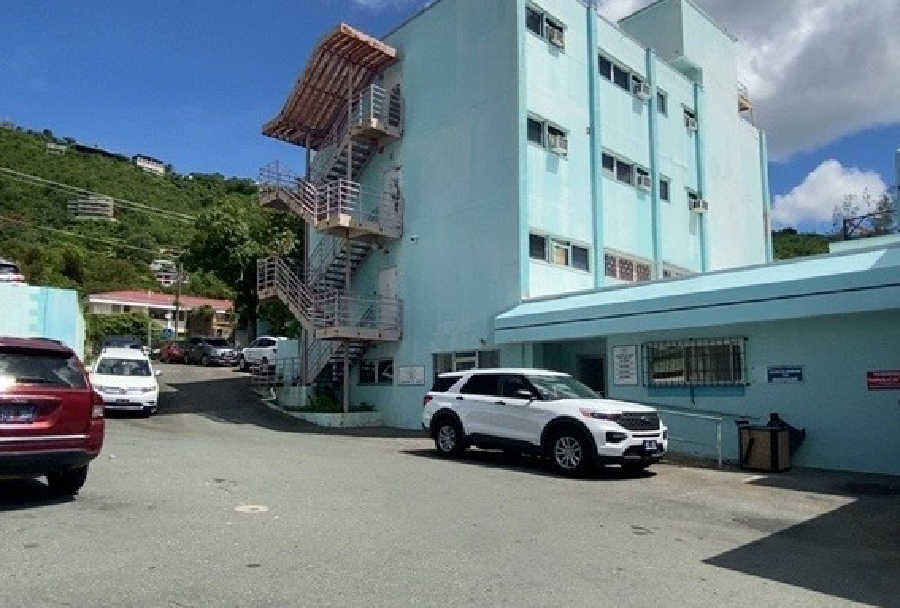
The V.I. Department of Human Services is in the early stages of rehabilitating and rebuilding three critical buildings under its stewardship, two of which provide vital services to the territory’s elders.

During Tuesday’s meeting of the Committee on Health, Hospitals, and Human Services, DHS Commissioner Averil George told lawmakers that her department is “executing a dual-track strategy” for the Queen Louise and Herbert Grigg Homes for the Aged. The strategy involves “stabilizing current operations” while “advancing long-term redevelopment designed to restore CMS-certified nursing facility capacity.” The federal certification is established by the Centers for Medicare and Medicaid Services (CMS).
Residents at the Queen Louise Home for the Aged in St. Thomas were recently relocated to temporary accommodations at Palms Court Harborview. The move for the 13 residents was “to allow for necessary structural and environmental repairs to the existing facility,” Ms. George said.
The residents are expected to remain temporarily housed at Palms Court for approximately 9 months. That stay comes at a cost of approximately $578,340 for the full period.

During the 9-month repair timeframe at Queen Louise, DHS must address the HVAC systems, electrical distribution infrastructure, fire alarm and suppression systems, and plumbing lines. There is also a need to reconfigure rooms and improve ADA accessibility, and enhance infection control layouts. These repairs are expected to be completed by January 2027.
In the long term, a new Home will be constructed on a parcel of land acquired near the Roy L. Schneider Hospital, with a bed capacity of 54. The Office of Disaster Recovery and the Super Project Management Office are involved. The anticipated project cost is $73 million, with funding from FEMA Public Assistance covering 95% of the cost.
On St. Croix, DHS is “actively advancing plans to construct a modern, CMS-certified long-term care facility on the south side” of the existing Herbert Grigg property. Ms. George informed the committee that an assessment revealed that “full redevelopment, rather than a piecemeal renovation, is the most viable.” Groundbreaking is scheduled for February 2027 with projected completion in May 2030.
Like the Queen Louise Home, DHS plans to design the new site in a manner that allows the territory to pursue CMS certification in the future. According to Assistant Commissioner Taetia Phillips-Dorsett, “we don't have what we need in the current facility…to pass CMS certification.” As the facilities are not currently CMS certified, DHS cannot bill for Medicaid/Medicare.
It’s why DHS intends to work with the Department of Health and follow CMS “guidelines and regulations.” Baseline CMS requirements are “embedded in the design of the facilities,” Disaster Recovery Specialist Akilah O’Brien shared.
CMS certification is not only determined by infrastructure, but also by appropriate levels of qualified staffing. Securing trained nursing staff, however, continues to be one of DHS’s biggest challenges.
Senator Kurt Vialet was pleased, however, that the department was taking the important first steps. “They're on the right path by making sure that during that design and engineering, that the CMS specifications are met,” he said. He also promised to hold DHS accountable. “Now, if it is not met, we going to roll back the tape to what you guys said today,” he warned.
Lawmakers also received an update on the planned demolition and rebuild of the Knud Hansen Complex, DHS’s historical home. Architectural and engineering plans for a FEMA-funded four-story, purpose-built complex are currently being developed. The new complex will house DHS administrative and client service spaces and the DOH-operated Community Health Clinic. The projected completion date is April 2030.
The rebuilt complex will “centralize critical DHS programs currently spread across multiple temporary sites,” Commissioner George explained.
As the design phase progresses, DHS is preparing to move staff into temporary leased locations “to maintain seamless service delivery.” Staff will soon move into Tutu Park and Havensight. The price tag for the temporary relocations comes in at over $1.48 million. This is 95% funded by FEMA, Ms. O’Brien noted.
Because the temporary spaces are smaller, Ms. O’Brien anticipates “some adjustment for the staff” during the reconstruction process. Deputy Commissioner of Operations Sean Georges confirmed that despite the smaller footprint, staff “will be able to accommodate our walk-up services” at the Tutu Park location.

DHS is currently immersed in an “active redevelopment effort” and is now “no longer managing the limitations” of a facility constructed in 1953. Instead, they are “moving to replace it,” Commissioner George declared.