




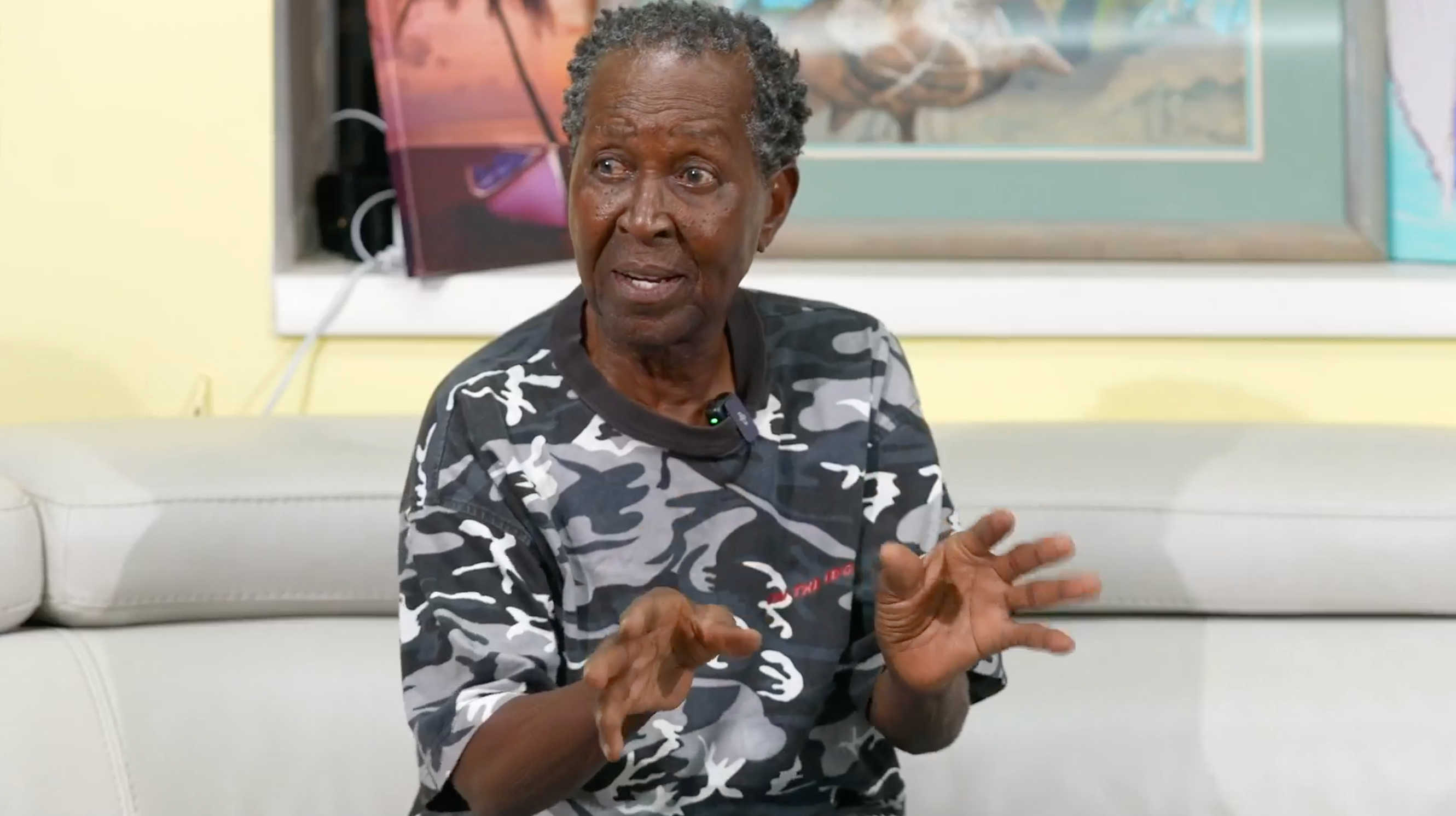
King Derby, whose legal name is Camile Macedon, and Calypso Inc. program director Ronald Phillips on Wednesday night defended the organization’s $272,170 ARPA award, saying the money was not paid in one lump sum, was not tied to political campaign songs, and did not involve double-dipping from the government’s Miscellaneous budget section during the same period.

The explanation came during a special V.I. Consortium interview requested by Mr. Macedon after controversy followed remarks by Senator Kurt Vialet during an Office of Management and Budget hearing. During that hearing, Mr. Vialet questioned why certain non-governmental entities appeared in the Miscellaneous section of the budget while also receiving federal funds administered through the Government of the Virgin Islands. He specifically sought justification for a Calypso Inc. allocation tied to a music and literacy summer program.
The controversy intensified after Wanda Vialet, Mr. Vialet’s wife, alleged in a social media post that “in 2022 a Calypsonian received $272,170 for the song written for the gubernatorial elections back then; crafted as a ‘summer camp!’” The post also alleged that public money was being misused.
Mr. Phillips said the public discussion created the impression that Calypso Inc. received the money at once, when the funds were actually released over a three-year period between May 1, 2022 and June 30, 2025.

“No, we did not,” he said when asked whether Calypso Inc. received the money as a single payment.
According to Mr. Phillips, the first award was approximately $68,000. He said Calypso Inc. later submitted a larger request of about $227,000 after asking Governor Albert Bryan Jr. for help purchasing vehicles to transport students. Mr. Phillips said the organization had aging vans and needed transportation support because Mr. Macedon often picked up children for practices and performances.
However, Mr. Phillips said OMB later informed the organization that ARPA funds could not be used to purchase the vans. Once that portion of the request was removed, he said, the funding request was reduced to $102,000. Calypso Inc. then received two program-year awards of $102,000, bringing the total ARPA award to $272,170 over the grant period.
The funds, Mr. Phillips said, supported two main program areas: summer camps and after-school programming built around literacy, music, calypso, performance and cultural education. He said the summer camps ran for about six weeks and were held at Reading Rainbow and at another learning facility. The after-school programming ran over a longer period.
Students were trained in calypso singing, public performance and instruments such as banjo and ukulele. Mr. Phillips said the program served underserved children and required public performances to demonstrate outcomes to the federal government.
“When these performances are done, you cannot charge the public,” he said, explaining that shows funded through the program had to be free to attend.
He said performances were held at venues including The Palms and Blue Bambou. For one variety show, Calypso Inc. retained Daddy Jones Production to provide music, adult calypsonians and rehearsal support for the young performers.
Mr. Phillips also provided a sample budget on air, showing a 2024-2025 program budget totaling $102,000. The breakdown included $20,000 for the coordinator, $8,000 for an assistant coordinator, $15,000 for instructors, $5,000 for assistant instructors, $1,500 for insurance, transportation-related expenses and other program costs, including camp and instruments.
Mr. Macedon served as coordinator, and Mr. Phillips as assistant coordinator.
Mr. Phillips said the number of students in the program was limited by staffing ratios, explaining that the summer camp generally served around 30 students, though Mr. Macedon said it had reached as many as 45. Mr. Phillips said the program required roughly one instructor for every five students.
Addressing questions about oversight, Mr. Phillips said Calypso Inc. submitted monthly reports to OMB, including both narrative updates and financial documentation. He said the organization had to itemize expenditures and provide receipts, proof of payment, canceled checks and contracts.
He also said that once the organization crossed the $100,000 threshold, its requests had to be reviewed by Ernst & Young, the consultant used by OMB. Mr. Phillips said he and Mr. Macedon met with the consultant for about three hours to understand the requirements.
“We are in excellent standing,” Mr. Phillips said.
That assertion was central to Calypso Inc.’s response to the broader OMB discussion, where Director Julio Rhymer said the government is tightening oversight of nonprofits and warned that organizations not in compliance would not receive future funding.
Mr. Phillips also denied that Calypso Inc. received Miscellaneous funds while drawing the ARPA award. He said the organization did not request or receive Miscellaneous funds from 2022 to 2025, and that OMB records would have flagged any improper overlap.
“From 2022 to 2025, we never requested any funds from the Miscellaneous Fund for Calypso Inc.,” he said.
He said the only current Miscellaneous allocation for Calypso Inc. is a $5,000 appropriation for fiscal year 2026-2027, which he attributed to Senator Hubert Frederick.
Mr. Macedon said Calypso Inc. has served children for decades and should not be reduced to a political dispute. He said the organization began in the late 1970s and was incorporated in 1982, with thousands of children passing through its programs.
“It’s a service that we’re doing to for our children,” he said.
Mr. Macedon said the organization has helped generations of young people, some of whom later pursued music, performance and other careers. He said participants often stop him in public to tell him the program made a difference in their lives.
Mr. Phillips pointed to singer as one example of a former participant who went on to pursue music, saying Calypso Inc. provided part of the foundation for her development.
The interview did not eliminate the broader question of how nonprofits are selected for major federal or local awards, an issue that Mr. Vialet raised during the budget hearing and that OMB has now placed under greater scrutiny. But Calypso Inc.’s response provided the organization’s clearest public defense: the $272,170 was released over several years, tied to youth programming, documented through monthly reporting, and not paired with Miscellaneous funding during the same period.

Mr. Macedon said the organization remains focused on children, not political arguments.