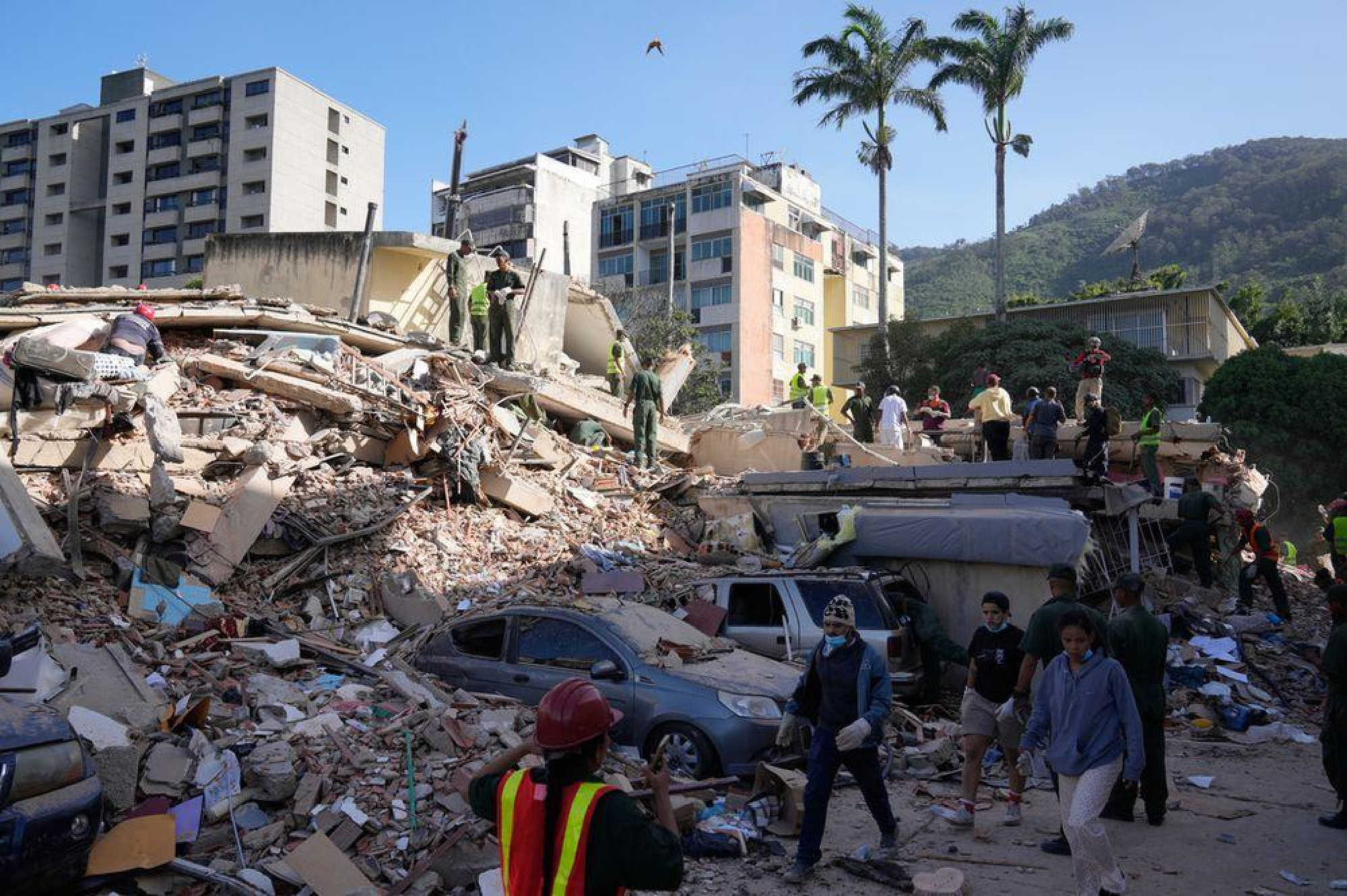
Venezuela’s death toll from the June 24 twin earthquakes has climbed to 3,342, with 16,470 people injured and 17,345 left homeless, according to official figures reported by Reuters, while international rescue teams, local volunteers and aid organizations continue working through collapsed buildings even as the mission increasingly shifts from rescue to recovery.

The devastation has been concentrated heavily in the coastal state of La Guaira, north of Caracas, where scores of buildings collapsed and thousands of families have been displaced. The Guardian reported that international teams were beginning to wrap up operations 11 days after the double shocks, while many families were still trying to recover the bodies of relatives from the rubble.
Even with the survival window narrowing, a series of late rescues has given the disaster response moments of hope. The most prominent came in Catia La Mar, where rescuers pulled 43-year-old security guard Hernán Alberto Gil Flores alive from the basement of the collapsed Galerías Playa Grande shopping center eight days after the earthquakes struck. According to the Associated Press, he had been trapped since June 24, and a small security cabin shielded him from crushing debris while creating a pocket of air.
Rescuers first made contact with Mr. Gil Flores days before his extraction, then worked more than 100 hours through unstable debris, heavy rain and aftershocks to reach him. AP reported that the effort involved teams from Venezuela, Chile, Costa Rica, the United States, Portugal and Mexico, with rescuers supplying him with food and water while the operation continued.

Other late rescues have also been reported. The Guardian reported that 21-year-old Aaron Levi Cantillo Vargas was pulled from rubble in Caraballeda after being trapped for 106 hours. AP also reported that a toddler had been rescued after six days under a collapsed building, while noting that official rescues had fallen sharply from the first two days after the quakes to only a handful several days later.
The survival stories are unfolding against a broader disaster response strained by the scale of the destruction. Reuters reported that the government said nearly 30,000 officials had been deployed alongside 3,281 international rescue workers, while an unofficial but widely used missing-persons tally stood at just over 41,000 over the weekend. More than 16,000 people were homeless at that stage, with some in official shelters and others in tent encampments.
Foreign rescue and aid support has come from across the region and beyond. The Guardian reported that teams from 30 countries, along with 3,681 rescuers, 1,086 tons of supplies, 27 vehicles and 118 canines, had been brought into the response, according to remarks attributed to interim President Delcy Rodríguez.
The United States has pledged more than $300 million in assistance, with the Guardian reporting that the aid is being directed through partner organizations including Samaritan’s Purse, Catholic Relief Services, the International Organization for Migration, the World Food Programme and the Red Cross. Washington also deployed four urban search-and-rescue teams made up of more than 300 first responders and nearly two dozen search dogs, and U.S. Marines were working to repair the port of La Guaira to help supplies move by sea.
The Netherlands sent the patrol vessel HNLMS Groningen from the Caribbean with relief supplies and water-production capacity, while China announced 100 million yuan in disaster relief aid. Mexico’s well-known Topos Azteca rescue brigade also deployed volunteers to Venezuela, joining the international search and recovery effort in La Guaira.
Humanitarian needs are expected to extend far beyond the immediate search effort. The World Food Programme says it is appealing for $50 million for the first phase of its earthquake response, aiming to reach up to 500,000 people in shelters during the first three months, with capacity to scale up to 1 million if funding is secured. WFP said it has begun emergency food distributions, installed the first of three temporary feeding centers in La Guaira, and pre-positioned 30 metric tons of food along with 10 metric tons of non-food items.
Medical needs also remain significant. Reuters reported that a field hospital in La Guaira run by Samaritan’s Purse, under U.S. State Department coordination with relief groups, had treated about 400 patients and was expected to perform nearly 30 surgeries by Saturday evening. The group’s 100-person team planned to gradually hand over operations to local doctors while leaving equipment and supplies in place.
The response has also been marked by public anger over the pace and organization of government relief. Reuters reported that civilians, survivors, volunteer paramedics and foreign teams have been digging through the rubble, while some residents and aid workers said food, medicine and heavy equipment arrived late. Ms. Rodríguez has defended the government’s response, saying security forces were deployed immediately and announcing the creation of a new military unit focused on emergencies and disasters.

For families still waiting near collapsed buildings, the work has become a search for both survivors and the dead. The official toll is already among the region’s most severe earthquake disasters in recent years, and the number may continue to rise as crews reach deeper into unstable structures and more of the missing are accounted for.