


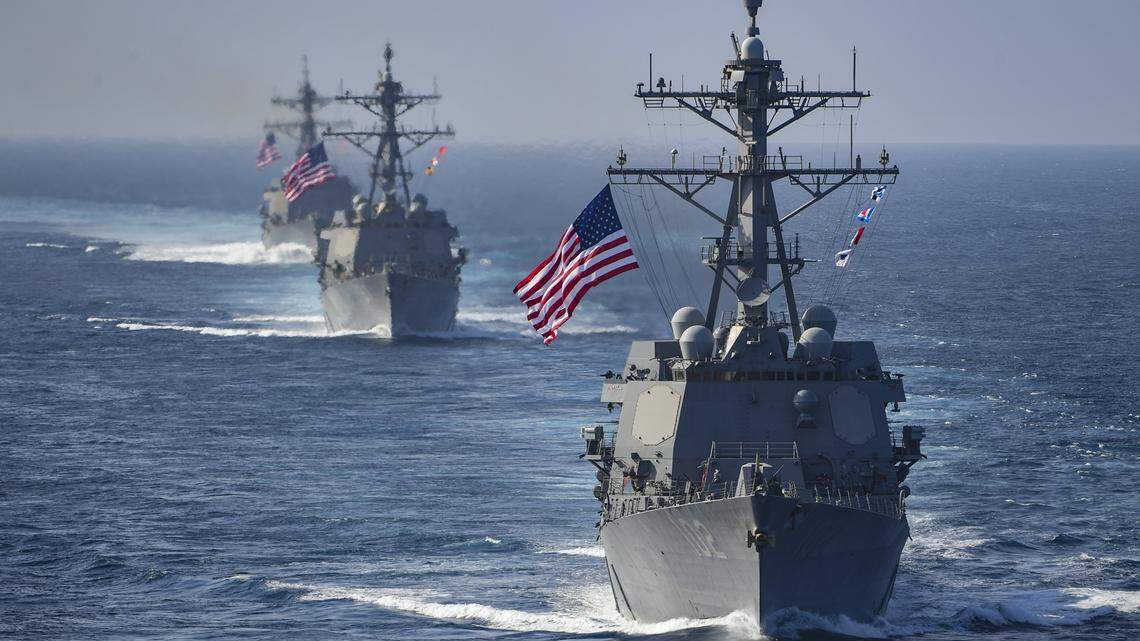
The government of Trinidad & Tobago has welcomed the deployment of United States warships in the southern Caribbean Sea.

Last week, the region learned that three Navy destroyers; the USS Sampson, the USS Jason Duhnam, and the USS Gravely, would be stationed off the coast of Venezuela. Additionally, an amphibious assault squadron of three warships – the USS San Antonio, the USS Iwo Jima, and the USS Fort Lauderdale – are also reportedly moving into place, carrying a complement of over 2,000 Marines among the 4,500 service members on board.
The stated mission of the military deployment is to crack down on international drug cartels, including Venezuela's Tren de Aragua, designated earlier this year as a global terrorist organization. The country's president, Nicolas Maduro, has been accused of leading the Cartel de los Solos, and described as “one of the world's largest drug traffickers” by Washington, despite little evidence.
The military escalation follows the U.S. decision to double its bounty for President Maduro’s arrest from $25 million to $50 million. Substantial evidence, including U.S. indictments and recent guilty pleas by former Venezuelan officials, links elements of the country’s military and political elite—often described as the “Cartel of the Suns”—to cocaine trafficking networks. At the same time, experts caution that branding Venezuela a full-fledged “narco-trafficking state” can be misleading, since the United Nations’ most recent World Drug Report identifies Colombia as the world’s dominant cocaine producer and does not list Venezuela among the top global hubs.
The independent nations of the Caribbean have mostly responded with alarm to the development, with two exceptions. The 10 member states of the Bolivarian Alliance for the Americas's Peoples’ Trade Agreement (ALBA-TCP) include Antigua & Barbuda, Cuba, Dominica, Grenada, Saint Kitts and Nevis, Saint Lucia, and Saint Vincent and the Grenadines. They issued a joint statement condemning the developments against their fellow ALBA-TCP member, saying that the deployment was a “threat to the peace and stability of the region…disguised as counter-drug operations.” The statement calls the move a “flagrant violation of international law.”
Reactions to the U.S. military deployment near Venezuela have been sharply divided. Trinidad and Tobago even endorsed the move and offered to assist if asked. Elements within Colombia—though led by a president warning of a ‘Syria-like’ escalation—also allowed for cooperation in anti-narcotics efforts while emphasizing national sovereignty. On the other hand, ALBA-TCP nations, along with China, Mexico, Cuba, Brazil, and Bolivia, condemned the deployment as destabilizing and imperialist, invoking principles of non-intervention and regional peace.
In a two-page statement issued on Sunday, the government of Trinidad & Tobago says it is in “full support” of the U.S. mission to "destroy the terrorist drug cartels.” The statement points to “massive spikes in transnational crime, gang activity, murders, violence and financial crimes” caused by the increase in drug, human, and firearms trafficking activity in the region. Because small island states “simply do not have the financial and military resources to take on the drug cartels,” the U.S. intervention is welcomed.
About CARICOM's commitment to maintaining the region as a “zone of peace" free of military activity, Trinidad & Tobago's statement makes clear that the country disagrees. The government “has not engaged and has no intention of engaging CARICOM on this matter.” Contrary to the regional grouping's tradition of speaking with a unified voice when it comes to foreign policy, the T&T statement declares that “each member state can speak for themselves on this issue.”
Guyana, which is currently embroiled in a bitter territorial dispute with Venezuela, stopped short of welcoming the U.S. naval deployment. However, in a carefully worded diplomatic statement reposted by Secretary of State Marco Rubio, the Guyana government noted the “threat to peace and security in the region posed by transnational organised crime and narco-terrorism.” The statement also acknowledged the Cartel de los Soles as having been “designated as a terrorist organization by some countries in the region.” Guyanese president Mohamed Irfaan Ali is supportive of a “collaborative and integrated approach to tackle transnational organized crime,” the statement said. Guyana is "committed to working with our bilateral partners to find meaningful solutions” to “dismantling criminal networks to safeguard our shared security.”