



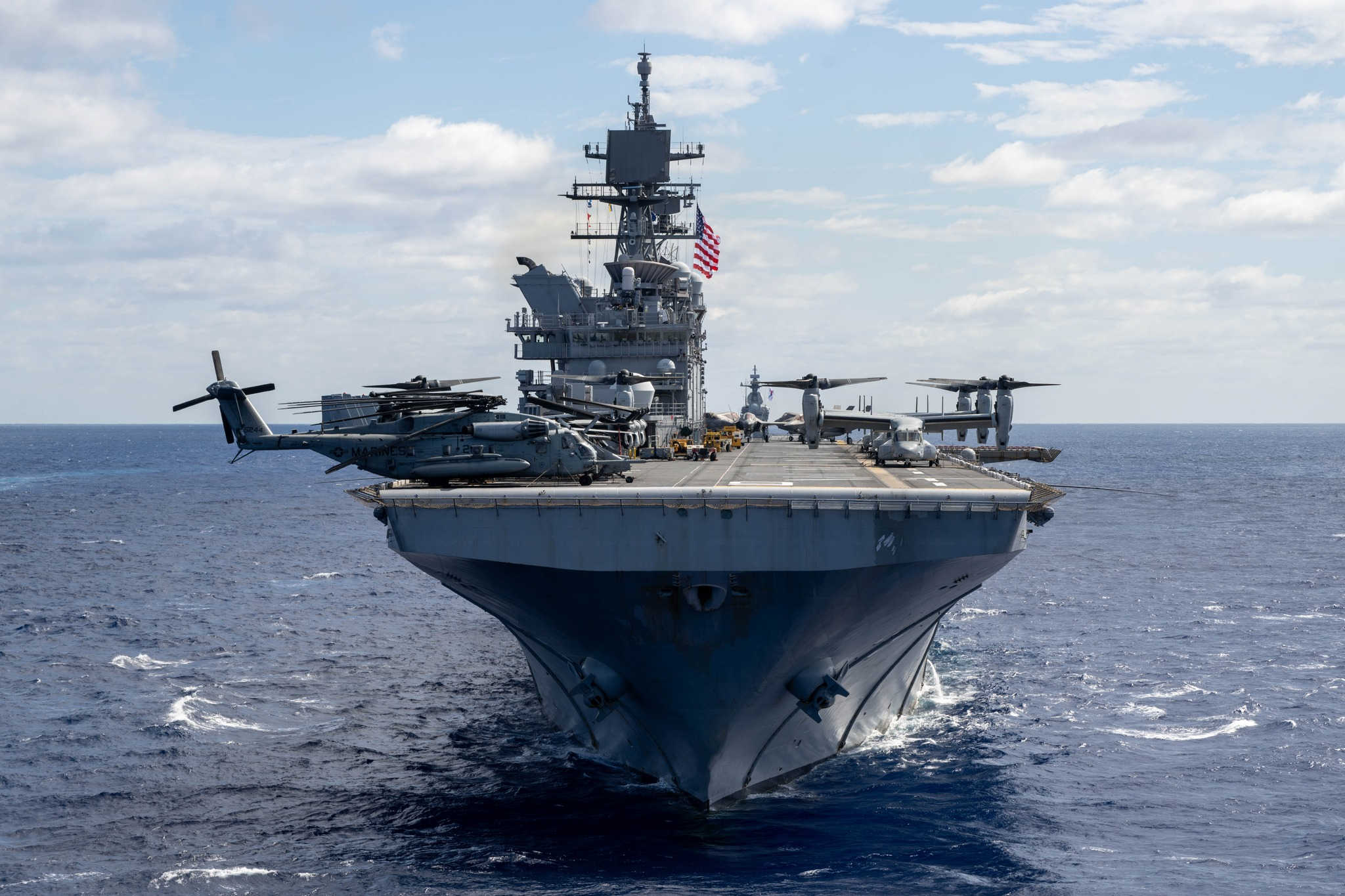
Recent pronouncements by President Donald Trump have signaled the possibility of escalating military operations in the southern Caribbean.
On the same day that high-ranking officers of the United States Navy visited Grenada for talks about establishing a radar station on the island, the president confirmed that he had authorized the Central Intelligence Agency to conduct covert operations inside Venezuela. According to President Trump, he did so for two reasons. “Number one, they have emptied their prisons into the United States of America,” he said during an Oval Office event on Wednesday. “The other thing…we have a lot of drugs coming in from Venezuela, and a lot of the Venezuelan drugs come in through the sea.”
President Trump said the administration was “looking at land” as the next phase of its anti-narcotics campaign in the southern Caribbean.
“We are certainly looking at land now because we’ve got the sea very well under control,” he said. “We’ve had a couple of days where there isn’t a boat to be found, and I view that as a good thing, not a bad thing. We had tremendous amounts coming in by boats — very expensive boats. The way you look at it is every boat that we knock out, we save 25,000 American lives. So every time you see a boat and you feel badly, you say, ‘Wow, that’s rough.’ It is rough, but if you lose three people and save 25,000 — these are people that are killing our population. And you can see it. The boats get hit and you can see the fentanyl all over the ocean, floating in bags, it’s all over the place,” the president said Wednesday.

While he did not say whether or not the CIA had been given approval to take direct action against Venezuelan President Nicolas Maduro, the South American leader did not take kindly to the notion of the covert agency operating within Venezuela's borders. “How long will the CIA continue to carry on with its coups? Latin America doesn't want them, doesn't need them and repudiates them,” Mr. Maduro said.
Venezuela's Foreign Ministry later issued a statement calling President Trump's comments a “very serious violation of international law and the United Nations’ Charter.” The statement called on the international community to “denounce these clearly immoderate and inconceivable statements.”
Trump administration officials have publicly called Maduro a “narco-terrorist” or associated him with terrorism rhetoric. Secretary of State Marco Rubio referred to Maduro as the leader of a “narco-terrorist organization” in public remarks.
Meanwhile, U.S. Navy Admiral Alvin Hosley, Commander of U.S. Southern Command (SOUTHCOM), recently wrapped up a two-country visit to Antigua & Barbuda and Grenada. Even before his arrival, Antiguan Prime Minister Gaston Browne ruled out the possibility of the country hosting any assets of the United States Military on its soil.
In Grenada, however, Admiral Hosley met with senior law enforcement officials at police headquarters in St. George's on Wednesday, to officially request permission for a temporary radar station to be installed at the Maurice Bishop International Airport. As of press time, there has been no official response from the Grenadian government.
The U.S. efforts at regional outreach come after months of diplomatic pressure on countries in the region over their cooperation with Cuba on medical missions in the Caribbean. In August, it was announced by the U.S. State Department that it had canceled the visas belonging to officials of several countries, including Grenada. Local media sources later revealed that it was Grenadian Finance Minister Dennis Cornwall and his estranged wife who had been targeted by the visa revocations.
The Grenadian government is also facing economic pressure from the United States. Grenada is one of 12 countries currently facing a ban on exporting fish to the U.S. beginning January 1, 2026 for failing to comply with the requirements of the U.S. Marine Mammals Protection Act of 1972. Analysis in local press outlets suggest that such a ban, if it comes into effect, would likely deal a crippling blow to the island's fishing industry.
The political and economic pressures facing the country makes Grenada's response to the current overtures from SOUTHCOM, coming so close to the anniversary of the 1983 invasion of Grenada by the United States, even more sensitive to negotiate.
As CARICOM nations grapple with the ramifications of increased U.S. military action in the region, the reality of the ongoing campaign of missile strikes against boats U.S. officials say are involved in narco-terrorism has hit home. Two Trinidad & Tobago nationals were among those killed in the most recent strike. Chad “Sharpo” Joseph and another man identified as “Samaroo” were among six men killed when the United States bombed a small boat off the coast of Venezuela. Relatives of the deceased men have now challenged the characterization of their loved ones as drug smugglers, and are reportedly demanding U.S. authorities supply evidence of their claim.
The government of Trinidad & Tobago has, as of press time, not commented on the summary execution of two of their citizens at sea. Prime Minister Kamla Persad-Bissessar had previously welcomed escalated action against suspected narco-traffickers operating in the region, encouraging the United States to “kill them all violently” in September. It is unclear whether that sentiment remains, now that Trinidadian citizens are among the casualties.
The recent deployment of roughly 4,500 U.S. troops across the Caribbean, including units assigned to Puerto Rico and the U.S. Virgin Islands, marks one of the most significant American military buildups in the region in decades. On St. Croix, soldiers have been stationed at the south shore refinery and terminal facility’s “Man Camp,” transforming the site into a logistical hub for operations in the southern Caribbean. Governor Albert Bryan Jr. has endorsed the deployment, describing it as both a security measure and an economic opportunity. “If we could stop this flow of drugs to our shores, why wouldn’t we be for that?” he said in September, noting that the troops’ presence provides a welcome boost to local commerce. “They gotta eat, drink and make merriment in our community. We are happy to have them.”