



Senate Republicans on Wednesday blocked a Democratic attempt to curtail President Donald Trump’s authority to carry out lethal military strikes on suspected drug-trafficking vessels in the Caribbean Sea, preserving the administration’s aggressive counter-narcotics campaign amid mounting international criticism.

The procedural vote, held under the War Powers Resolution of 1973, failed 51–48 along mostly partisan lines. The measure, co-sponsored by Sens. Tim Kaine (D-Va.) and Adam Schiff (D-Calif.), sought to prohibit the president from ordering further hostilities against non-state actors engaged in drug smuggling without explicit authorization from Congress. The resolution’s defeat allows the White House to continue operations with limited congressional oversight and marks the latest flashpoint in a broader struggle over presidential war powers.
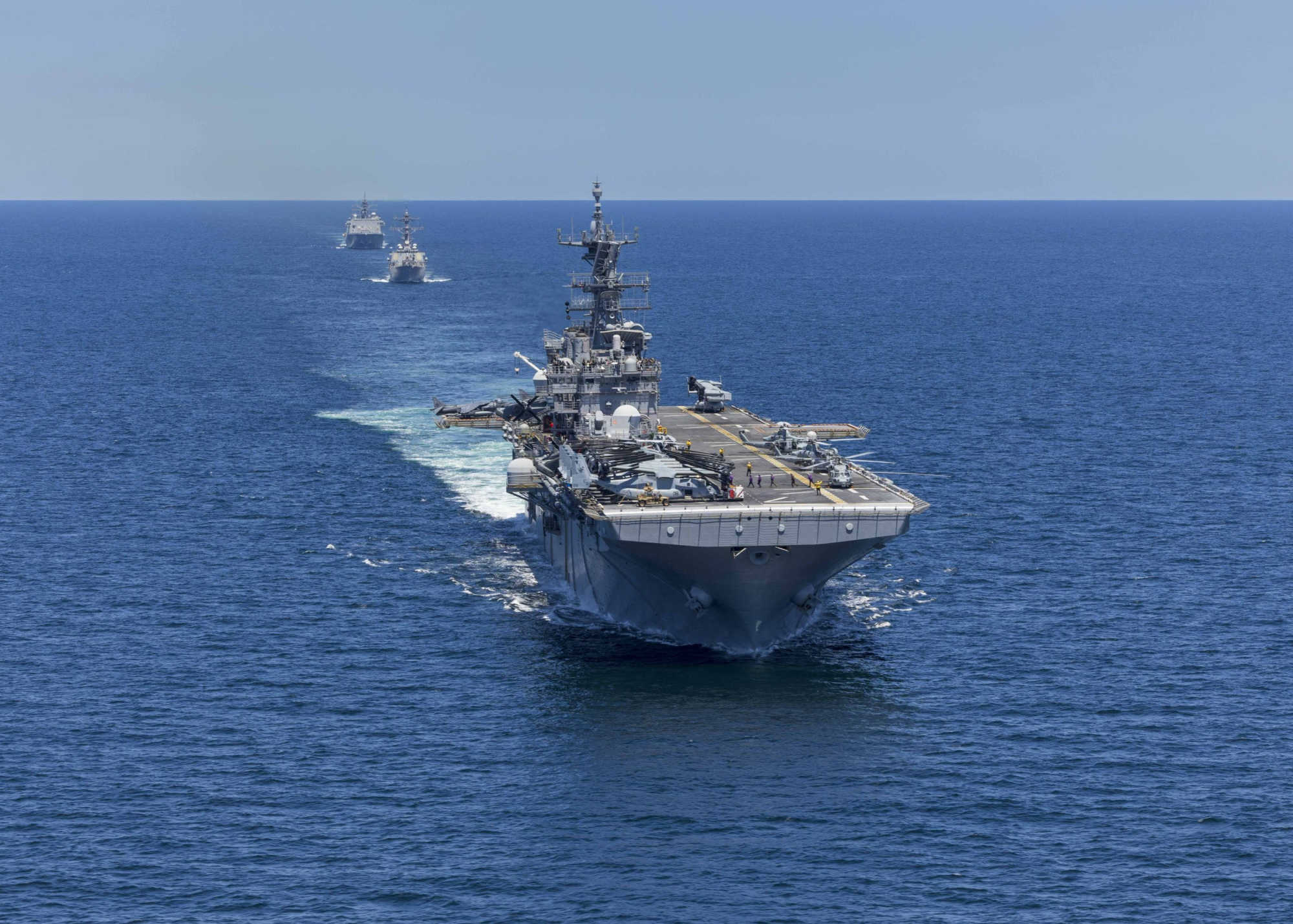
The operations at issue—begun in early September—have so far targeted at least four boats allegedly linked to Venezuelan-based cartels, killing more than 20 people, according to administration figures. Secretary of State Marco Rubio has described the strikes as “targeted actions against imminent threats,” asserting that the vessels were “traffickers of poison” bound for U.S. shores. The Pentagon has characterized the campaign as part of a “non-international armed conflict” against organizations such as Tren de Aragua, which Washington has designated as a foreign terrorist entity.
Rubio, speaking after a closed-door meeting with Senate Republicans, defended the administration’s legal standing. “The president has the constitutional authority as commander in chief to act in international waters to defend our national security,” he said. The U.S. Navy and Air Force have carried out the strikes under a joint command structure, with F-35 fighter aircraft deployed to Puerto Rico to support the mission.
Democrats, meanwhile, warned that the escalation risked drawing the U.S. into a wider conflict and bypassing Congress’s constitutional role in authorizing the use of force. “For perhaps the first time in our history, a president of the United States ordered the U.S. military to use lethal force against individuals who posed no imminent threat of attack and who could have been stopped thousands of miles from our shore,” Schiff said on the Senate floor before the vote. Kaine added that the administration had refused to provide classified intelligence justifying the strikes.
Only two Republicans—Rand Paul of Kentucky and Lisa Murkowski of Alaska—joined Democrats in voting for the resolution. Paul questioned the operation’s legitimacy and potential for civilian casualties. “The blow-them-to-smithereens crowd might stop to ponder that a good percentage of the ships that we actually search turn out not to be drug smugglers,” he said. In a rare defection from his party, Sen. John Fetterman (D-Pa.) opposed the Democratic measure, arguing that it unduly constrained the executive branch.
Republican leaders dismissed the proposal as political theater. Senate Majority Leader Mitch McConnell (R-Ky.) said the resolution was “an effort to tie the president’s hands in fulfilling his duty to protect the homeland,” while Sen. Tom Cotton (R-Ark.) called the operations “lawfully sound and extremely limited.”
The vote came as foreign leaders across Latin America voiced alarm. Colombian President Gustavo Petro condemned the U.S. airstrikes as acts of “aggression against all of Latin America and the Caribbean.” Writing on social media after Trump announced the fourth strike—an attack that killed four people off Venezuela’s coast—Petro claimed “indications show that the last boat bombed was Colombian with Colombian citizens inside of it.” He urged the families of the deceased to “step up and report what happened.”
The White House denied Petro’s allegations. An unnamed senior official, speaking to Reuters, called the Colombian leader’s remarks “reprehensible and baseless” and urged him to retract them “so that the two countries can return to a productive dialogue.” Petro refused, demanding that Washington disclose the identities of those killed “so we can see if my information is unfounded.”
Venezuelan officials echoed Colombia’s concerns. Interior Minister Diosdado Cabello accused the U.S. of imposing a “death penalty for any citizen they believe they can murder, using the excuse that drugs, according to them, are coming from Venezuela.” The Venezuelan government has since launched military exercises along its northern coast in the states of Carabobo and La Guaira, which Defense Minister Gen. Vladimir Padrino said were intended to prepare for a “counteroffensive” against what he described as “a serious threat.”
Venezuelan President Nicolás Maduro has condemned the strikes as “acts of aggression” and vowed to defend the country’s sovereignty. U.S. officials say there has been no direct Venezuelan military response, though diplomatic ties have further deteriorated, with communication between Washington and Caracas effectively suspended.
Legal analysts in Washington remain divided over the administration’s justification. The Constitution Project, a nonpartisan legal watchdog, argues that designating drug cartels as foreign terrorist organizations does not automatically confer authority for lethal military action, warning that the policy could violate international norms on proportionality and self-defense.
However, several national security attorneys and former Pentagon officials take a different view, noting that the President’s Article II powers as commander in chief allow the use of limited force abroad when protecting U.S. interests and citizens. They argue that the War Powers Resolution permits short-term military actions without congressional authorization, particularly in international waters. “The President has broad constitutional authority to act against non-state actors posing direct threats to the United States,” said a former Defense Department legal adviser familiar with such operations. Supporters also point out that Congress has not moved to revoke the 2001 and 2002 Authorizations for Use of Military Force, which presidents have repeatedly cited as legal cover for counterterrorism operations beyond traditional battlefields.
The failed Senate resolution leaves the administration’s campaign intact for now. Trump officials have credited the operations with disrupting drug flows and saving American lives, citing declining fentanyl seizures along U.S. shores as evidence of progress. Critics, however, say that without transparent oversight and verified intelligence, the strategy risks deepening instability in the region.
The Senate Armed Services Committee, chaired by Sen. Roger Wicker (R-Miss.), has requested briefings on the ongoing operations but postponed formal debate. Democrats have pledged to revisit the issue through amendments to upcoming defense spending bills.
For now, the administration appears determined to sustain its Caribbean campaign. Pentagon officials have confirmed additional naval patrols and aerial surveillance flights, underscoring what they call an “enduring mission” to combat transnational narcotics trafficking.
The latest maneuvers follow last month’s deployment of roughly 4,500 U.S. troops across the Caribbean, including forces assigned to Puerto Rico, Trinidad and Tobago, and the U.S. Virgin Islands. On St. Croix, soldiers have been housed at the south shore refinery and terminal facility's "Man Camp”, as part of the region-wide buildup.
Governor Albert Bryan Jr. has voiced his support for the deployment, citing both security and economic benefits. “If we could stop this flow of drugs to our shores, why wouldn’t we be for that?” he asked in remarks in September, noting that traffickers are increasingly using Caribbean routes as enforcement tightens along the U.S. southern border. Bryan added that hosting several hundred troops on St. Croix also brings a spillover effect: “They gotta eat, drink and make merriment in our community. We are happy to have them.”

With U.S. troops already on the ground in St. Croix, the Virgin Islands has become a frontline hub in that campaign, directly tying the territory’s residents and economy to Washington’s push against the narcotics trade in the Caribbean.