




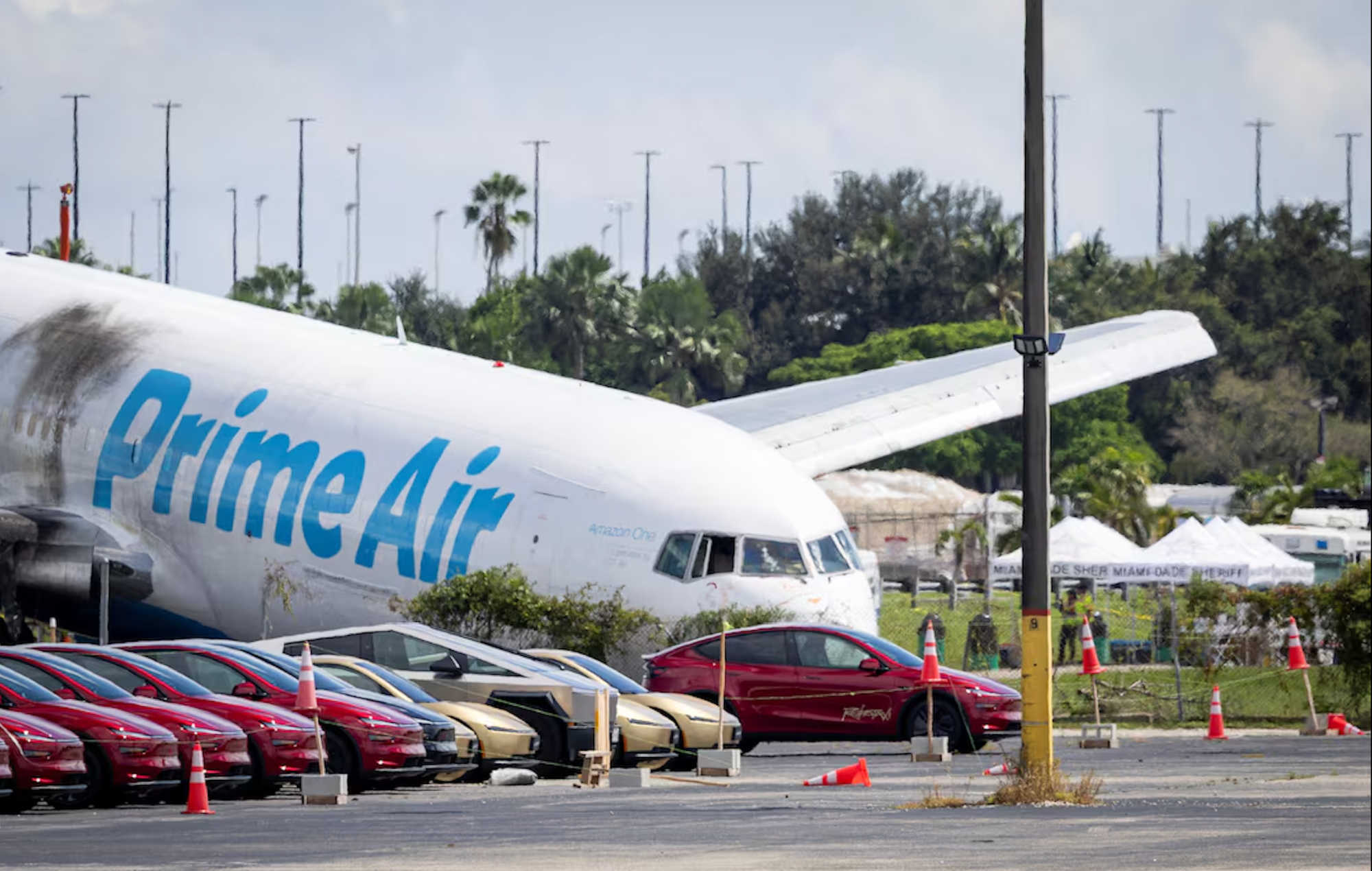
Newly recovered cockpit and flight data from the Amazon cargo plane that crashed after arriving in Miami from San Juan shows that one pilot repeatedly warned that the aircraft was moving too fast during the final approach, as automated “sink rate” and “too low terrain” warnings sounded in the cockpit.

The National Transportation Safety Board released the findings Wednesday as part of its ongoing investigation into the September 6 crash of 21 Air Flight 7598, a Boeing 767-33A cargo aircraft operating from Luis Muñoz Marín International Airport in Puerto Rico to Miami International Airport. Five people were killed and five others injured when the aircraft overran the runway and struck vehicles beyond the airport perimeter. The plane was being operated by 21 Air for Amazon Air.
The new information provides the clearest account yet of what was happening inside the cockpit during the final minutes of the flight.
According to the NTSB, both the cockpit voice recorder and flight data recorder were recovered and successfully downloaded at the agency's laboratory in Washington. The cockpit recorder contained more than two hours of good-quality audio, while the flight recorder captured approximately 54 hours of information across more than 400 aircraft parameters.

About one minute and 42 seconds before the cockpit recording ended, one pilot called for the flaps to be set to 20 degrees. The other pilot cautioned that the aircraft was “too fast.”
That pilot continued making comments about the aircraft's excessive speed through the remainder of the recording. The NTSB said there was not a consistent verbal response to those warnings. The agency has not identified which crew member made the warnings or drawn any conclusion about why the approach continued.
Seconds later, the cockpit began registering a rapid series of automated warnings.
At approximately 1 minute and 4 seconds before the recording ended, the aircraft generated a “sink rate sink rate” warning. The same warning sounded again seven seconds later. With 48 seconds remaining, the system called out “too low terrain” four times. Another “too low terrain” warning followed nine seconds later.
The cockpit recording captured a sound consistent with touchdown with approximately 31 seconds remaining. A pilot did not call for a go-around until about 15 seconds before the end of the recording. Five seconds later came a sound consistent with the aircraft departing the paved surface.
The separate flight-data recorder offers additional detail about the aircraft's speed and the attempted go-around, although the NTSB cautioned that its clock has not yet been precisely synchronized with the cockpit recording.
The data shows that the nose and right main landing gear touched down at a groundspeed of 158 knots. Braking began seven seconds later, at 146 knots. The left main gear touched down when the aircraft had slowed to 134 knots.
Then came a striking sequence.
At 120 knots, the brakes were released and the throttles were increased to a setting consistent with go-around thrust — indicating an attempt to get the aircraft airborne again. Just four seconds later, however, the throttles were reduced to idle and the brakes were reapplied at 117 knots. They remained that way through the end of the recording.
The aircraft's final recorded groundspeed was still 65 knots. The NTSB said the data showed no indication that the speed brakes or thrust reversers were deployed before the recorder stopped.
The crash killed five workers who were inside a cleaning-service van struck by the aircraft after it left the runway, according to subsequent reporting. The flight's pilots survived.
Despite the extraordinary level of detail now available, the NTSB has emphasized that the recorder information is preliminary and subject to change. Investigators have not determined the probable cause of the crash, and the data by itself does not establish why the pilots continued the approach, why the go-around was initiated so late, or why it was discontinued seconds later.

The agency said a cockpit voice recorder group will conduct a more detailed review and eventually produce a written transcript of the accident flight. The broader investigation remains ongoing.