

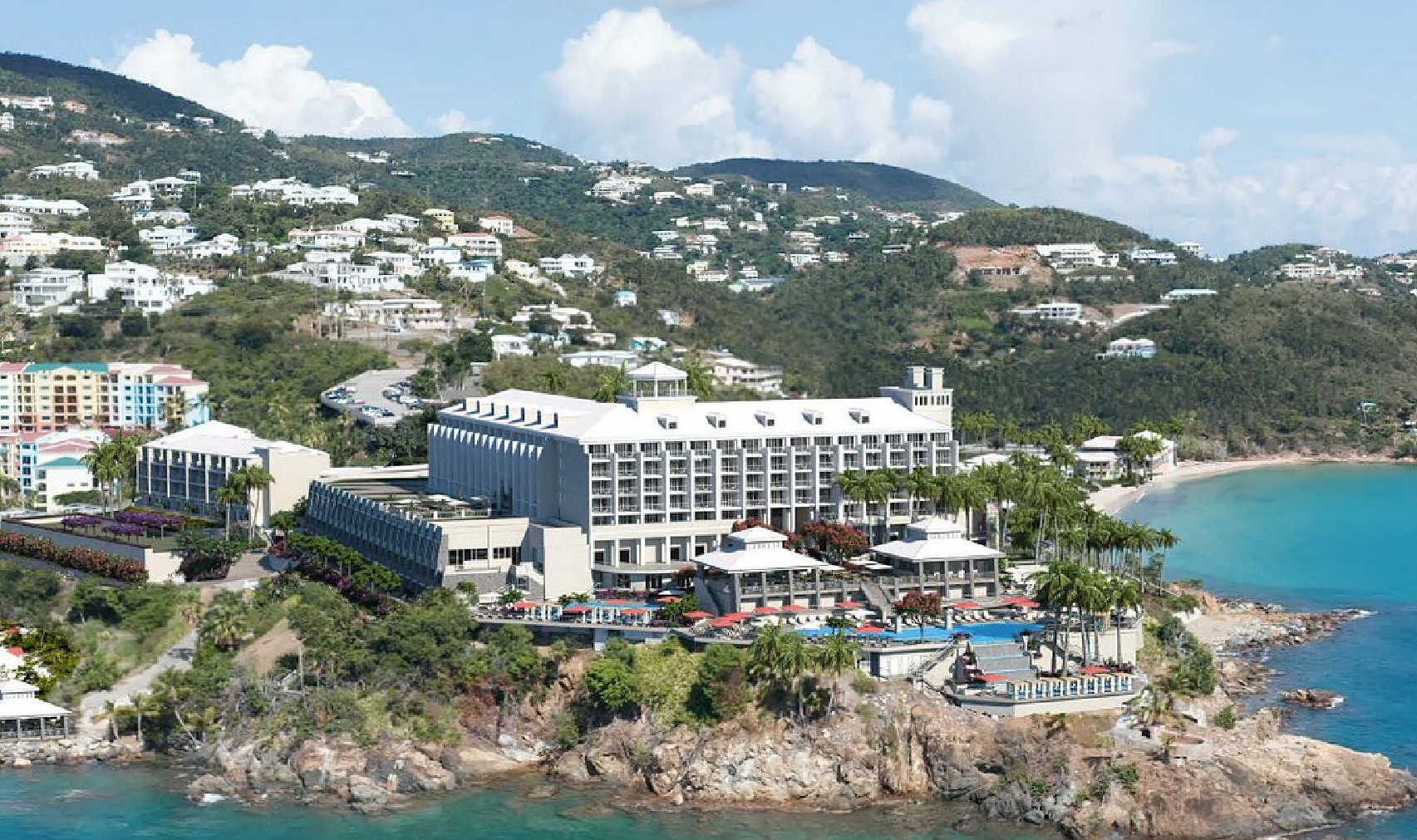
The Virgin Islands government is moving ahead with a complex financing structure for the Frenchman’s Reef Hotel that relies on a new V.I. Public Finance Authority subsidiary to issue tax-exempt hotel bonds, even as the government remains behind on required financial audits and continues to insist it has no intention of owning or operating hotels in the near term.

The transaction, which ultimately transfers title of Frenchman’s Reef to the Government of the Virgin Islands after the bonds are paid off, sits at the center of a broader policy push to amend the Hotel Development Act and has prompted questions about long-term public risk and ownership.
At its November 13 meeting, the PFA board approved a resolution authorizing the creation of the Virgin Islands Hotel Development Finance Corporation, a wholly owned subsidiary that will act as the issuing vehicle for hotel development bonds. Officials said the structure mirrors the approach used previously when the PFA created the Virgin Islands Transportation and Infrastructure Corporation to issue bonds for the Garvey Bond projects. The new subsidiary will carry out responsibilities under the Hotel Development Program and manage service agreements for auditing, accounting, legal, financial, purchasing, and procurement duties.
PFA officials explained that changes in municipal securities regulations require issuers to provide current audited financial statements. Because the Government of the Virgin Islands remains behind on its audits, the PFA cannot directly issue the bonds needed for the Frenchman’s Reef initiative. “We have been behind on our audits for, you know, quite some time,” the PFA said, noting that progress made before Hurricanes Irma and Maria was disrupted and that efforts to complete the 2023 and 2024 audits are ongoing. Another PFA official added that the Department of the Interior has applied “added pressure” to complete the work, with auditors currently engaged on the 2023–2024 cycle and a timeline in place for 2025.

The administration has been laying the groundwork for this structure for weeks. In a prior message to lawmakers, the Bryan administration asked senators to amend the Hotel Development Act so a wholly owned subsidiary of the PFA can issue tax-exempt bonds for hotel projects, a mechanism officials say will cut borrowing costs without pledging government revenues or creating taxpayer liability. “This is a smart, no-debt tool,” Governor Albert Bryan Jr. said. “We cut financing costs for private capital, protect taxpayers from liability, and secure a clear path for long-term ownership. That’s how you make hospitality investment work for Virgin Islanders.”
In discussing the long-term outcome, Bryan added that through this transaction, “we're acquiring an asset with a current value of over $400 million that will probably have a future value somewhere in the neighborhood at 800 to a billion dollars, if not more.” The measure is presented as pairing existing hotel-program incentives with a lower-cost financing tool to move projects from planning to construction, support reinvestment in aging properties, and boost competitiveness in group, leisure, and cruise-adjacent markets — all “without shifting financial risk to the public.” It asserts that the government is not purchasing Frenchman’s Reef, will not run hotel operations, and is not guaranteeing bonds; Davidson Hospitality would remain manager under the current arrangement.
At the same time, the administration has told senators that once the bonds reach maturity — expected in roughly 30 years — title to Frenchman’s Reef would transfer to the public. In practical terms, “the people of the Virgin Islands” is the Government of the Virgin Islands; the property would revert to government ownership, after which officials could sell or lease the asset via normal public processes. Government House, in an October 22 letter to Senate President Milton E. Potter, wrote that PFA is working with Fortress, the Frenchman’s Reef owner, on a financing “like an industrial development bond,” without any commitment or pledge of government revenues or assets. The letter highlights the direct public benefit as follows: “upon the final redemption of the bonds, in 30 years or so, the Frenchman’s Reef property would revert to Government ownership.” That end-state sits in tension with repeated assurances that the government does not wish to own hotels now — a contradiction the Legislature will likely need to address directly in statute and public messaging.
The Frenchman’s Reef transaction involves the hotel’s current owner, Fortress, selling 100 percent of its interest to a special-purpose 501(c)(3) corporation that will act as a conduit borrower. The PFA subsidiary will issue triple-tax-exempt, unrated bonds equal to the current appraised value of the property. The proceeds will be lent to the 501(c)(3), which will purchase the hotel’s equity from Fortress. An attorney from Dwayne Morris, speaking on behalf of bond counsel, explained that revenues generated by the hotel will be “lockboxed” by the trustee and used first to pay taxes on earlier bonds issued in 2024, and then to cover operating expenses, capital improvements, and principal and interest on the new hotel development bonds.
Attorney Michael Barz of Duane Philip LLP underscored that the conduit entities involved “receive a fee, but they're not looking to make any profits, and they have no risk, because the only risk is repayment of the bonds, and the bonds are only repayable by revenues generated by the hotel. If the hotel is lays fallow and isn't generating revenues. The bondholders take that risk.” Barz added that “there's up to a year of debt service reserve,” explaining that if revenue falls short, bondholders have a year of coverage “to figure out how to get that hotel up and running.” He also noted that the bonds are unrated but attractive because they are “tax free at the federal, state and local levels,” which makes them appealing to investment funds and similar organizations.
In everyday terms, this means Fortress is selling the hotel, and a specially created nonprofit-style company is buying it using borrowed money. The PFA’s new company will borrow that money from investors by selling tax-free bonds. The hotel’s income will then be kept in a tightly controlled account, and that money will be used in a set order: first to pay what is already owed on earlier bonds, then to run and maintain the hotel, and then to pay back the new bonds over time. The hotel’s cash flow, not the government’s budget, is what repays the debt.
According to officials, feasibility analysis indicates that hotel revenues are expected to retire the bonds within approximately 27 years. Once the bonds are paid, the hotel will revert to ownership by the Government of the Virgin Islands. The 501(c)(3) created for the transaction “has no interest in the hotel, no interest in owning the hotel, and will receive no monies in profit for being this conduit.” The structure obligates the property to be operated and maintained to a “first class standard,” monitored under a Marriott franchise agreement. One board member asked what would happen if the brand failed, prompting officials to clarify that Marriott is the management and branding company, and if necessary, another operator could be secured without altering government risk.
Draft language for the new Virgin Islands Hotel Development Financing Corporation — the same entity approved by the PFA board — would amend Title 29, Chapter 23, §1303 to define the corporation as a public body controlled by the PFA, and add §1318 to create it with powers related to the development, operation, and financing of one or more hotels in the territory, mirroring authorities under Title 29, Chapter 15, §916 et seq. Under the proposal, the hotel owner could use tax-exempt bonds to refinance and recoup its initial private investment by accessing lower interest rates, in a structure akin to U.S. industrial development-style conduit bonds. The administration says all bond payments and liabilities remain 100% the owner’s responsibility, with no pledge of government revenues or assets, no government guarantee, and no taxpayer backstop. After the bond term, ownership would transfer to the public; the government would be free to sell or lease the property and is not obligated to operate it.
Board members questioned why the government must resort to a workaround entity rather than provide the required audited statements directly. Officials responded that while the goal remains full audit compliance, the transaction cannot wait for the completion of long-delayed reports. They noted that bondholders—not the government—bear the financial risk associated with hotel revenues, hurricane impacts, or any operational downturns. When asked about worst-case scenarios, an attorney explained that insurance, debt service reserves, and operating reserves are in place, and bondholders assume the risk if revenue falls short. Officials stressed that there is “no financial risk to the government whatsoever, other than it's a hit on tourism and employment revenues for the government,” framing the financing decision as separate from the operational and tourism risks that exist whether the hotel is privately or publicly financed.
USVI law already establishes project-specific trust funds and permits the redirection of project-generated hotel occupancy taxes, casino taxes, and Economic Recovery Fees into those funds to reduce Hotel Development Notes. While not a full-faith-and-credit pledge, these dedicated streams are a real policy cost that lawmakers must weigh against expected benefits. Public-private partnership literature and U.S. federal guidance warn that, absent tight handback conditions, private owners may defer major capital upkeep near contract end, risking assets returning in sub-optimal condition. Even with no guarantee, the Hotel Development Program’s dedicated revenue diversions are foregone public receipts during the term.
Those policy choices can constrain future budgets; lawmakers are encouraged to confirm the value-for-money rationale and stress-test assumptions. Taking title in 30 years may coincide with a property needing capital refresh or facing a soft market. If the asset underperforms, the public inherits the problem — whether holding costs before a sale or lease or accepting a discounted disposition. Studies of publicly owned or heavily subsidized convention hotels show frequent under-performance, market distortion (rate suppression for private competitors), and budget exposure when revenues miss forecasts. Even if the USVI intends to sell or lease promptly, interim ownership still carries risk.

The board ultimately approved the resolution to create the new PFA subsidiary after discussion, with members noting the importance of returning Frenchman’s Reef to full operation after years offline. Officials also emphasized that the arrangement secures a major hotel asset for the territory at the end of the term. “Funds are set aside for maintenance…so that in 30 years, the property will be kept up to a standard that Marriott says for its properties,” one official said, adding that the government should inherit “a good asset in excellent condition.”