

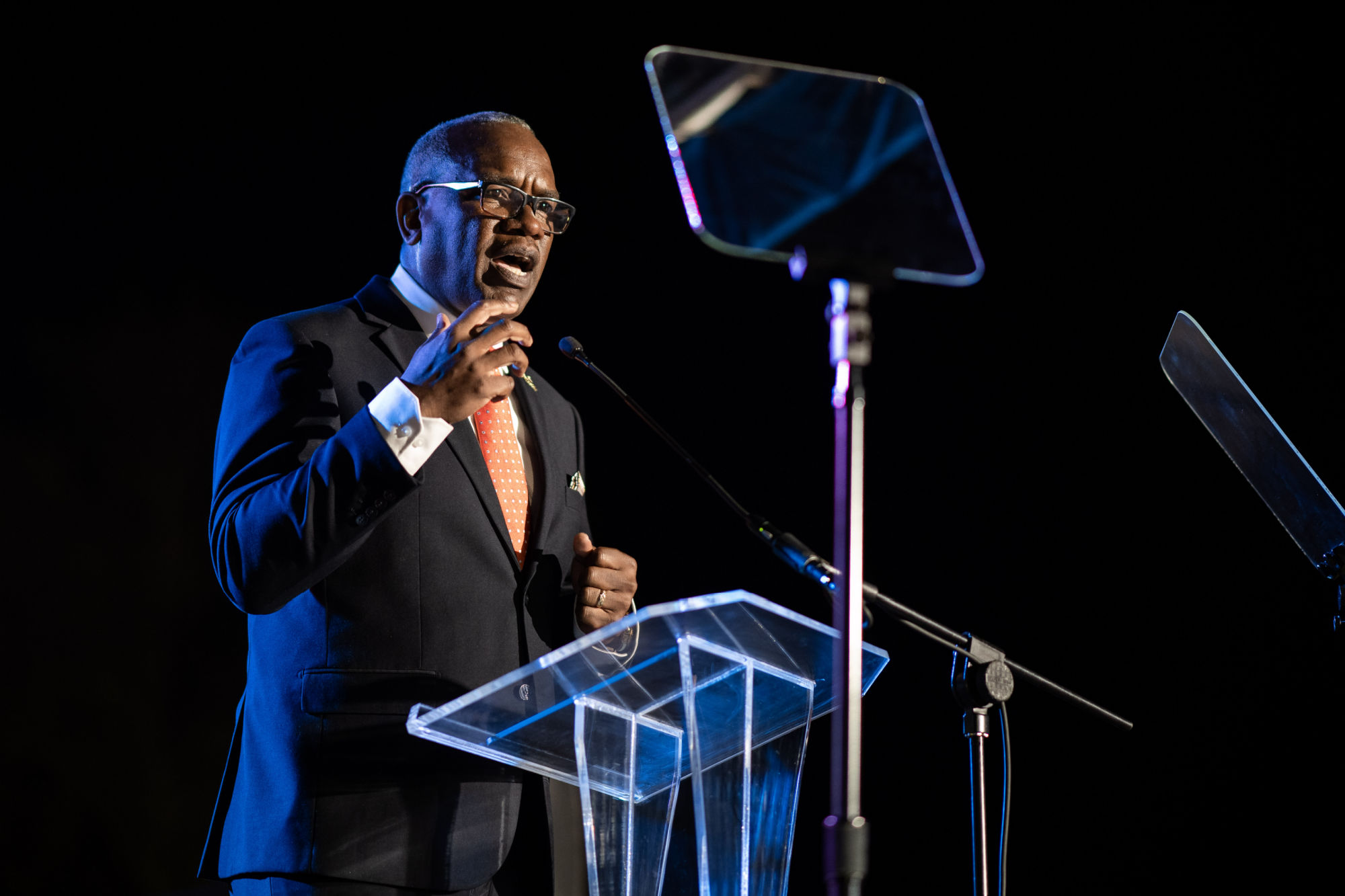
Governor Albert Bryan Jr. has introduced two major pieces of legislation to the 36th Legislature, with the most sweeping proposal centered on a territory-wide minimum wage increase designed to strengthen the private-sector workforce while supporting economic stability.

Under the proposed “Act to Increase the Minimum Wage,” the Virgin Islands’ base pay would rise from $10.50 to $15 an hour over three years — increasing to $13 in 2026, $14 in 2027, and $15 in 2028.
Governor Bryan said the bill is built on fairness, sustainability, and economic inclusion, ensuring that the territory’s wage growth benefits all workers, not just those in the public sector.
“This phased minimum wage increase balances compassion with common sense,” he said. “It delivers meaningful raises to our people while giving businesses time to plan and adapt. It is about dignity, fairness, and ensuring the entire economy grows together.”

The proposal contrasts sharply with the Legislature’s earlier move to raise government employees’ minimum salary from $27,000 to $35,000 in a single step. “I objected to that approach because it bypassed union negotiations, created unsustainable budgetary pressures, and risked triggering inflation,” Bryan said. “What we are proposing here is the opposite: a phased, responsible increase that strengthens the private-sector workforce, lifts wages for all, and does so in a way that supports long-term economic stability.”
The governor added that the plan will have broad economic benefits, stimulating consumer spending, reducing poverty, and helping families build generational wealth. He noted that the measure is part of a wider economic vision to ensure that growth and prosperity reach every household and business.
“These proposals reflect a pragmatic and forward-looking vision,” Bryan said. “They balance economic growth with fairness and accountability, and they chart a path toward a stronger, more resilient Virgin Islands economy.”
The second proposal, “An Act to Support Small-Scale Distilleries and Breweries,” would amend zoning laws to allow microbreweries and microdistilleries as conditional uses in agricultural and certain residential districts, but only after public notice, community consultation, and formal approval from the Department of Planning and Natural Resources (DPNR) and the Department of Agriculture.
“This measure is about empowering Virgin Islands farmers and entrepreneurs to innovate and expand their businesses,” Bryan said. “By allowing microbreweries and microdistilleries directly tied to agriculture, we are giving our farmers the ability to add value to their crops, preserve our cultural heritage of rum production, and create new experiences that attract visitors, while ensuring strong oversight and community protections.”
The bill aims to bolster agriculture-driven innovation, giving local farmers and small producers the opportunity to transform their crops into marketable products while preserving the islands’ deep-rooted rum-making tradition.

Both measures have been transmitted to the Legislature for consideration. Governor Bryan urged senators to act quickly, stating that the proposals — one supporting wage growth and the other expanding small-scale manufacturing — are integral to advancing entrepreneurship, economic mobility, and prosperity across the Virgin Islands.