

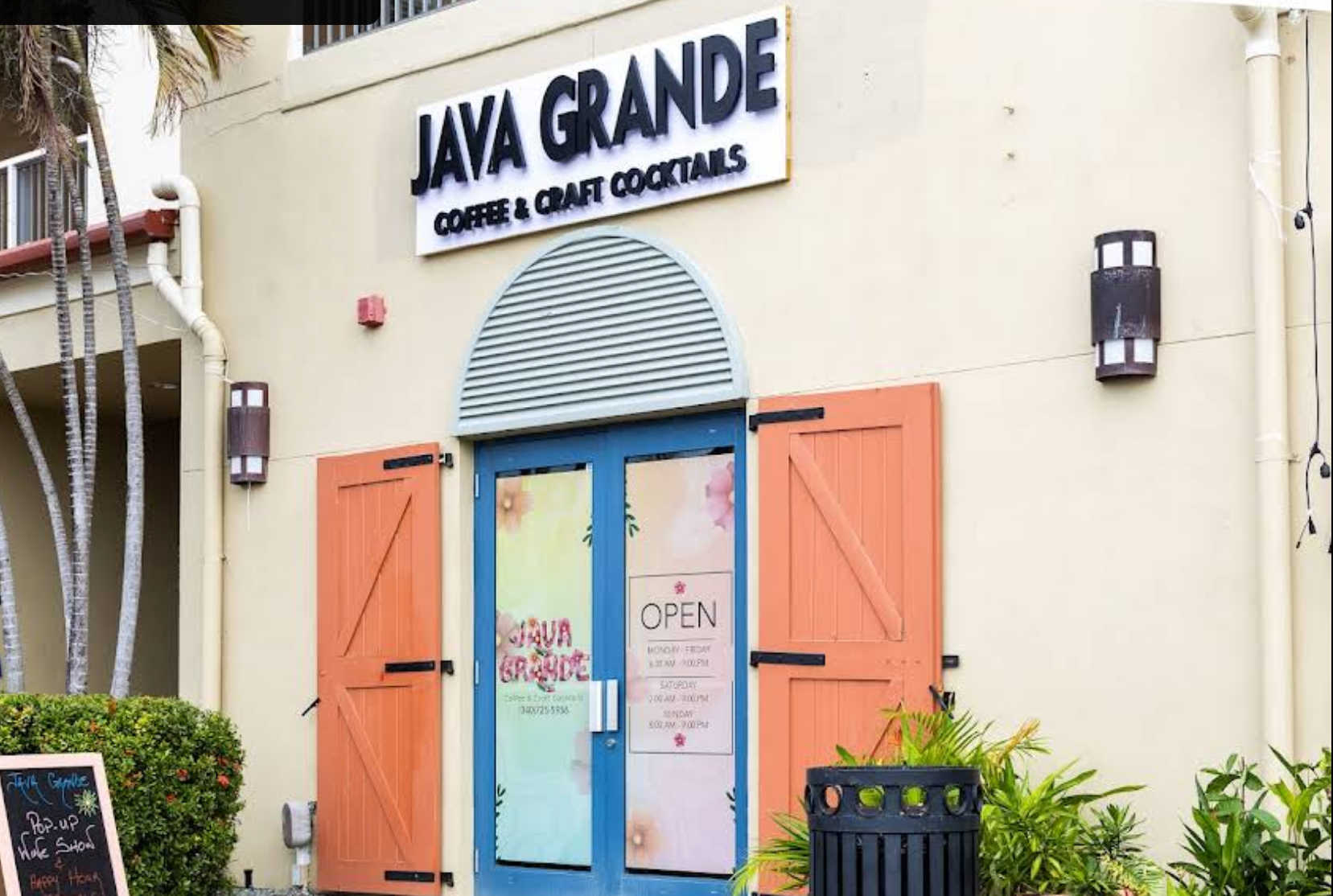
Java Grande at Yacht Haven Grande, the coffee shop space at the center of trial testimony about Jenifer O’Neil’s $17,730 lease payment.
Federal prosecutors used the third day of trial in the U.S. v. Ray Martinez and Jenifer O’Neal case to tighten their narrative around two pivotal themes: the flow of money that ended with a $17,730 lease payment for O’Neal’s planned coffee shop at Yacht Haven Grande, and a June 2024 call in which Martinez, after phones were seized by federal agents, told David Whitaker to “Burn the phone then.” Those moments shaped hours of testimony and recordings that traced how invoices were structured, how money was redirected, and how efforts to conceal communications intensified after federal agents stepped in.

The Yacht Haven lease payment was laid out in detail. On April 8, 2024, Whitaker texted O’Neal, asking, “how much money for Charlie,” referring to the Yacht Haven Grande representative handling her lease. In a text shown in court, O’Neal replied, “$17,730.” Jurors then saw the wire transfer that followed: $17,730 sent to Yacht Haven Grande with a memo line reading “Payment to Yacht Haven Grande for Jenifer O’Neal for lease payment.” Whitaker had testified that he sent that payment from a bank account he described as a “slush fund,” funded with $70,000 from one of the inflated invoices at the center of the case. The FBI, he said, instructed him to stop spending from that account shortly afterward, making the Yacht Haven lease the last payment out of that pool.
Prosecutors presented evidence indicating the payment did not occur in isolation. Earlier recordings captured O’Neal and Whitaker discussing in granular detail the costs of building out the Yacht Haven coffee shop. In a meeting held in a busy setting — likely a restaurant or similar venue — with drinks and food on the table, O’Neal described the equipment she needed: “So the coffee shop equipment was expresso machine, coffee grinder, commercial coffee maker, refrigerator and freezers, display cases, and that depends on how many you want,” she said, before continuing through a longer list of items. She estimated that the buildout would fall somewhere between $50,000 and $100,000, particularly once furniture and other finishings were factored in. Whitaker, according to the recording, added that costs such as workers’ insurance would also need to be covered.
At one point in that conversation, Whitaker projected that O’Neal would need $60,000 to $70,000, and O’Neal confirmed, asking, “in total.” She went on to explain that she expected support from her sons, saying one had offered $25,000 and another $20,000 to help fund the shop.
The same conversation included one of the first references to the lease deposit. “We still need to pay the $17,000,” O’Neal said, referring to the downpayment for the Yacht Haven Grande lease. Whitaker told her that Martinez had instructed him to “put 15 on there” for her. O’Neal responded that “the 15 is for the down payment.” Whitaker questioned whether that amount would be sufficient, but O’Neal replied that “it might be enough,” adding that having “a little extra” would be good. She stressed that they needed to look carefully at what the coffee shop required, saying, “We got to look at what is needed.”
The theme of helping O’Neal with cash resurfaced in later phone calls between Martinez and Whitaker. Martinez described stopping by O’Neal’s office early one morning while she was in an 8:30 a.m. meeting with the governor about budget issues. According to his account, she was under stress from budget matters and personal relationship issues. Martinez said he told her, “You don’t ask for anything, so I’m going to give you $10,000,” and that she became emotional and hugged him, adding that the only thing she did not do was break down. He described her as someone who enjoyed their friendship and called him “big brother.”
Other records tied O’Neal more directly to invoice processing. In a January 20, 2024 text, Whitaker asked her whether a $216,000 VIPD invoice had processed. She replied that she would check with her staff. By the end of the month, bank records showed $216,000 paid to Mon Ethos.
The April 6, 2024 meeting at Whitaker’s office tied these strands together. Present for that meeting were Whitaker, Martinez, and O’Neal. Prosecutors played audio of the three going through documents referencing the $70,000 embedded in one of the invoices and line items for both O’Neal’s coffee shop and Martinez’s restaurant. They also spoke about ongoing funding for Mon Ethos. When Whitaker asked O’Neal whether the coffee shop lease had been signed, she said it would be signed the following week. Discussion turned to the $17,000 needed for the lease payment. According to the recording, they agreed that once the $17,000 was set aside, there would still be “50,000 plus” remaining from the alleged inflated invoice.
Then the group addressed how that lease payment would actually be delivered. Whitaker asked O’Neal, in substance, whether she wanted the lease money wired to her business. O’Neal first answered, “I guess,” but quickly added that she would have to think about it, saying, “I don't like traces of anything, so wire means it's traced.” Whitaker asked, “how's the easiest way to do that that's not traceable?” He pointed to Martinez as the expert on such matters. Martinez answered, “everything is traceable.” They briefly discussed using cash, but Martinez warned that sizable cash deposits would draw unwanted attention from banks, noting that when someone deposits around five thousand dollars, staff begin asking where the money came from.
From there, the narrative fast-forwarded to June 2024, when phones belonging to Martinez, O’Neal, and another high-level official were seized by federal agents. Records and audio presented Friday showed the tone shifting sharply after that point. In a June call, Whitaker asked Martinez whether they could “trust” O’Neal, and Martinez responded that people behave differently “when they're under the gun,” advising Whitaker to be careful. The conversation then turned to devices and records.
On one call, Whitaker said the FBI was at the gate of his complex and asked Martinez what he should do. Martinez replied that agents would take his devices and instructed him to “Get rid of this phone.” In another exchange, Martinez pushed the point further, telling Whitaker to “Burn the phone then,” operating under the assumption that Whitaker’s phone had not yet been seized. Martinez also discussed deleting emails and encouraged Whitaker to move to iPhones, which he viewed as more secure than the Android device he had used. Whitaker asked whether Martinez had given investigators the PIN for his own phone. Martinez indicated that, as an Android, it could be accessed by federal authorities, suggesting he might have already provided the code.
In that same long, post-seizure conversation, Martinez went through past transactions one by one, talking about altered invoices, tuition payments, and other transfers, and suggested explanations he thought might withstand scrutiny. When discussing one invoice that had been changed after submission, Martinez suggested Whitaker tell investigators that “after you sent the invoice in, you saw that there was an error,” and that the correction was simply fixing that mistake. He also encouraged Whitaker to destroy other electronic records, at one point saying, “Yeah, destroy it, destroy it, bro,” in reference to material they believed could be compromising.
The proceedings also revealed no recordings or messages indicating further contact between Whitaker and O’Neal after the June phone seizures, unlike the continued communication between Whitaker and Martinez.
Once the government concluded that portion of its case, the focus shifted to the defense’s cross-examination of Whitaker, led by Attorney Miguel Oppenheimer on behalf of Martinez. Oppenheimer began by highlighting the personal relationship between Whitaker and Martinez, eliciting testimony that the two were friendly, that Whitaker knew Martinez’s wife and children, and had spent Thanksgiving at Martinez’s home. Whitaker said he was introduced to Martinez through Lavelle Campbell.
Oppenheimer then moved to the listening devices Whitaker had installed in government offices. Whitaker acknowledged planting them and walked through where they were later discovered. From there, questioning turned to Whitaker’s early work for the V.I. Police Department. Whitaker testified that in 2022, he began by investigating individuals who had problems with Martinez or whom Martinez viewed as problematic, naming former Senator Janelle Sarauw as one example.
A significant part of the cross-examination focused on how invoices were written after Mon Ethos entered into a contract with VIPD. Whitaker testified that, once the contract was in place, he was told to change the language on many of his invoices so that it tracked the federal funding language rather than only the wording in the contract itself. According to Whitaker, O’Neal told him to do this, and explained that the wording on the invoices had to be similar to what the ARPA funding was for, so that the invoices could be processed.
Oppenheimer then turned to the “Steak Out” memorandum, signed on April 1, in which Martinez and Whitaker outlined a concept for a show at Don Felito’s, where Martinez would cook and discuss cold cases. Whitaker had testified previously that the memo was a facade intended to cover up payments for restaurant equipment, but Oppenheimer pushed the idea that it reflected a bona fide business arrangement. He displayed the document in court and read sections stating that Whitaker was responsible for funding needed infrastructure for the restaurant and that the memo was essential to provide transparency in light of the ongoing business relationship between Mon Ethos and VIPD. He asked Whitaker if he had an attorney draft the agreement, implying a real joint venture. Whitaker replied, “I wouldn’t say it like that.” Oppenheimer then asked whether invoices from Martinez and his wife for restaurant equipment began arriving after the memo was signed. Whitaker said they did.
The defense also briefly revisited the Boston trips, suggesting that at least some of the travel may have had a medical aspect, as Martinez had been in the hospital with a brain tumor on St. Thomas. Whitaker acknowledged that on the second trip to Boston, O’Neal and her son Jafari also traveled. When Oppenheimer tried to steer questioning toward Whitaker’s lifestyle in 2005 and 2006 — including private jets, expensive rentals in Miami, and a high-priced New Year’s Eve party — the prosecutor objected repeatedly. The judge sustained those objections, ruling that Whitaker’s travel and spending from roughly 20 years ago were not relevant to the present case.
The court day ended not because the cross-examination had run its course, but because the clock reached 5:00 p.m. Jurors were released for the weekend with instructions from Judge Mark Kearney not to search for information about the case, conduct any online research, or discuss the matter with anyone. He told them that if anyone approached them about the case, they must report it to the court, and expressed confidence in their ability to follow his directions.

Trial is set to resume at 8:30 a.m. on Monday, with Oppenheimer expected to continue his cross-examination of Whitaker as the defense ramps up its effort to challenge the government’s cooperating witness and reframe the narrative around the “Steak Out” agreement, the ARPA-funded invoices, and the money that moved between Martinez, Jenifer O’Neal, and Mon Ethos.