

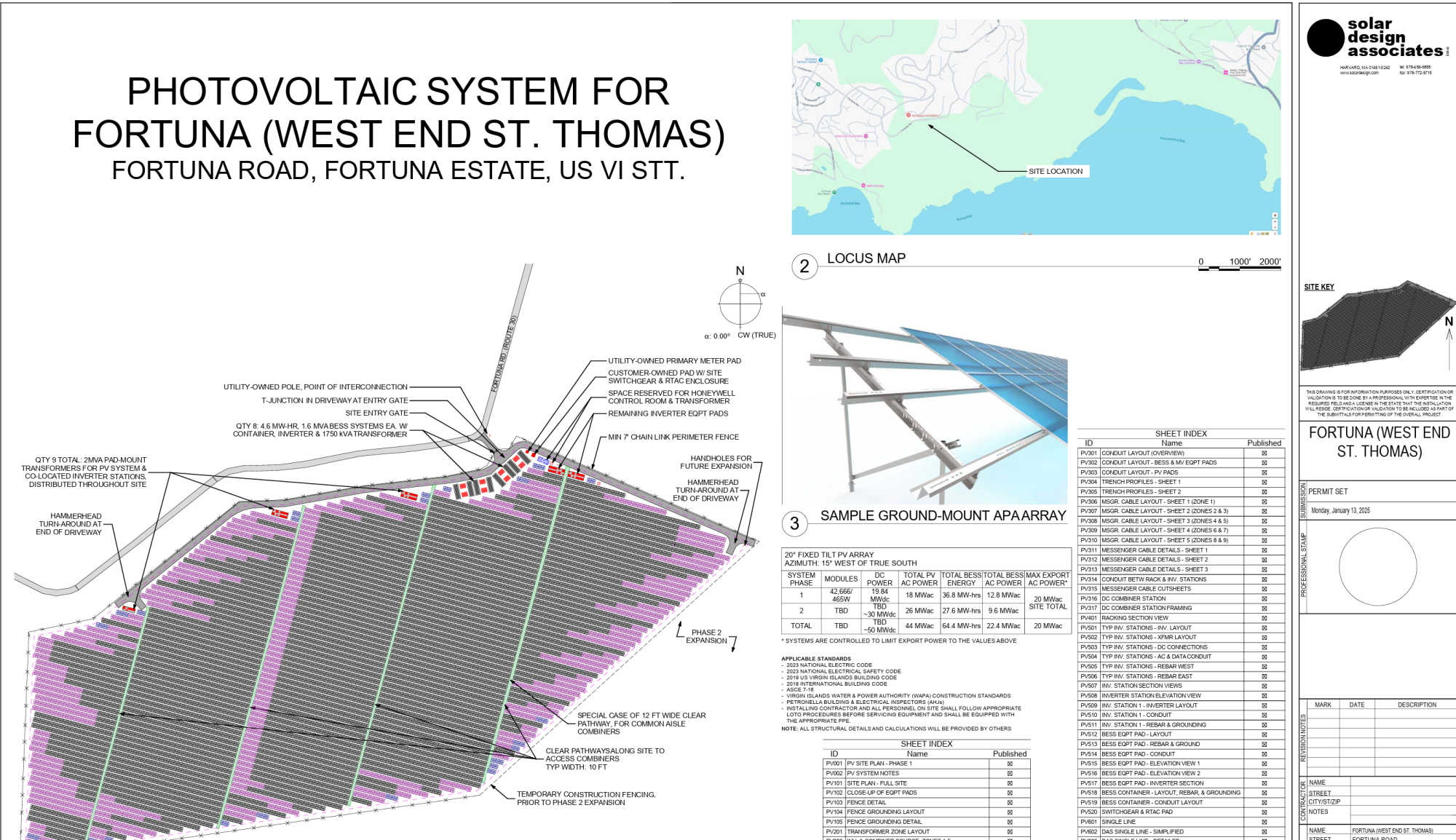
Site plans for the proposed Fortuna solar farm on St. Thomas, showing the layout of more than 100,000 ground-mounted panels and the project footprint near nearby residential areas. Photo Credit: V.I. LEGISLATURE.
Two requests to bypass the Coastal Zone Management Commission’s permitting process and allow for expedited installation of solar farms on St. Thomas left lawmakers debating between the need for a steady power supply and the potential risk to homeowners.

In the end, a desire to strengthen the reliability of power on St. Thomas won, with 11 out of 15 senators advancing the request to Governor Albert Bryan Jr.’s desk.
Bills 36-0914 Bill 36-0915 relate to solar farms on Parcel Nos. 3B & 2 Estate Fortuna and Rem. 17 Estate Bovoni, and Nos. 1 & 2 Frenchman's Bay Quarter on St. Thomas respectively. Both solar farms are an investment of VI Electron, which has established successful solar farms on St. Croix. According to Jean-Pierre Oriol, Commissioner of the Department of Planning and Natural Resources, the farms have “significantly improved the quality of life for the residents” with minimal power disruptions.
He hopes for the same for St. Thomas and appealed to lawmakers to approve the permitting waiver request. The need for a waiver is due to new developments under the Trump administration relating to green energy. VI Electron benefits from the Investment Tax Credit, introduced under the Biden administration. President Trump, however, issued a directive to the Secretary of the Treasury to terminate these tax credits for wind and solar facilities “unless substantial portions of a subject facility have been built.”
Now, developers like VI Electron have until December 31, 2025, to demonstrate substantial progress or risk losing access to the tax credit incentive. The CZM permitting process, as outlined by Oriol, makes it “impossible to meet the substantial construction benchmark set forth by the Treasury.” The process could be “at best 130 days,” Mr. Oriol explained. The waiver, therefore, is necessary to fast-track the commencement and completion of the solar farms on St. Thomas.
Mr. Oriol assured the Committee of the Whole that the projects have been “thoroughly reviewed” by DPNR and that the developer must follow specific requirements to protect neighboring houses and reduce stormwater runoff. Mr. Oriol said concerns of the aforementioned nature arose during a November 16 town hall meeting organized by Senator Carla Joseph in Fortuna.
VI Electron is required to conduct “pull tests that simulate conditions equivalent to 185 mile an hour storms” to ensure the solar panels can withstand hurricane-force winds. The developer must also secure insurance coverage that will “pay for damages that may arise from the panels causing damage to property during the passage of a major storm,” Mr. Oriol said.
Karl Knight, Chief Executive Officer of the Water and Power Authority, touted the success of the solar farm projects on St. Croix and encouraged senators to consider the permitting waiver. He insisted that the solar farms in the pipeline for St. Thomas would provide “significant improvement in reliability for that portion of the island.” WAPA expects that the combined impact of all the solar farms will result in “positive cash flow for the first time in over 10 years.”
Also on hand to testify was VI Electron principal Christian Loranger, who reaffirmed his commitment. Mr. Loranger has already purchased “$10 million in land between the Fortuna and Bovoni sites alone.” He has invested an additional $3 million in civil and solar engineering.” The developer has also spent “10s of millions of dollars in equipment purchases for those sites.”
“It has not been easy,” he admitted.
Residents of Fortuna and Bovoni, however, seem to also be having a difficult time. Yolanda Titus and Merwin Potter both stated that they were unaware of the plan to establish a solar farm in their residential community until approximately a week ago.
Ms. Titus resided in Donoe during the 2017 hurricanes, when panels at a nearby solar farm became airborne and damaged properties. “There was solar panels that bust my roof and they landed all over the porch downstairs, blocked the doors, causing damages to my car,” Ms. Titus recalled. She told the committee that she and her five minor children were effectively trapped in their home. Ms. Titus is currently part of a class action lawsuit on the matter, though “nothing hasn't happened.”
Ms. Titus was particularly concerned about the sheer number of panels to be installed on one of the sites, 110,000 in total. She remained skeptical of hurricane-proofing provisions outlined by DPNR. “I'm not for that solar panel, and I would like something to be resolved,” Ms. Titus stated.
Also in opposition to the project locations was Merwin Potter. He said the “industrial-scale undertaking of enormous magnitude” should “never have advanced without full public disclosure, transparency and meaningful community.” He testified that there was no opportunity for the public to “review or comment on a proposal.” Yet Mr. Potter said “excavation began without notice, despite clear and substantial potential impacts on our homes, on our environment, and our safety.”
Mr. Potter shared that residents are “deeply disappointed that the governor would request that the Legislature circumvent the coastal zone management process.” He lamented the lack of public engagement. Mr. Potter also lambasted Senator Carla Joseph for what he believes was the exclusion of those living in proximity to the proposed farms during the recent town hall.
“Residents living within 500 feet of this massive project are now terrified,” Mr. Potter said, referencing the risks posed by natural disasters. He also stated other concerns, including the possibility of fires. He begged the Legislature to “reject approval of this project.
The revelation that community members were not adequately engaged caused a rift in the Legislative chamber.
“I'm offended for them,” said Senator Alma Francis Heyliger. She argued that though these residents are expected to be the beneficiaries of the solar farm, little consideration was paid to them. Senator Francis-Heyliger did not oppose the solar farms on principle, but declared that “I have a problem with the location, and I cannot, in good conscience, put people's lives at risk.”
Senator Franklin Johnson stated his position boldly. “I don't submit to anybody putting a shotgun to my head to vote on nothing when we going to circumvent the process that we have in place here,” he declared.
“We truly had more than sufficient time to be able to engage this community,” Senator Novelle Francis said. He noted that many residents simply want “transparency.” Like many of his colleagues, though, he understood the rationale for the solar farms. “I don't see no reason why that can't happen in tandem or in parallel,” Sen. Francis said.
“It's mandatory that the voices of those who live near these projects are heard and adequately considered,” Senator Ray Fonseca agreed. Early on, he warned that he would vote against the request.
“We have a difficult decision to make, but one that needs to be made,” Senator Kurt Vialet said as lawmakers prepared to consider the next step.

Ultimately, Senators Dwayne DeGraff, Ray Fonseca, Alma Francis Heyliger, and Franklin Johnson would vote against both requests. However, their opposition was not enough to prevent the measures from passing with approval from the majority of lawmakers.