
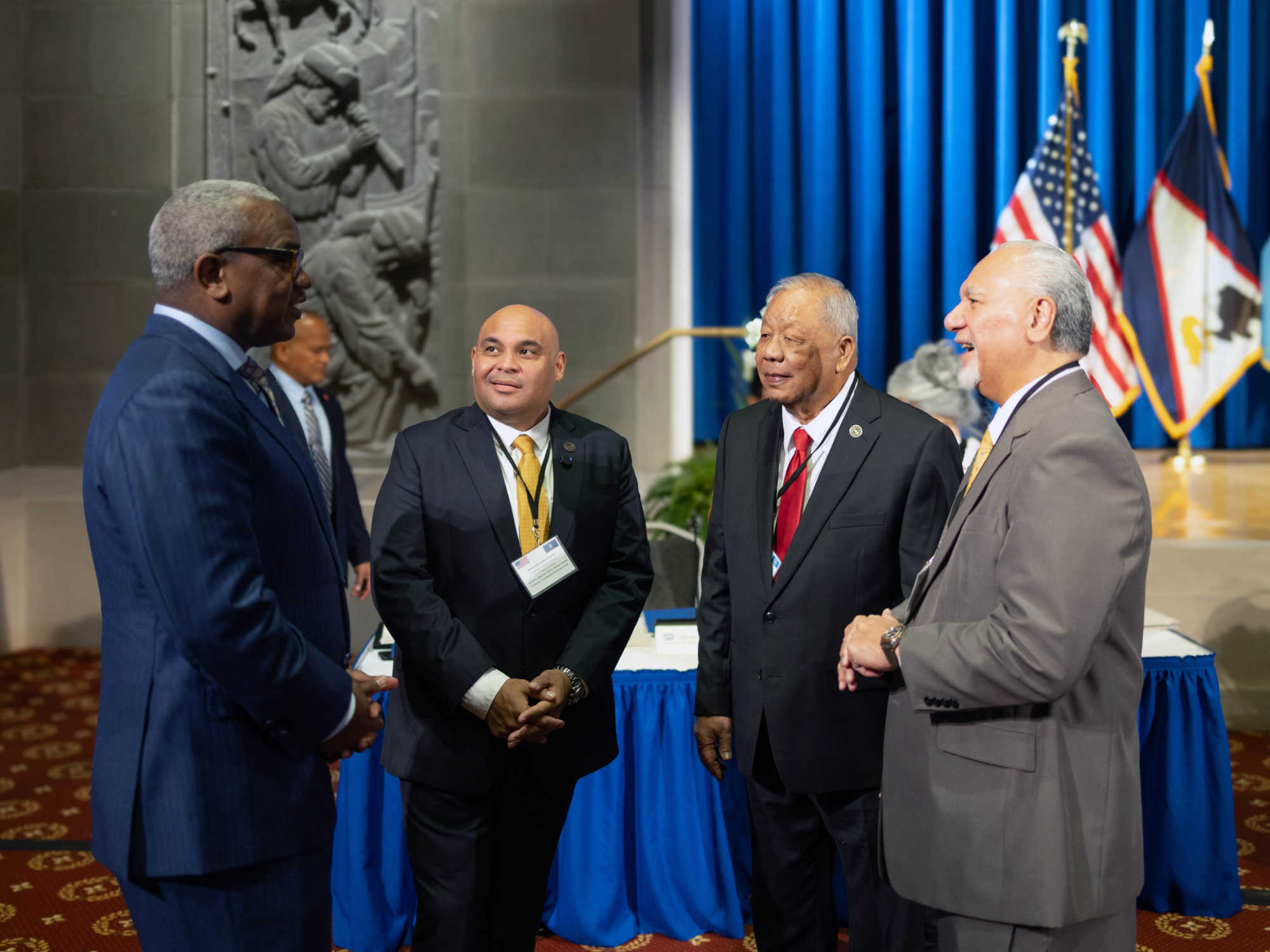
From left, Governor Albert Bryan Jr. of the U.S. Virgin Islands speaks with territorial leaders from Guam, the Northern Mariana Islands, and American Samoa during a September meeting in Washington. Photo Credit: GOV'T HOUSE.
Governor Albert Bryan Jr. has secured the backing of three other U.S. territorial governors in a joint appeal to President Donald Trump, formally requesting that the administration exempt the territories from new customs duties on small packages shipped between the mainland and the islands.

The letter, co-signed by the governors of Guam, the Commonwealth of the Northern Mariana Islands, and American Samoa, represents one of the most coordinated territorial efforts in recent years. Together, the governors argued that Executive Order 14324, while intended to strengthen U.S. trade enforcement and supply chain security, has inadvertently imposed a financial strain on residents who depend heavily on parcel shipping for basic goods.
The collaborative appeal follows Bryan’s meeting last week with senior officials at the U.S. Department of the Interior, after which he mobilized his territorial counterparts to join the request. Alongside the letter to the president, Bryan also sent a separate appeal to Deputy Secretary of the Interior William Hague, urging immediate administrative action to relieve the burden on the territories.
“For Virgin Islanders and our fellow Americans in Guam, American Samoa and the Northern Marianas, small package shipping is not a convenience. It is a lifeline,” Bryan said. “Ninety percent of what we consume—food, school supplies, medical equipment, hurricane rebuilding materials—arrives from the mainland. Imposing duties on these everyday essentials amounts to a tax on families, seniors, students and small businesses simply for being American citizens who live outside the continental United States.”
Four Key Points From the Territorial Letter
- The governors’ joint letter outlined several shared concerns and policy arguments:
- Territorial status overlooked: Unlike Puerto Rico, which lies inside the U.S. Customs Zone, the Virgin Islands, Guam, American Samoa, and the Northern Marianas remain outside that jurisdiction. The governors said their inclusion in the new trade restrictions was inadvertent, as the territories do not engage in foreign trade that poses national security risks.
- Disproportionate impacts: Residents in the territories rely on small-package shipping as their primary link to the mainland. The new duties on inbound and outbound packages would raise prices for food, fuel, and medicine, delay shipments, and further strain limited supply chains.
- National service and loyalty: The letter cited the high enlistment rates of territorial residents in the U.S. Armed Forces as evidence of long-standing patriotism. “Americans in the territories have earned equal treatment, not unequal burdens,” the governors wrote.
- Precedent for exemptions: The territories pointed to previous cases where federal policymakers issued exemptions to avoid economic harm to island communities when new trade rules unintentionally affected them.
In a separate correspondence to Deputy Secretary Hague, Bryan noted that the territories’ request was not a challenge to federal policy but an effort to ensure fairness and economic equity. “We fully support the administration’s broader trade objectives,” he wrote. “But the unintended consequences of this policy strain household budgets, increase small business costs and undercut economic resilience. A tailored exemption for the territories will preserve the intent of federal policy while ensuring fairness for Americans living outside the continental United States.”
Economic Stakes and Broader Implications
Bryan stressed that the issue goes beyond commerce, describing it as one of economic justice and national security. The new duties, he warned, could severely disrupt the territories’ ability to import essential goods such as building materials and medical supplies, particularly during hurricane recovery efforts.
“The residents of the Virgin Islands and all U.S. territories are Americans. We serve, we sacrifice and we contribute to the strength of this nation,” Bryan said. “We should not be penalized because of geography.”
Goods from the mainland account for the vast majority of both consumer and industrial imports in the Virgin Islands and other territories. The governor noted that the customs duties could hinder reconstruction projects, increase living costs, and undermine local economic stability at a time when the islands are already facing inflationary pressures.
Governor Bryan expressed optimism that the administration would act quickly to address the matter. “This is about protecting our people, our economy and our place in the American family,” he said.

If granted, the exemption would follow past precedents where federal agencies have adjusted trade policy to protect U.S. territories from unintended harm. Such action would allow continued access to affordable goods without compromising the national goals of Executive Order 14324.