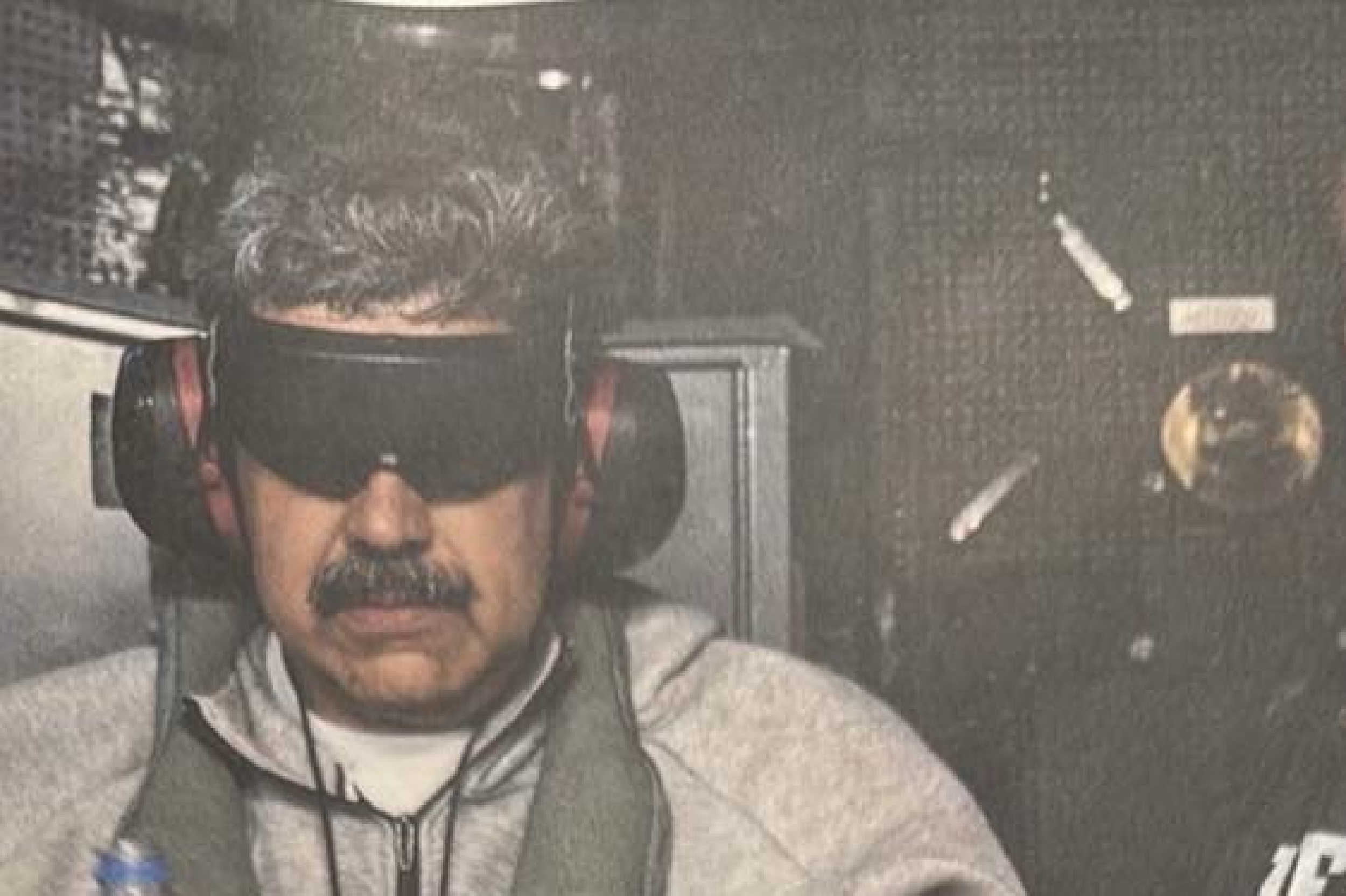
Nicolás Maduro aboard the USS Iwo Jima following his capture by U.S. forces; U.S. officials say he has since been transferred to New York. Photo Credit: PRESIDENT DONALD TRUMP.
President Donald Trump said Saturday that the United States will temporarily assume control of Venezuela following the capture of President Nicolás Maduro, describing the move as necessary to ensure what he called a “safe, proper, and judicious transition” for the country and to prevent Venezuela’s oil resources from falling into the hands of U.S. adversaries.

Trump made the remarks during a press conference after announcing that U.S. forces had conducted a “large-scale strike” inside Venezuela that resulted in the detention of Maduro and his wife, Cilia Flores. While outlining his vision for Venezuela’s immediate future, Trump emphasized securing the nation’s oil infrastructure but did not specify how long U.S. oversight would last or what governing structure would be put in place.
The president’s comments followed an earlier post on Truth Social in which he said Maduro had been captured and removed from the country. White House officials later confirmed that Maduro and Flores were being transported to the United States for processing, marking the culmination of months of escalating U.S. pressure against the Venezuelan government.
According to reporting, the operation involved U.S. special forces deployed under Operation Southern Spear and targeted Maduro’s compound. The announcement came after overnight reports of explosions and gunfire in Caracas. Venezuelan state media initially characterized the events as unrelated before ceasing coverage.
Trump’s declaration caps a long campaign by the United States against Maduro that began with Washington’s rejection of his 2018 reelection as fraudulent and the recognition of opposition leader Juan Guaidó as interim president in 2019. Since then, U.S. actions have expanded to include economic sanctions, the designation of Venezuelan entities as terrorist organizations, a military buildup in the Caribbean starting in August 2025, interdictions of suspected drug vessels, and a blockade of Venezuelan oil tankers in December. Trump had also issued a public ultimatum offering Maduro safe passage if he stepped down.
Following the president’s announcement, U.S. Attorney General Pam Bondi said Maduro and Flores had been indicted in the Southern District of New York on charges including narco-terrorism conspiracy, conspiracy to import cocaine into the United States, possession of machine guns and destructive devices, and conspiracy to possess such weapons. In a statement, Bondi said the couple would “face the full wrath of American justice” on U.S. soil, thanked Trump for demanding accountability, and praised the military for executing the capture. The indictments revive and expand charges first brought against Maduro in 2020, reflecting the Justice Department’s continued focus on his alleged ties to drug trafficking networks, including the Cartel de los Soles.
The ripple effects of the operation were felt beyond Venezuela. The Federal Aviation Administration imposed temporary airspace closures over Puerto Rico and the U.S. Virgin Islands until at least 1 a.m. Eastern Time on January 4, citing heightened security risks tied to military activity. Officials referenced concerns about possible retaliatory actions and the risk of incidents involving U.S. military assets operating at an elevated tempo. Airlines rerouted or suspended flights, and passengers were urged to check with carriers for updates. The restrictions have since been lifted.
International reaction was swift and divided. Russia and China condemned the operation as a violation of Venezuelan sovereignty and called for an emergency meeting of the United Nations Security Council. Some Latin American governments, including Colombia, expressed support for efforts aimed at stability, while others, such as Brazil and Mexico, urged restraint, citing concerns over migration flows and broader regional instability.

In the United States, congressional leaders from both parties requested briefings on the operation. Republicans largely expressed support for Trump’s actions, while Democrats raised concerns about potential overreach and long-term foreign policy consequences.