

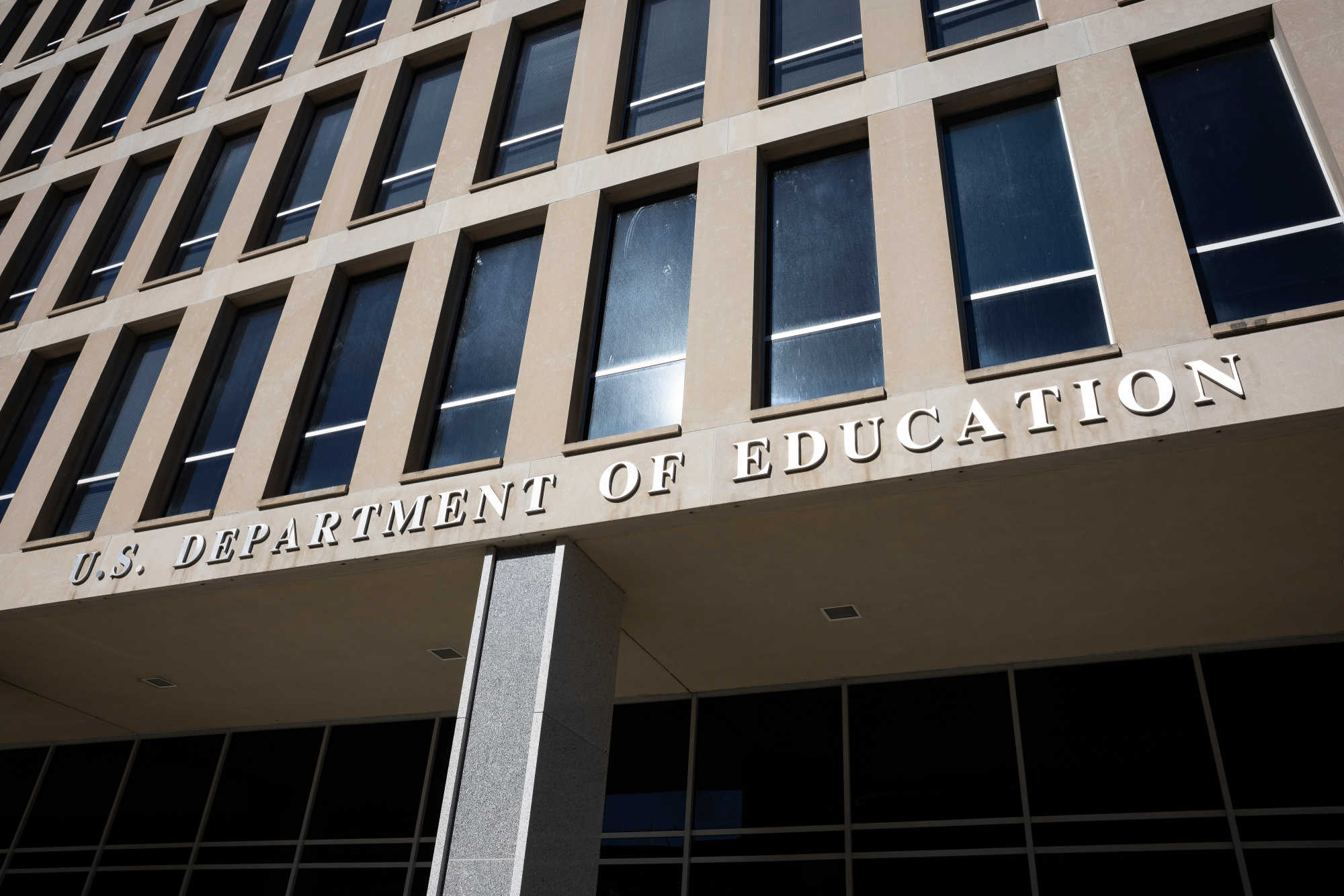
U.S. Department of Education headquarters.
In a landmark decision, the U.S. Supreme Court on July 14 granted the Trump administration the authority to proceed with significant layoffs at the U.S. Department of Education, lifting a lower court injunction that had halted the plan.

The 6-3 ruling allows the administration to cut approximately 1,400 employees—nearly one-third to half of the department’s workforce—advancing President Donald J. Trump’s campaign pledge to reduce the federal government’s role in education. While the decision does not permit the complete dismantling of the department without congressional approval, it marks a pivotal step toward reshaping federal education policy.
The Supreme Court’s order, issued on the emergency docket, paused a preliminary injunction from U.S. District Judge Myong J. Joun, who in May 2025 had blocked the administration from laying off 1,378–1,400 Department of Education employees. Joun’s ruling, upheld by the First Circuit Court of Appeals, required the reinstatement of these workers and halted the transfer of key functions, such as federal student loan management, to other agencies like the Treasury Department. The Supreme Court’s decision reverses that block, allowing the layoffs to resume while litigation continues in lower courts.
The layoffs stem from an executive order signed by President Trump on March 20, 2025, directing Education Secretary Linda McMahon to downsize the Department of Education “to the maximum extent” permitted by law. The order aimed to reduce federal bureaucracy and shift education responsibilities to states, aligning with Trump’s long-standing goal of decentralizing education policy. While the administration cannot fully eliminate the department without congressional action, the layoffs represent a significant reduction in its operational capacity.
The case, American Federation of Teachers et al. v. Department of Education, pits the administration against a coalition of 20 Democratic-led states, the District of Columbia, teachers’ unions, and school districts. Plaintiffs argued that the mass layoffs were an attempt to “effectively dismantle” the department without congressional approval, violating the separation of powers. Judge Joun agreed, stating in his May 22, 2025, ruling that the cuts would “likely cripple the department” and undermine its ability to carry out congressionally mandated functions, such as administering federal student loans, enforcing civil rights laws, and distributing education grants.
The Trump administration, represented by Solicitor General D. John Sauer, countered that the executive branch has the constitutional authority to manage staffing levels and internal operations of federal agencies. Sauer argued that the layoffs targeted “discretionary functions” better handled by states, not the department’s core statutory obligations. The Supreme Court’s majority, led by its conservative justices, sided with the administration, though the lack of a detailed opinion leaves the legal reasoning opaque.
The three liberal justices—Sonia Sotomayor, Elena Kagan, and Ketanji Brown Jackson—dissented sharply. In a blistering opinion, Sotomayor called the decision “indefensible,” warning that it “effectively grants the executive branch a new power to repeal statutes by firing all those necessary to carry them out.” She argued that the layoffs could hollow out the department’s ability to serve millions of students, particularly those reliant on federal programs like Pell Grants and Title IX protections.
Education Secretary Linda McMahon hailed the ruling as “a significant win for students and families,” emphasizing that it affirms the president’s authority to streamline federal agencies. “We’re cutting bureaucracy and returning education to the states, where it belongs,” McMahon said in a statement. “The Department of Education will continue to perform its legally required functions, but we’re eliminating waste and focusing on what works for our kids.”
The administration’s plan involves not only staff reductions but also transferring certain functions, such as student loan oversight, to other federal agencies.
The executive order also encourages states to take on greater responsibility for education policy, aligning with Republican priorities of local control. Supporters argue this approach will reduce federal overreach and allow states to tailor programs to their unique needs. “States know their schools better than Washington bureaucrats,” said a spokesperson for Senate Majority Leader John Thune. “This is a step toward empowering communities.”
Regarding the U.S. Virgin Islands' stance on the new ruling, in March, Governor Albert Bryan Jr. told the Consortium that he aligned with many of Trump's policies, including education reform, particularly efforts to reduce bureaucratic hurdles that delay the allocation of federal education dollars to states and territories. According to Mr. Bryan, funding restrictions often prevent local education departments from effectively addressing critical staffing shortages, among other challenges. He highlighted how deregulation could enable the territory to spend funds more efficiently and meet pressing educational needs.
Opponents warn that the layoffs could severely impair the Department of Education’s ability to serve millions of students, educators, and institutions. The department, with a budget of approximately $80 billion annually, oversees critical programs, including $30 billion in Pell Grants for low-income college students, $15 billion in Title I funding for disadvantaged K-12 schools, and enforcement of civil rights protections under laws like Title IX. Sheria Smith, president of the American Federation of Government Employees Local 252, called the layoffs a “callous act” that risks “devastating the educational services that millions rely on.”
The National Education Association (NEA), representing 3 million educators, echoed these concerns, estimating that the cuts could disrupt services for 50 million public school students and 7 million college students who depend on federal aid. “This isn’t streamlining—it’s sabotage,” said NEA President Becky Pringle. “Reducing the department’s workforce by nearly half will gut its ability to support our most vulnerable students.”
The Congressional Budget Office (CBO) has not yet released a detailed analysis of the layoffs’ impact, but a 2024 report on similar proposals suggested that significant staff reductions could lead to delays in loan processing, reduced oversight of federal grants, and weakened enforcement of anti-discrimination laws. The 21 Democratic state attorneys general involved in the lawsuit warned that the cuts could disproportionately harm low-income and minority students, who rely heavily on federal programs.
The Supreme Court’s decision aligns with other recent rulings supporting the Trump administration’s efforts to reduce federal agency staffing, including at the Departments of Housing and Urban Development, State, and Treasury. These rulings reflect a broader conservative push to limit the size and scope of the federal government, bolstered by a 6-3 conservative majority on the Court. The decision also comes amid other executive actions, such as the “One Big Beautiful Bill Act” signed on July 4, 2025, which restructured housing and welfare programs, signaling a concerted effort to decentralize federal authority.
However, the Department of Education’s fate remains tied to Congress. While the layoffs can proceed, fully eliminating the department would require legislation, a prospect that faces significant hurdles in a divided Senate. The administration’s 2026 budget proposal, which includes further cuts to education funding, will likely face intense scrutiny in upcoming congressional debates.

Meanwhile, the case returns to lower courts, where plaintiffs will continue to argue that the layoffs unlawfully circumvent congressional authority. Legal experts predict a protracted battle, with potential appeals revisiting the Supreme Court in 2026 or beyond. In the meantime, the Department of Education is expected to begin implementing the layoffs, with notices already issued to affected employees in March 2025.