
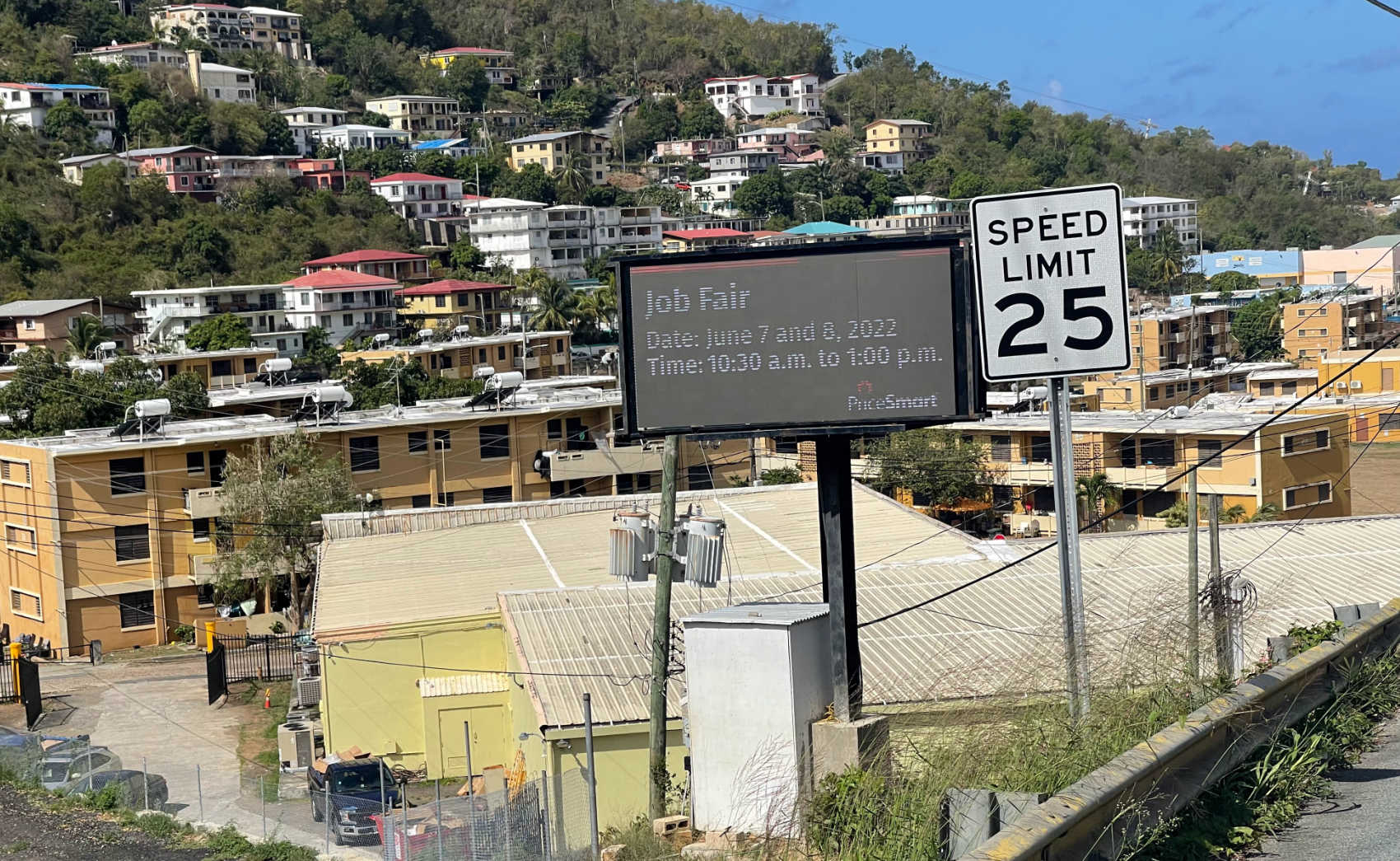
A billboard from a company called Smart Signs in St. Thomas. Photo Credit: V.I. CONSORTIUM.
A tense debate over free speech, private-property rights, and government authority unfolded Friday as lawmakers confronted longstanding concerns about the territory’s signage laws. Senator Carla Joseph’s proposal to remove the Department of Public Works’ power to regulate signs on private land drew broad interest from senators who agreed the current statute overreaches, yet held the measure temporarily while they worked to revise setback requirements and address safety issues that could reshape how signs are governed across the Virgin Islands.

Senator Joseph presented Bill 36-0052 to the Committee on Government Operations, Veterans Affairs, and Consumer Protection, explaining that the proposal aims to clarify that the statute governing advertising devices applies “exclusively for public property.” The bill would amend Title 29, Chapter 9, Section 502 by striking the phrase “whether on public or private property” and inserting “on public property,” removing private property from DPW oversight.
The St. Thomas lawmaker argued that existing language in the statute has created “uncertainty regarding the rights of property owners.” Free speech, she said, “must be safeguarded, not restricted, especially on private property, where individuals have the strongest protections over their speech.” Joseph insisted that refining the law’s scope would “uphold the fundamental civil liberties while maintaining reasonable regulation of public spaces.”
Under current law, no advertising device may be erected or maintained on publicly owned property or within 50 feet of the center line of a public highway without written approval from the DPW commissioner.
DPW Commissioner Derek Gabriel strongly opposed the measure. However, his opposition was rooted largely in operational and financial concerns rather than the constitutional issues raised by lawmakers. He said the existing permitting process helps “maintain public safety and consistent oversight over all advertising devices,” and warned that removing DPW’s authority over private property would “significantly” undermine the goals of the territory’s advertising program. Permit fees, Gabriel noted, are a key revenue source that allows the department to monitor and regulate signage throughout the Virgin Islands. Without them, DPW would struggle to identify sign locations or enforce safety rules intended to prevent visibility obstructions for drivers.
Gabriel also said the bill “appears to favor a specific group of stakeholders,” though he did not identify who those stakeholders would be or explain how the legislation would advantage them. He further cautioned that weakening signage enforcement may jeopardize compliance with federal standards and potentially affect funding.
Testifiers offered differing perspectives. Realtor Roger Minkoff, appearing in his personal capacity, supported the bill as a chance to “provide legislative support of The First Amendment of the U.S. Constitution.” Meanwhile, Russell Pate, president of the Virgin Islands Bar Association, reminded senators that even if “private property” is removed from the statute, the government still holds an easement interest along public roadways. If a sign obstructs sight lines, he said, the government retains the “authority to request the billboards be moved, modified or taken down for the protection of health and public safety.”
As deliberations continued, senators acknowledged the need to balance free-speech considerations with roadway safety. Senator Novelle Francis recommended differentiating requirements for major highways versus narrow community roads, noting that a 50-foot setback from the center line can extend deep into private parcels. Senator Marvin Blyden agreed, remarking that for small roads “it’ll be part of the house.”
Pate encouraged lawmakers to reexamine the provision. “Fifty feet from the centerline does not quite make sense because the larger the road, the less easement jurisdiction the government has,” he said. “That’s one of the easiest fixes.”
Senator Alma Francis Heyliger supported Senator Joseph’s intent as long as safety considerations remain. She said the 50-foot rule “might be a little too much,” adding that government must stop “overstepping our boundaries.” She also noted the Legislature can establish a cap on the number of signs allowed on a property.
Senator Joseph announced that a pending amendment would reduce the setback from 50 feet to 10 feet. Commissioner Gabriel noted that a typical two-lane road in the territory ranges from 18 to 25 feet wide, meaning that if 10 feet is calculated from the centerline, nearly all private property would fall outside the permitting requirement entirely. Senator Kenneth Gittens suggested a different approach: a setback of “10 to 20 feet…from the roadway edge.”

With amendments still being drafted, the committee opted to hold the bill until the revised language is complete. Senator Joseph said she hopes to return the legislation for further consideration in short order.