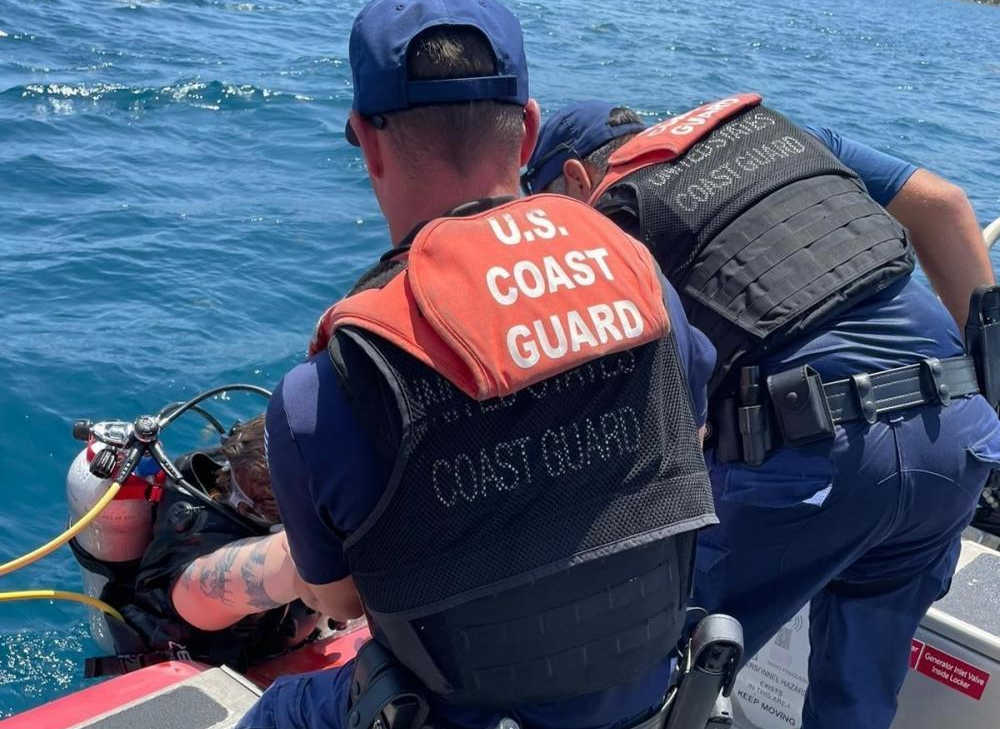
A Coast Guard Boat Forces Detachment Saint Thomas crew rescued two divers in distress the afternoon of Sept. 9, 2021 from the middle of the channel just off Coki Point, St. Thomas, USVI. Photo Credit: U.S. COAST GUARD.
Individuals who ignore marine advisories and later require emergency rescue during hazardous weather conditions could face financial penalties under legislation advanced Monday by the Committee on Budget, Appropriations, and Finance.

Bill No. 36-0209, sponsored by Sen. Hubert Frederick, proposes the creation of civil penalties for disregarding marine advisories and establishes a Territorial Marine Safety Fund. Frederick introduced the measure during the committee’s meeting, framing it as a response to what he described as repeated and avoidable emergencies on territorial waters.
Community members voiced frustration following an August 16 rescue in which individuals were pulled from rough seas and deteriorating weather, despite marine advisories that had been issued ahead of the incident.
The senator said the legislation addresses “serious and preventable dangers” that arise when people choose to go out to sea despite warnings. “These reckless actions endanger our first responders and cause a strain on the very limited resources we have,” Frederick told lawmakers. As written, the bill proposes a $500 civil penalty and creates a dedicated fund intended to ensure that “every dollar collected is reinvested into the emergency response effort and equipment.”
Frederick described the proposal as being about “saving lives, promoting responsible behavior, and protecting the men and women who respond to dangerous situations at sea.”
The V.I. Police Department voiced support for the measure. Assistant Police Commissioner Sean Santos testified that the bill would serve as “a powerful deterrent against reckless behavior on our waters.” He said the establishment of a fund would be “a significant step forward” by ensuring that money collected through penalties is reinvested back into the community.
Support also came from the Virgin Islands Territorial Emergency Management Agency. VITEMA issues marine advisories based on guidance from the National Weather Service in Puerto Rico.
The Department of Planning and Natural Resources likewise supported the intent of the bill. Commissioner Jean Pierre Oriol testified that there have been “several incidents” where individuals ignored marine warnings and went out to sea, including a rescue as recently as August 2025. He said such actions “put my officers in harm’s way unnecessarily” and agreed that a civil penalty is appropriate for what he characterized as “selfish actions.”
Oriol, however, raised several concerns with the bill’s current language. He noted that the measure specifically references advisories issued by the U.S. Coast Guard, National Weather Service, DPNR, VIPD, VITEMA, and Virgin Islands Fire and Emergency Medical Services. He recommended revising the language to explicitly refer to “public safety notices issued by any of the following agencies” to avoid confusion.
He also suggested tying the advisory standard to U.S. Coast Guard port conditions to better define when marine conditions are considered dangerous. According to Oriol, not all small craft advisories necessarily mean vessels should remain in port. He stressed the need for “a hard definition of when this advisory or stay in port goes out.”
In addition, Oriol argued that a higher fine would be more effective, stating that “a penalty of $1,500 would be much more effective as a punitive measure than $500.”
Oriol also discouraged the creation of a centralized fund administered by the Department of Finance and distributed among multiple agencies. “I think this is the perfect example of too many cooks in the kitchen,” he said, suggesting instead that any penalties collected be directed into existing special funds within the issuing agencies.
Despite these concerns, Bill 36-0209 advanced without amendments. Lawmakers indicated, however, that changes could be introduced as the bill continues through the legislative process.
Several senators acknowledged the need for clearer language. “It is very important that agencies and departments understand what it is we’re asking them to do,” said Sen. Marise James.
Sen. Kurt Vialet agreed with Oriol’s concerns about the proposed fund, arguing that the amount collected annually would likely be minimal and that dividing it among several agencies would dilute its impact. “What are you really going to buy?” Vialet asked, suggesting instead that the agency issuing a citation retain the funds in its own special account.
VITEMA Director Daryl Jaschen urged lawmakers to strike a balance between deterrence and public safety. “Ultimately, we want to save lives. We want to have people make good decisions, but please not to the point that they don’t want to ask for help and support because they don’t have the dollars in their pocket,” he said.
Frederick also disclosed that a future amendment — not formally offered during Monday’s meeting — would significantly increase penalties. Under that proposal, a first offense would carry a $2,000 fine, a second offense $3,000, and a third offense $5,000 along with a 30-day prison sentence. According to Frederick, the “enhanced penalties reflect the true severity of this regarding public safety warnings.”

Bill 36-0209 now moves to the Committee on Rules and Judiciary, which is scheduled to meet in January, where lawmakers are expected to further refine the proposal.