

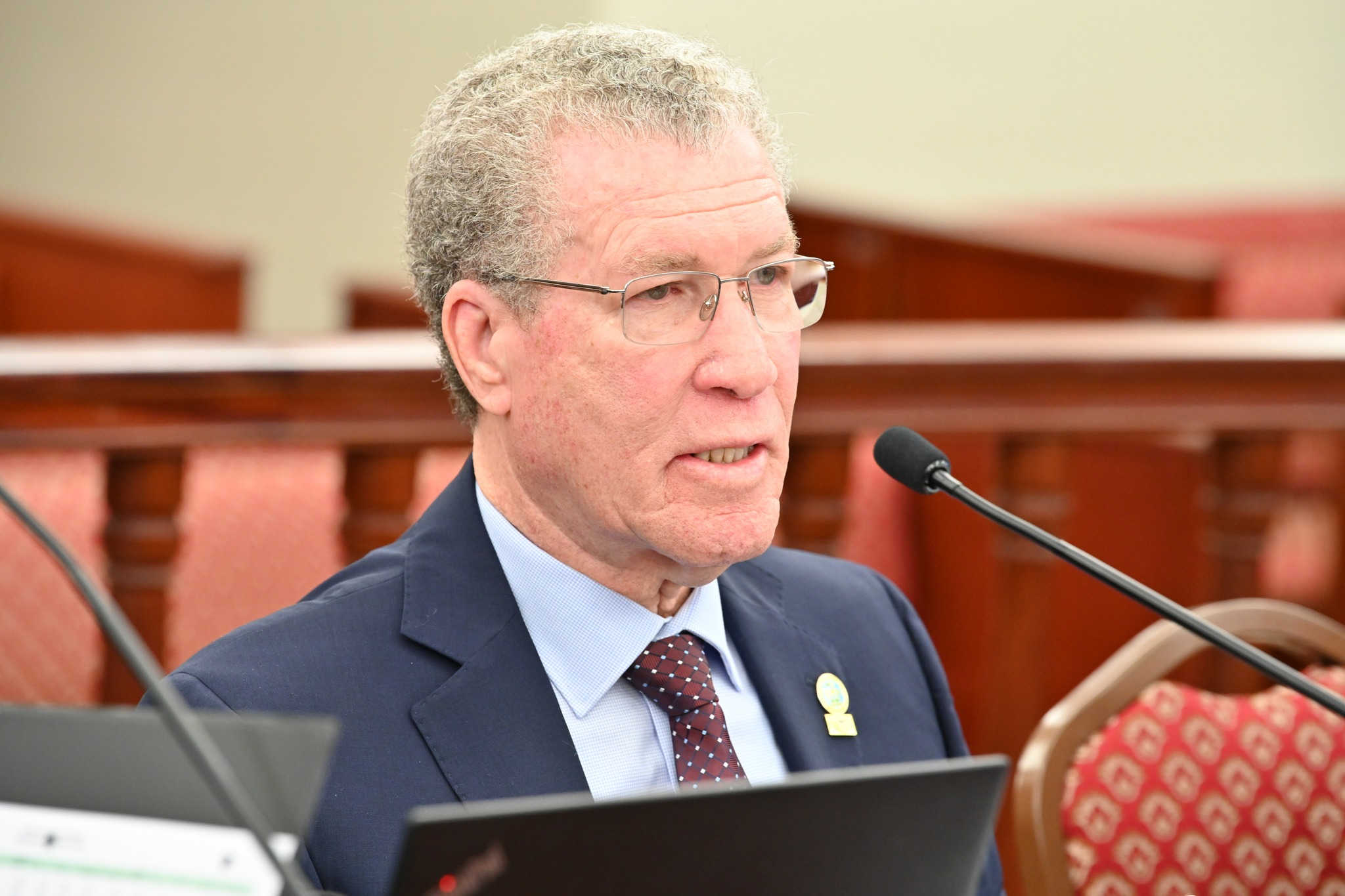
Supreme Court Chief Justice and leader of the judiciary, Rhys Hodge. Photo Credit: V.I. LEGISLATURE.
The Judiciary of the Virgin Islands made its annual appearance before the Legislature on Thursday to defend its budget request for FY2026. The Judiciary is requesting a total budget of $53,096,326, with an additional request of $145,342 for the Judicial Council, and $1,105,131 for the Office of Conflict Council.

Chief Justice Rhys Hodge, in his testimony, reminded lawmakers that the budget of the judicial branch should not be influenced by the executive, something that is written in local law. The Judiciary, therefore, is required to submit its budget directly to the Legislature, with a copy shared with the governor. But as Justice Hodge testified, this no longer seems to be the modus operandi.
“Despite these well-established national principles and the requirements of local law, the executive branch annually imposes a budget ceiling amount for the Judiciary, as though it were just another executive agency of the government,” the chief justice said. “This ceiling is imposed with the strict instruction that the fixed ceiling is not to be exceeded without the governor's approval, and that ceiling amount is presented in the executive budget as the governor's funding recommendation,” Hodge testified.
He said appropriations over the last nine years “have more closely aligned with the executive branch ceiling recommendations” rather than the Judiciary’s direct request to the Legislature. He lamented that for five years, the Judiciary was kept at the same budget ceiling while “every other agency's budget increased annually.” Though the Legislature offered “slight increases” between fiscal years 2022 to 2024, Justice Hodge said that in FY2025, “it once again adopted the governor's exact recommended ceiling for fiscal year 2025, resulting in a 3.3% reduction.”
The chief jusice has therefore pleaded with the Legislature to approve its $53,096,326 request without the “arbitrary budget ceiling recommendation of the governor and the executive branch.”
The budget breakdown includes $24,864,744 for salaries and $11,280,309 for fringe benefits. Services and other charges will cost $5,969,359, while $6,568,941 is allocated for capital expenditures, $1,964,416 for utilities, $1,038,500 for other personnel services, and $700,000 for supplies.
The total personnel costs, inclusive of salaries and fringe benefits, “include the 4% compensation scale adjustment requested in fiscal year 2025, totaling $922,982, but not funded,” Chief Justice Hodge explained. The Judiciary intends to fill 55 “critical vacancies” in the upcoming fiscal year “at a prorated cost of $2,769,882 with fringe.”
The aforementioned 4% was calculated after a market review study, which determined the Judiciary’s compensation structure needed to be increased by that percentage. “The 3.3% reduction in appropriated funding to the branch made it impossible to do so this year,” the Chief Justice explained. The Judiciary, he said, has already used its “moderate funding” for salary increases. Hodge believes that providing the 4% increase will result in increased retention, a challenge that the Judiciary continues to battle. “Our inability to implement the promised adjustment was both disappointing and a difficult broken promise to our employees,” he stated.
The Judiciary’s payroll projects do not account for impending increases by the Government Employees' Retirement System (GERS). “It would be necessary to increase our request by an additional $100,144 to cover the 3% increase for the first quarter of fiscal year 2026”, if the increase is implemented, Hodge noted.
The 3.3% reduction has placed the Judiciary in a position where it “struggles to meet legislative and other mandates at the expense of other funding priorities,” Hodge testified. That includes capital improvements, including roof replacement on the RH Amphlett Leader Justice Center. This year, they’ve included a request of $4,100,000 to continue the work. Cybersecurity upgrades and vehicle replacements to the tune of $366,000 are also included.
However, despite Hodge’s best attempts at stressing the importance of granting the Judiciary’s funding recommendation, Senator Hubert Frederick posed what has become a favorite question. “What are you guys doing as a separate branch of government to curb your operational costs so that you can, in fact, operate within reasonable budgetary measures?” he wondered.
“We have been basically operating lean,” Justice Hodge replied. “We've gotten at least $10 million less than we asked for, and we have always lived within that and at the expense of foregoing projects that we need.” Issues with water and air conditioning infrastructure regularly force the Judiciary to close its office. “It's about time that we actually start paying attention to these. If not, it's going to adversely impact the court.”
Sen. Frederick doubled down. “What stood out to me when I was reviewing your documentation, is you have 138 vehicles in the judicial branch…With all due respect, your rate of pay, the resources you have allocated, it's far more than the other two branches.” He remarked that other agencies “don't have a fraction of the cars that you have.”
“I find it a little difficult to hear how hard you're having it when other agencies that provide direct services don't even have a 20% automobile ratio to employees,” said Frederick.
“We actually have a shortage of vehicles,” Chief Justice Hodge countered, noting that most of the judiciary's fleet are assigned to court marshals.
Senator Carla Joseph sided with the Judiciary. “I find it very alarming when I hear conversations about and comparisons relative to the judicial branch and agencies, because that's a branch of government, and they cover the entire territory,” she stated. “I hear your plea and I understand it clearly.” Your allotment is not being honored, your amount of appropriation, a request where you come before this body isn't being honored,” she observed.
Even the allotments for FY2025, diminished as they were, are slow to be released. The Judiciary must request cash draws for the Department of Finance, which their chief financial officer says they complete on time. Their April allotment was received in May, but only in part. “It was a portion of that. The request was for $924,100, and we received $885,140.68. We have a June request that's outstanding for $1,003,400,” Paulette Simmons, the CFO, made known.
Funding for the Office of Conflict Council to the tune of $500,000 is also outstanding. “The judiciary proper has been absorbing those costs,” explained Regina deChabert Petersen, the administrator of courts. She has requested the release of funds from the Office of Management and Budget, but reminded lawmakers that the OCC was an “unfunded mandate.” The Judiciary remains challenged in accessing those funds.

Now, the judicial branch is depending on its sister branch, the Legislature, to fund its $53,096,326 budget, as well as the requests for the Judicial Council and Office of Conflict Council.