





 77°F
77°F


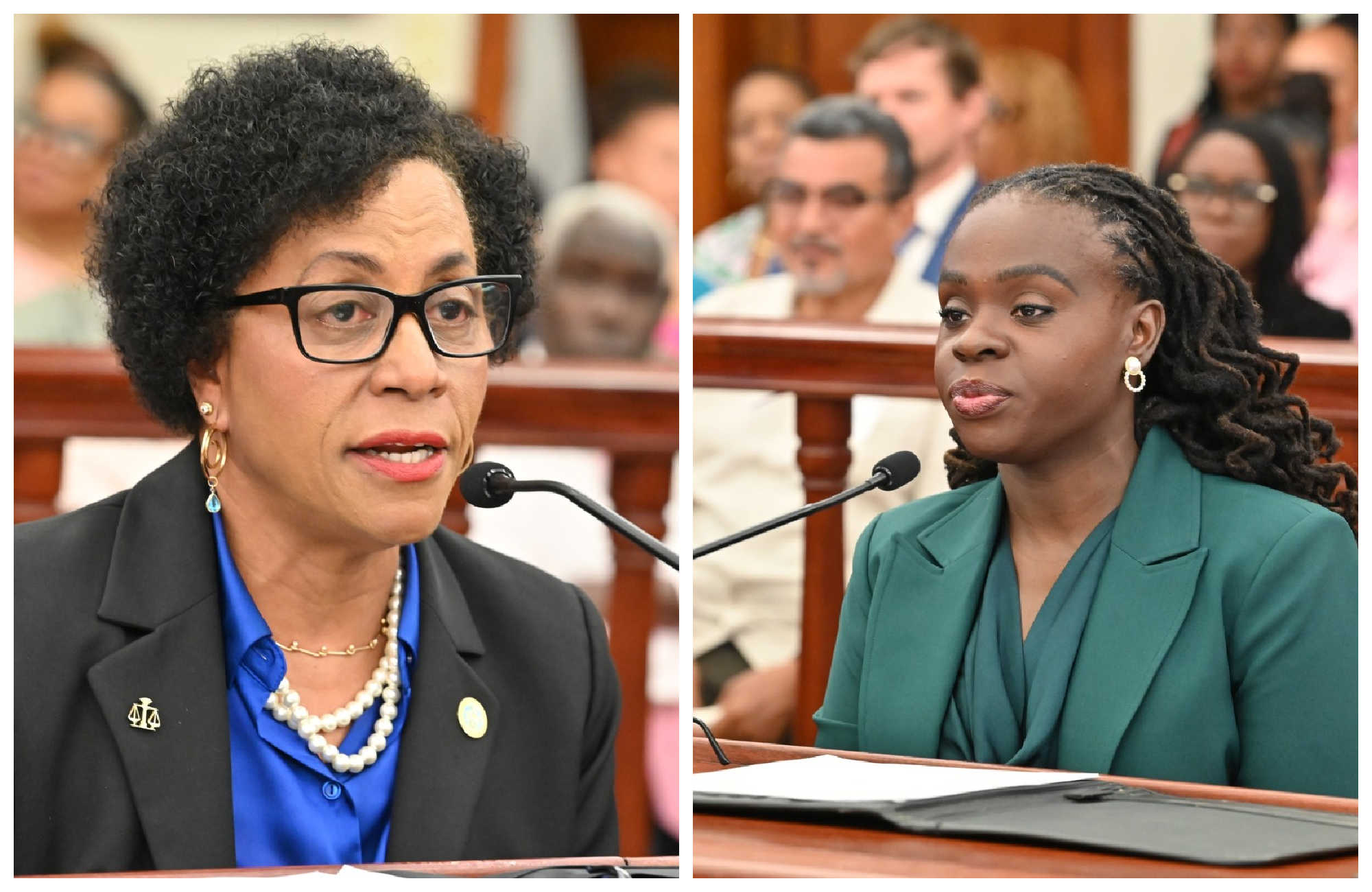
From left to right, Venetia H. Velazquez and Melanie Turnbull. Photo Credit: V.I. LEGISLATURE.
The Committee on Rules and Judiciary on Thursday advanced two nominees to fill judicial vacancies on the Superior Court, backing a pair of Virgin Islands attorneys whose careers span public defense, mediation, community service, and case management. The hearing centered on their qualifications, judicial philosophies, and plans for addressing longstanding concerns about access to justice and court backlogs.

Venetia H. Velazquez, nominated to serve on the Superior Court District of St. Croix, testified first. A former journalist and teacher, she was admitted to the Virgin Islands Bar in 2001 and is a certified mediator who has held several leadership roles within the Virgin Islands Bar Association. Ms. Velazquez told lawmakers she has served at “every level of the justice system,” including as an assistant territorial public defender and, for the past year, as a magistrate judge.
During that year, she said she has “issued 570 orders in civil cases, and closed 532 of those cases.” She has issued 282 probate orders and closed 46, with a pending probate caseload of “approximately 139 cases, and that includes 68 new cases that were filed in the past year.” If confirmed, she pledged to continue ensuring “full access to the courts through timely decision making without compromising thoroughness and reasoning,” and plans to “immediately begin assessing and triaging the case docket I would inherit to identify potential conflicts and determine whether there are delays that may be ameliorated.”
Attorney Melanie Turnbull, nominated to the Superior Court’s Family Division on St. Thomas, provided her testimony next. Her local legal career began as an appellate law clerk before becoming a public defender handling a felony docket, with additional experience in juvenile matters in the family division. Ms. Turnbull emphasized that “service to both the legal and broader community has always been a core part of my identity here in the Virgin Islands,” pointing to volunteer roles with the Virgin Islands Justice Initiative and her work as a moot court coach at Ivana Eudora Kean High School. These experiences, she said, have given her “a broader understanding of the challenges families face, educationally, socially and economically.”
If confirmed, Ms. Turnbull said she intends to approach her work with “fairness and impartial judgment, empathy for children and families in crisis, firmness to ensure safety and accountability,” and other foundational principles. She described the family court as “a unique and demanding assignment requiring a judge who can maintain objectivity, navigate conflict, and issue decisions that prioritize the well being of children and other members in need.” She is set to succeed Judge Debra S. Watlington — a full-circle moment, as her first legal experience was as an intern in the territorial public defender’s office then headed by Judge Watlington.
With several vacancies across the Superior Court, Senator Carla Joseph said the committee intends to move nominations “where possible” to support timely justice. “We understand that justice shouldn't take a long time,” she said, joining colleagues in commending both nominees for their willingness to serve and expressing confidence in their leadership.
The nominees also outlined their own goals. Ms. Turnbull said she wants to expand access to justice by digitizing “forms for basic, repetitive and redundant needs,” including “checklists for guardianship petitions” and “checklists for what an individual will need for visitation.” She anticipates that such tools will help unrepresented individuals “see all the things that they need to do in order to file their petitions and get the answers that they need from the court.”
Case backlog concerns drew sustained attention from lawmakers. Senator Angel Bolques Jr. questioned how they planned to confront the longstanding challenge. Magistrate Velazquez acknowledged that the backlog is “complicated” but “important” to address, emphasizing deadlines and clear expectations as central to her case-management approach. Ms. Turnbull, who has not yet served as a judge, promoted “early resolution and alternative dispute resolution” and later said that “vigorous, aggressive case management is what will address the community getting the justice that they seek.”
Lawmakers closed the hearing with strong support for both nominees as they prepare for potential confirmation. Ms. Turnbull, poised to serve as a judge for the first time, said she feels “very confident in my abilities to navigate the family division.” Ms. Velazquez, already on the bench as a magistrate, said she hopes to complete her tenure “knowing that I had left it in a better state than I found it.”

Both nominations will be taken up at the next legislative session for further action.