

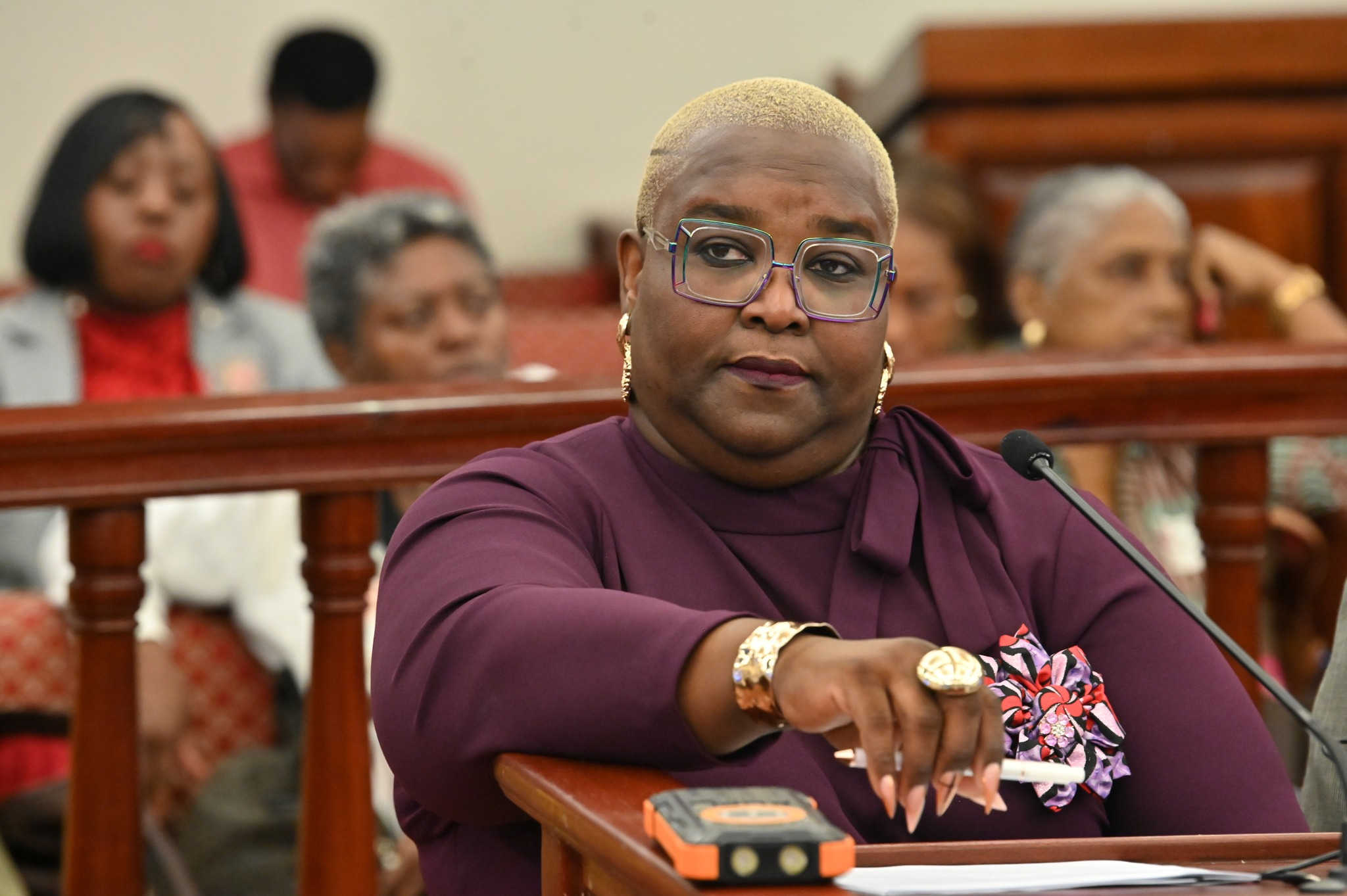
GESC Chair Beverly Joseph defends the board’s role in overseeing health coverage, warning of risks to sick employees under a premature self-funded plan. Photo Credit: V.I. LEGISLATURE.
A proposal to explore a shift from the government’s current fully insured health insurance model to a self-funded system is raising concern among lawmakers, board members, and stakeholders—especially those worried about the Virgin Islands government's ability to manage health insurance payments reliably. Despite the interruption in debate caused by a power outage, lawmakers heard enough to ultimately reject the measure.

Sent down by Governor Albert Bryan Jr. for Friday’s special session, Bill No. 36-0126 seeks to establish a special committee to issue a Request for Proposal (RFP) for the provision of a self-funded group health and dental insurance plan for government employees and retirees. In correspondence submitted to the Legislature, Governor Bryan said the measure was prompted by “the significant rise in premiums under the existing fully funded plan,” calling the current trajectory of healthcare costs unsustainable and in need of “decisive legislative action.”
Supporters of the bill—including Commissioner of Finance Kevin McCurdy and Director of Personnel Cindy Richardson—highlighted potential cost savings and administrative efficiencies. Mr. McCurdy noted that over $1.2 billion has been spent by the government on premiums over six years, arguing, "yet our health care outcomes and infrastructure do not reflect that level of investment." He warned that the current system is unsustainable with an anticipated 19.5% premium increase. "That's $34 million we won't have anymore," he said.
But Beverly Joseph, Chair of the Government Employees Service Commission (GESC) Health Insurance Board, challenged the administration’s approach, asserting that the board already possesses the tools and expertise needed to explore self-funding. She took issue with Section 6 of the bill, which explicitly removes the board from participating in the RFP process.
“If anyone has a conflict of interest, it’s the Director of Personnel,” said Ms. Joseph, responding to Director Richardson’s claim that the board may be too close to the current carrier, Cigna. Ms. Joseph said the board includes certified fiduciaries and subject matter experts and actively collaborates with the government’s consultant, the Gehring Group, to identify cost-saving strategies.
“The board is not saying no to self-funding,” she said. “We’re just asking, can you sustain it?”
Ms. Joseph highlighted the board’s consistent review of claims data and said the real driver of rising costs is the deteriorating health of plan members. She cited increased use of GLP-1 drugs for diabetes and weight loss and noted that 12 plan members have racked up costs exceeding $2 million. She also criticized the administration for missing GESC meetings and failing to send representatives from other advisory arms such as OMB and Finance.
“The data is presented and sent to [Richardson’s] office before our board meetings,” Joseph said. “She has it.”
Joseph warned that delays in claims payments under a self-funded model—where the government directly assumes financial risk—could be catastrophic for sick employees. “If you don’t have the money, claims don’t get paid, and people will not get the care they need,” she said.
Senators echoed those fears. Senator Franklin Johnson spoke emotionally about losing a loved one to cancer and questioned how the government could sustain reliable payments under self-funding. “How many lives are we going to lose in saving this dollar?” he asked.
Senator Milton Potter also questioned why the bill excludes the very board created to oversee government health insurance. “We have subject matter experts who’ve been doing this for a while. Why are we eliminating the board from doing its job?” he asked.
In defense, Director Richardson argued that forming a separate committee would reduce potential conflicts of interest and accelerate decision-making. “It’s not about eliminating them fully,” she said. “It’s just for this RFP process.”
However, Joseph pushed back, pointing out that the Gehring Group already conducted a comparative analysis. It showed only a modest 2.5% savings—approximately $4.3 million—under a self-funded model compared to a 19.5% guaranteed increase under the current one. The self-funded model, she warned, would come with an added risk: no guarantee on that 17% increase.
Sen. Potter asked Office of Management and Budget Director Julio Rhymer whether the administration's estimates of $20 million to $50 million in savings by switching to a self-funded model were “based on any specific data.”
“The data is just preliminary,” the OMB director admitted, but affirmed that there are opportunities on the “pharmaceutical side” where insurance companies receive refunds “in excess of, probably $10 to $15 million a year.” That assessment failed to win over Potter, who opined that “it seems very just arbitrary…with no real analytics, with no real data.” He suggested that publicizing these estimated savings figures is a means of “skewing the whole conversation..but those numbers aren't really based on any real-life data.”
Indeed, accurate, reliable data will be critical to the decision-making process. Senator Marvin Blyden reminded the financial team of the USVI’s increasingly aging population. “A self-plan can be sustained if there's a bunch of young people in the plan,” he said. “It is glaring what the choices are in terms of coverage,” added the St. Thomas senator. He considered that the “main problem” with the conversation thus far.
Ms. Joseph confirmed that the government’s insurance plan has more retirees on the rolls; 7,109 compared to 6,984 active employees. That figure includes employees of semi-autonomous and autonomous agencies like the V.I. Port Authority and the University of the Virgin Islands, who will not be obligated to switch to the self-funded plan, thus potentially skewing the ratio further.
Senator Carla Joseph's primary concern was “the potential for high unexpected medical claims that could strain the government's finances.” The GVI is not known for historically running cash surpluses. “We're going to need $208 million, inclusive of the semi-autonomous agency. I don't know if we have all of that money,” Sen. Joseph cautioned. As Senator Angel Bolques Jr. explained, “self-funding requires the government to have millions of dollars in liquidity, perhaps even weekly, to pay out the claims on time.”
Senator Marise James was troubled by “the crisis that we face in terms of a government that is not financially stable enough to have a self-funded plan. That seems to me to be the bottom line.” Indeed, in a self-funded model, coverage boils down to whether the government can afford it. The GESC Health Insurance Board presented lawmakers with a laundry list of reasons why self-funding could place the GVI in a precarious fiscal position.
Chairperson Joseph explained that the government operates on a “legislative appropriations system not built for absorbing spontaneous multimillion-dollar claims.” Therefore, an employer may have to “seek emergency funding, divert capital from other programs or reduce staffing.”
“The impact of unpaid claims reverberates most painfully among the employees themselves,” Ms. Joseph noted. Potential disruptions “could become tragic,” she added. Ms. Joseph also raised fear over the mental and emotional impact on employees. “The risk financially, unpredictability, administrative complexity and employee vulnerability are profound,” she said in her testimony. Chairperson Joseph later warned the Legislature that “you better have that money in the kitty, or else your members don't have access to care.”
As Sen. James noted, the preparatory measures for self-funding would have to include “ensuring predictable funding” and “building sufficient reserves.” OMB director Rhymer himself admitted that “when it comes to fiscal controls and fiscal management, at times, the government lacks it.”
George Rosenberg from V.I. Equicare, a Preferred Provider Organization (PPO), raised this risk as the biggest fear of healthcare providers in the territory. They are “terrified” of the possibility of having to depend on the GVI for healthcare payments. Dr. Rosenberg insisted that a self-funded model could only work in a “reliable” system that is competent in “paying their bills in a timely fashion.” It is “demonstrable that is not the case here,” he pointed out. “To start holding up the payments from the private insurance could be devastating to health care, and I think we would end up losing a lot of physicians.” He assured that the provider community is “not opposed to self-insurance, but fears that being done at this time, in this situation, it could be catastrophic.”

The special session to hear the bill ended prematurely power issues. Nonetheless, senators voted down the bill, meaning all of Governor Bryan’s proposed measures for the special session were either rejected or shelved entirely.