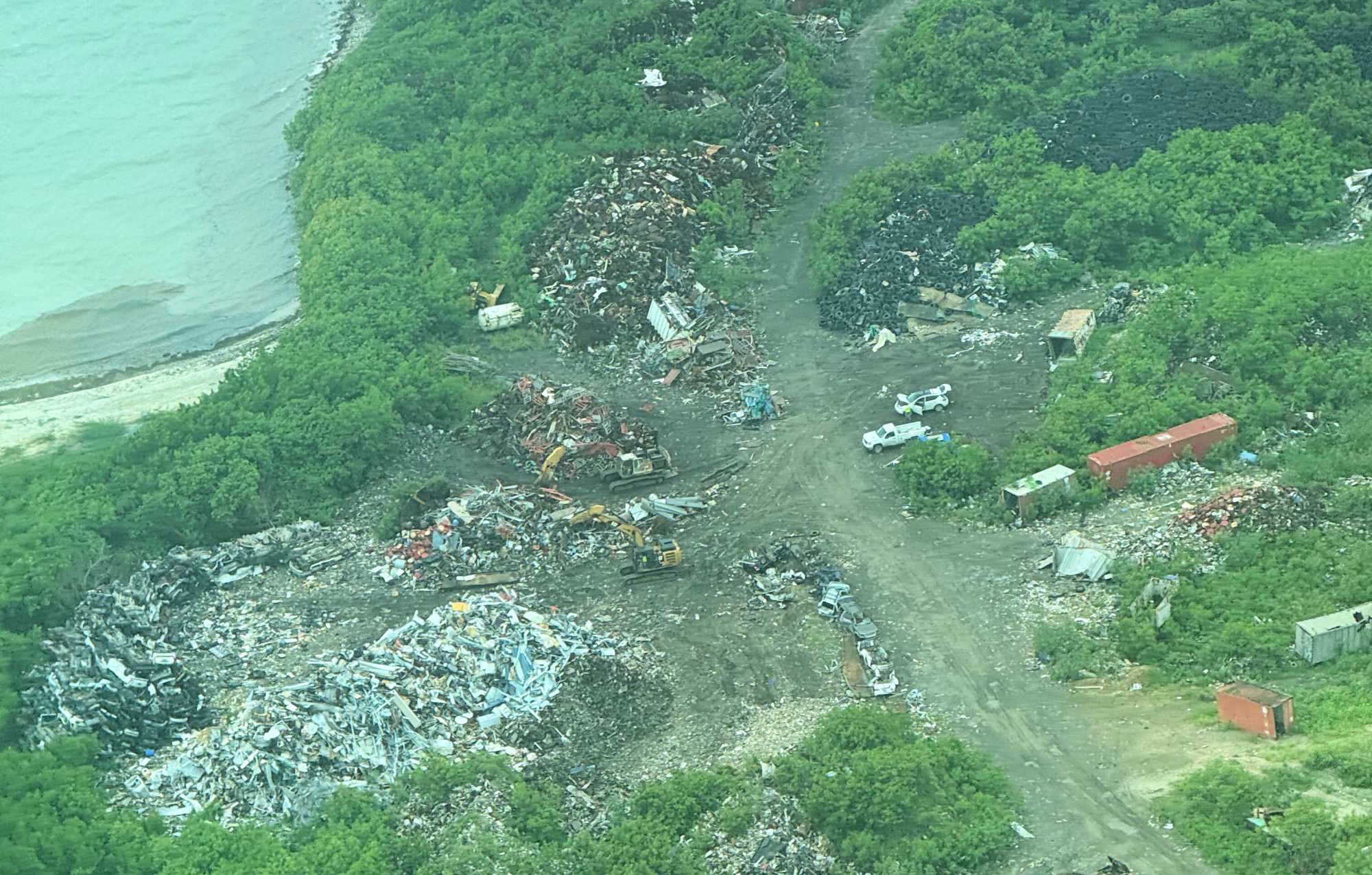
A portion of the St. Croix Anguilla Landfill. Photo Credit: V.I. CONSORTIUM.
Less than two months after taking over as executive director of the Virgin Islands Waste Management Authority, Hannibal Ware delivered his first official briefing to lawmakers on Tuesday, outlining what he described as a waste management system under severe strain. Testifying before the Committee on Government Operations, Veterans Affairs and Consumer Protection, Ware detailed the breadth of challenges facing the agency and the steps underway to address them.

“Our system, stretched far beyond its intended capacity, is now in crisis,” Ware said at the start of his testimony. He described the current conditions as “a culmination of longstanding structural issues, historical underinvestment and aging infrastructural conditions that have left us with limited room for error.”
Ware told senators that both landfills are at capacity, wastewater collection systems are collapsing, and the agency lacks a stable funding structure. Despite the severity of the situation, he pointed to early progress, including a recently secured $46 million grant that will allow for the closure of three-quarters of the Anguilla landfill on St. Croix and expansion of the remaining portion. He said this expansion would provide “approximately five additional years of operational capacity” while a new landfill is designed. Public engagement on possible locations for the new site will begin in January 2026, he added. Parallel efforts are underway for phased closure and expansion at the Bovoni landfill on St. Thomas.
“Bovoni has reached a point where additional surrounding property must be acquired to ensure safe operations,” he told lawmakers. He said grant applications for both landfill projects are under review by the Virgin Islands Housing Finance Authority, and that WMA is resisting efforts by VIHFA to reduce a previously approved $100 million grant due to funding limitations. “We are imploring everyone that we require the full amount to address these major crisis issues,” Ware said, noting both landfills remain under federal consent decrees and are behind schedule on required milestones.
WMA is also using interim measures to extend the lifespan of the landfills. Ware highlighted a vegetative waste management program designed to reduce green waste entering landfill sites. He estimated that 80 to 85 tons of green waste are generated daily across the territory. Federal grants will allow the agency to acquire equipment to reduce bulk and mulch material. “The mulch produced will be available to the Department of Agriculture for distribution to farmers and landscapers,” Ware said, adding that the program is expected to be operational by late summer.
Illegal dumping remains a persistent problem. “Tires, used oil, white goods and construction debris continue to appear in remote areas, creating environmental and public health hazards,” Ware said. Without sufficient machinery, WMA often has to rent equipment to address the piles, increasing operating costs. He called for stronger enforcement and legislative support to curb the practice.
Ware also discussed plans for additional convenience centers on St. Croix and St. Thomas, though he emphasized that expanding door-to-door trash collection would be the most effective deterrent to illegal dumping. A $350,000 grant will fund two rail-loader trucks for a pilot program serving neighborhoods with tight roads and limited turnaround space.
To reduce overall waste heading to the landfills, WMA has partnered with the University of the Virgin Islands to create an integrated sustainable materials management plan, which Ware said will guide “strategic waste diversion, resource recovery, and infrastructure planning.” Completion is expected by April 2026.
Ware additionally asked lawmakers to authorize WMA to burn vegetative debris generated after storms. An air curtain burner, he said, “has the ability to reduce vegetative debris by up to 98% while producing a beneficial biochar product.”
The executive director described the wastewater system as facing “an equally urgent set of risks and obligations,” estimating that a wastewater crisis occurs “every half a day” due to “severely deteriorated infrastructure, much of which is long past its useful life.” Frequent blockages and failures can only be resolved through a “comprehensive overhaul,” he told senators.
While working toward total system replacement, WMA is focusing on the most critical trouble spots, including recent repairs in Estate Tutu on St. Thomas, Estate Mon Bijou on St. Croix, and a main line in Frederiksted. Ware emphasized that the progress was achieved with “a tiny crew of dedicated employees,” and noted that new staff are now in training. He said incoming pumps for several stations, including LBJ, will significantly support ongoing upgrades. “The ongoing efforts to replace large swathes of the territory’s wastewater infrastructure…will be a ‘complete game changer for us,’” he said.
Alongside infrastructure improvements, WMA is pursuing “major initiatives to improve communication and customer service.” The new “Preserve Paradise Now Customer Care Portal” is active, with an awareness campaign beginning soon. The portal allows residents to submit and track service requests using automated routing, dashboards, and timestamped records. Ware also pointed to recent public engagement sessions as evidence of the agency’s “commitment to caring, listening and acting.”
Despite billions of federal dollars obligated for wastewater replacement, Ware said the agency cannot be sustainable without a new funding model. He urged lawmakers to support household and commercial waste fees and updated tipping fees “to reflect national cost recovery standards.” He also called for timely transfer of appropriated funds, stronger enforcement tools, and support for capital investments, including public-private partnerships.
“Under the existing fiscal structure,” Ware said, “full waste collection in this territory is going to be very difficult.” He noted that WMA will not be able to address its $31 million vendor debt under the current system and may require a bailout. He said waste collection fees “would not be overly onerous” and noted that “there is no jurisdiction under the United States flag where we don't have a fee structure for waste collection” aside from the Virgin Islands.
Lawmakers generally responded positively to Ware’s presentation. Senator Alma Francis Heyliger said the agency has not received special appropriations in a timely manner, leaving residents “living in squalor” because WMA cannot pay for services. She said the Legislature may need to ensure future appropriations reach the agency more predictably, even if it requires new mechanisms to distribute funds.
Committee chair Senator Avery Lewis asked how public behavior could shift toward better waste practices. Ware said a comprehensive public education campaign will begin next year and acknowledged that “our agency has to make things a lot more convenient for our people.” With improved service delivery, education, and enforcement, Ware expressed confidence that compliance will rise.
Senator Angel Bolques Jr. urged WMA to expand efforts in “source separation, recycling and repurposing” to reduce the approximately 750 tons of municipal waste received daily. He also called for a crusher on St. John to help remove derelict vehicles. Senator Carla Joseph questioned enforcement, and Ware replied that the agency issues fines, though courts often reduce them. Still, he believes citations remain a deterrent.
Senator Kenneth Gittens praised Ware’s leadership and said he was pleased to see the former federal inspector general at the helm of the agency. Other lawmakers echoed their support, saying they welcome the direction Ware is taking the Waste Management Authority.

In closing, Ware told senators the challenges before the agency are difficult but solvable. “There's some rough waters that we're going through right now to get to where we need to be in the future,” he said. “I will place my all into this job, and I could tell you that those around me…will be doing the same.” He said the incoming funds dedicated for infrastructure replacement will be put to “very efficient use in this territory,” adding, “We have the money other places wish they had to solve their problems.”